
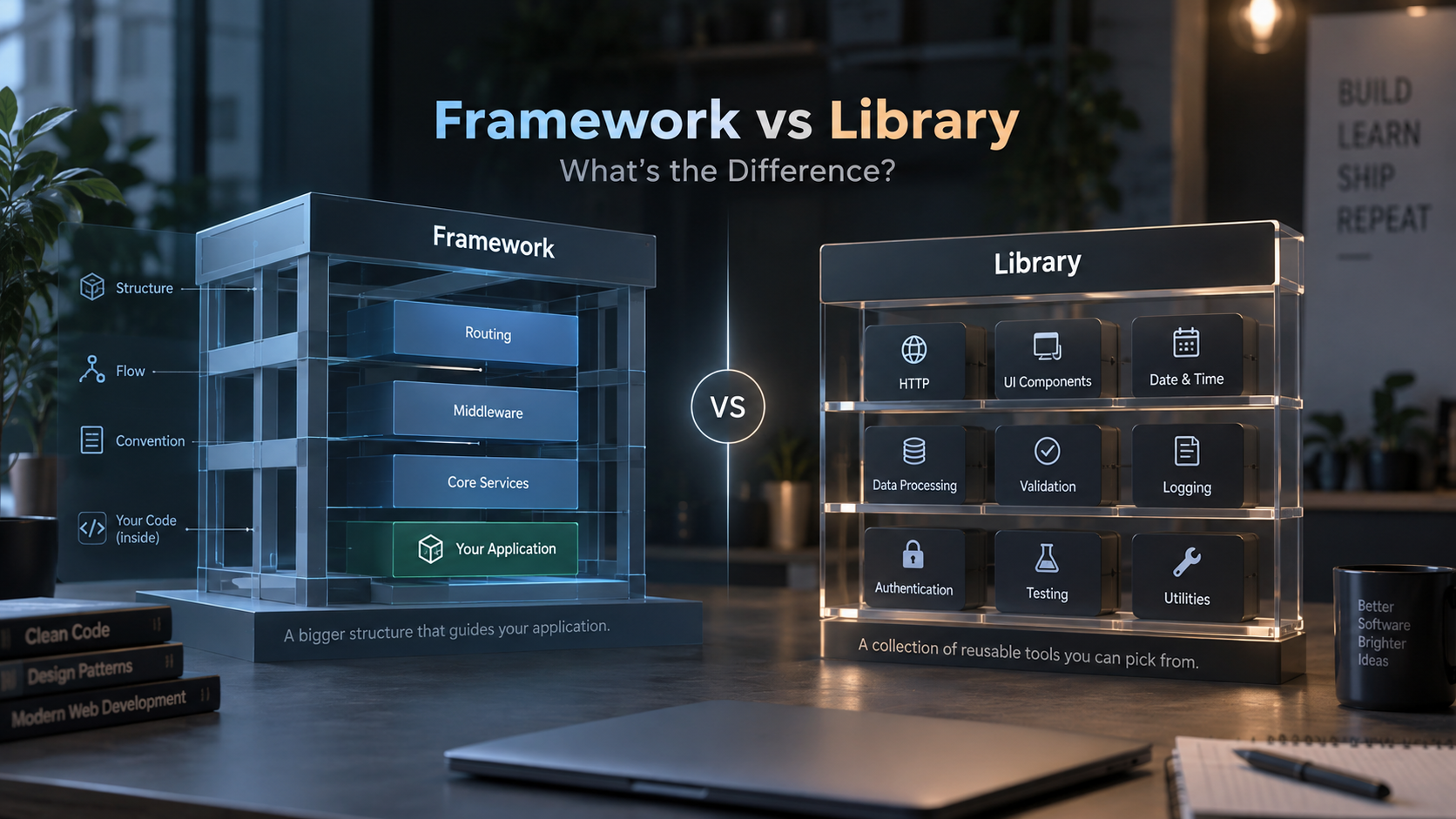
Both are code someone else wrote to save you time. The line between them comes down to one question: who is in charge, you or the code?
A library and a framework are both reusable code. The difference is who decides when that code runs.
If you have read anything about web development, you have seen the words library and framework used almost interchangeably. React gets called a library on one page and a framework on the next. Someone insists Flask is a framework, someone else swears it is really just a tidy library.
It is one of the most common sources of quiet confusion for beginners, and it trips up plenty of experienced engineers too. The good news is that the distinction is not vague. Once you see the one property that separates the two, the fog lifts and every tool you meet afterwards slots cleanly into place.
Before the difference, it helps to be clear about what the two share, because the common ground is larger than people expect. Both a library and a framework are simply reusable code that someone else wrote and packaged so you do not have to.
Both are installed the same way, usually with one command from a package manager like npm, pip, or Composer. Both exist for the same reason: to save you from rebuilding solved problems and to let you stand on work that thousands of other developers have already tested. Neither is magic, and neither is better than the other.
The one difference that matters
Inversion of control
Here is the whole thing in a sentence: when you use a library, your code is in charge and calls the library; when you use a framework, the framework is in charge and calls your code.
That reversal has a name that sounds more intimidating than it is. It is called inversion of control, and it is the single trait that decides which category a tool belongs to. Not its size, not its popularity, not how many features it bundles, not even what problem it solves.
The direction control flows is the only line that reliably holds. A tiny tool can be a framework and a huge one can be a library. What matters is who holds the steering wheel while the program runs.
With a library, you are the author of the story and the library is a character you summon when you need it. You are working through your own program, you reach a point where you need to format a date or make an HTTP request, so you call the function, get your answer back, and carry on where you left off.
The library sits quietly on the shelf until you decide to open it. You control when it runs, how often, in what order, and what happens with the result. Martin Fowler's much-cited essay on inversion of control makes the point that this you-are-in-charge style is what most of us think of as normal programming.
A framework flips that relationship on its head. With a framework, you are no longer writing the main storyline. The framework owns the main loop, the running engine of the whole application, and your job is to write small pieces of code and hand them over.
You do not call your own code. You register it and then wait. When a web request arrives at a matching URL, the framework calls the handler you wrote. When a component's data changes, the framework calls your component to redraw it. Your code stops being the director and becomes a set of answers to questions the framework knows how to ask.
The freeCodeCamp write-up on the difference between a framework and a library frames it neatly: with a library you choose the flow, and with a framework the framework provides the flow and leaves gaps for you to fill.
Library Your code calls it You are writing the program. When you need a specific job done, you reach for the library, call a function, and use the result. You decide the timing. | Framework It calls your code The framework is running the program. You write pieces in the shape it expects and register them. It runs the main loop and calls into your code when it decides. |
WORKING DEFINITION A library is a collection of reusable functions your program calls on demand to do a focused job. A framework is a reusable application skeleton that owns the control flow and calls your code at the points it has left open for you. |
The “Hollywood Principle” and a house you can picture
Two metaphors that make it stick
Engineers have a joke that captures inversion of control better than any formal definition. They call it the Hollywood Principle: “Don't call us, we'll call you.”
A library is like a phone number you dial whenever you need something. You are in control of the call. A framework is like a casting director who keeps your number on file and rings you when there is a part to play. The framework is in control, and you respond when it reaches out.
This is why a five-line function in a web framework can quietly power a real production website. The framework does all the surrounding work, receiving the request, checking who sent it, matching the URL, running security checks, and it only calls your handful of lines at the one moment your logic is actually needed.
The other metaphor that lodges in people's memory is building a house. Using libraries is like building a home from the ground up. You own an empty plot, you decide the architecture, you arrange the rooms however you like, and you call on whichever supplier you need whenever you need it. You have total freedom and total responsibility.
Using a framework is more like moving into a house that is already framed and wired to a proven plan. The load-bearing walls are up, the rooms are laid out, the wiring reaches every socket, and your job is to decide what goes in each room. You give up some freedom over the layout, but you skip months of structural work.

A framework is a house already framed and wired to a proven plan. A library is a tool you pick up to furnish rooms on your own terms.
The InterviewBit comparison of framework versus library uses this same building analogy, and it endures because it captures the real trade: freedom for a reliable head start.
Both metaphors point at the same truth. The choice is really about who makes the architectural decisions. When you adopt a framework, you are hiring an experienced architect whose opinions you agree to live with.
Those opinions are what people mean by opinionated. Frameworks sit on a spectrum, from loosely opinionated ones that let you swap almost anything out, to strongly opinionated ones that expect you to do things their way. A library rarely has opinions about the rest of your app at all. It does its one job and stays out of your way.
If you want the full architectural picture of what a framework actually is, from its lifecycle to its extension points, the companion guide to what a software framework is takes that skeleton apart piece by piece and pairs closely with everything here.
READ NEXT The deep companion to this piece: the anatomy of a framework, its history, and how to choose one you won't regret. |
Seeing it in real code
The same idea, twice, in Python
Abstractions become obvious the moment you watch them run. Here is inversion of control in two short snippets. First, a library. Python ships an enormous standard library, and one of its modules is json.
When you want to turn a JSON string into a Python object, you import the module and call its function at the moment you need it. You asked a question, it answered, and your program continues on the very next line. Nothing in the json module was running before you called it, and nothing keeps running after.
# LIBRARY: your code is in charge and calls in when it needs something import json data = json.loads('{"title": "Hello", "views": 42}') print(data["title"]) # you called json; it answered; you carry on |
Now the same kind of job, but through a framework. Below is a view function written for Django, a batteries-included web framework. You define the function and register it against a URL pattern, and then you stop.
You never call article_detail yourself anywhere in your code. When a browser requests a matching URL, Django receives the request, parses it, runs its middleware, checks the URL configuration, and only then reaches into your file to call your function. It takes what you return, runs more middleware, and sends the bytes back. You wrote a few lines. The framework ran the whole show and decided the order.
# FRAMEWORK: you write the piece; the framework calls it for you from django.http import JsonResponse def article_detail(request, slug): article = Article.objects.get(slug=slug) return JsonResponse({"title": article.title}) # urls.py: you register the hook, then never call it yourself urlpatterns = [ path("articles/<slug>/", article_detail) ] |
The difference is small on the page and huge in consequence. In the library example you are the caller, and the flow of the program is yours to design. In the framework example you are the callee. You handed a piece of yourself to a larger machine and agreed to be summoned on its schedule. Everything else people say about frameworks flows from that one arrangement.
Side by side: the practical differences
What inversion of control changes downstream
Inversion of control is the root difference, but it branches into several differences you feel every day. Because a framework owns the architecture, it has strong opinions about scope, structure, and lifecycle, and it becomes deeply woven into your project. That makes it powerful but hard to remove later.
A library holds no opinions about the rest of your app, so it stays lightweight, focused, and easy to swap if it disappoints you. The table below collects the differences that follow from the root, drawing on the way the GeeksforGeeks comparison lays the two side by side.
| Aspect | Library | Framework |
|---|---|---|
| Control flow | You call it when your code needs something. | It calls your code at points it defines. |
| Scope | One focused job, like dates, HTTP, or resizing. | An architecture for a whole class of app. |
| Opinions | Few. Rarely cares how the rest is built. | Many. Dictates structure, naming, lifecycle. |
| Freedom | High. You assemble your own architecture. | Lower. You work inside its conventions. |
| Replaceability | Usually easy to swap out. | Hard to remove once you've built on it. |
| Learning curve | Read the API for the parts you use. | Learn the whole mental model and lifecycle. |
| Examples | Lodash, Axios, NumPy, jQuery, Requests | Django, Angular, Rails, Spring, Flutter |
How one difference in control flow ripples out into everyday development.
One row surprises people: testing. When you build on libraries, your code stays in the driver's seat, so you tend to write small unit tests that call a function and check its output. Mocking is straightforward because you control every call.
When you build on a framework, testing often means spinning up part of the framework's machinery so it can call your code the way it does in production. That is more involved, but it tests behaviour closer to the real thing. As the Sencha team notes in their breakdown of the framework versus library decision, the trade is less about the first line of code and more about who controls the architecture across the whole life of the project.

On a larger team, a framework's enforced conventions turn into a shared language everyone already speaks.
Where the line genuinely blurs
Why React starts every argument
If the rule is so clean, why do developers argue endlessly about whether React is a library or a framework? Because React sits right on the boundary.
React calls itself a library for building user interfaces, and narrowly that is true. You can drop a single React component into an existing page and control when it renders, which is library-like behaviour. But React also owns its own rendering loop, decides for itself when your components re-render, and imposes a component model that shapes the whole application.
In daily use it calls your code far more than you call it, which is framework behaviour. That is why most developers treat it as a framework in practice, whatever the label says.
The lesson is not to memorise which bucket each tool claims. It is to ask the diagnostic question directly: in normal use, does this tool mostly call my code, or does my code mostly call it? And how much of my architecture does it dictate? Answer those two questions and you can place any tool correctly.
So which one should you use?
A practical decision guide
Here is the reassuring part. This is not a fight where one side wins. Almost every real project uses both: a framework for the overall structure, and a handful of libraries plugged into it for specific jobs.
A typical Django application leans on Django for routing, the database layer, and security, while calling libraries for image processing, payment APIs, or date maths. So the useful question is rarely “library or framework?” in the abstract. It is “for this particular need, do I want structure or a focused tool?”
Still, when you choose the foundation for a whole project, the balance tips one way or the other. The criteria below point you at the right default.
Lean toward a library when You need one specific capability, not a structure. You already have an architecture that works. The project is small, or you are solo. You want full control over how things fit. Performance budget is tight and bloat hurts. Requirements are unusual and may pivot often. | Lean toward a framework when You are building a whole application from scratch. The project is large and needs organisation. Your team benefits from shared conventions. You want to skip architectural bikeshedding. Security best practices out of the box matter. The app will live for years and change hands. |
Two forces settle the decision more than any feature list. The first is team and lifespan. A framework's greatest gift is not the code it writes for you, it is the agreements it enforces. Shared conventions let a new hire who already knows Django become productive on an unfamiliar Django codebase within hours.
On a solo weekend project that portability is worth little. On a five-person team building something meant to last years, it is worth a great deal.
The second force is the cost of being wrong later. A library is cheap to remove if it disappoints you, so choosing one is a low-stakes bet. A framework becomes the skeleton your whole application hangs on, so switching later can mean a rewrite. The AngularJS to Angular migration famously consumed enormous engineering effort across the industry.
That asymmetry is a good reason to prototype a thin, real slice of your application in a candidate framework before you commit. It is also worth reading a broader survey, such as the Simple Talk overview of libraries versus frameworks, before betting a multi-year project on any single foundation.

The bottom lineStrip away the size, the popularity, and the marketing, and the difference is one clean reversal. With a library, your code is in charge and calls the library when it needs a specific job done. With a framework, the framework is in charge and calls your code at the points it has left open for you. That is inversion of control, and it is the only test that reliably works. Choose a library when you want a focused capability and full control. Choose a framework when you want a proven structure for a whole application and can live with its opinions. And remember: the honest answer to “which one?” is usually “both, at different levels.” A framework for the skeleton, libraries for the parts that make your product yours. |
Discussion 0
More posts
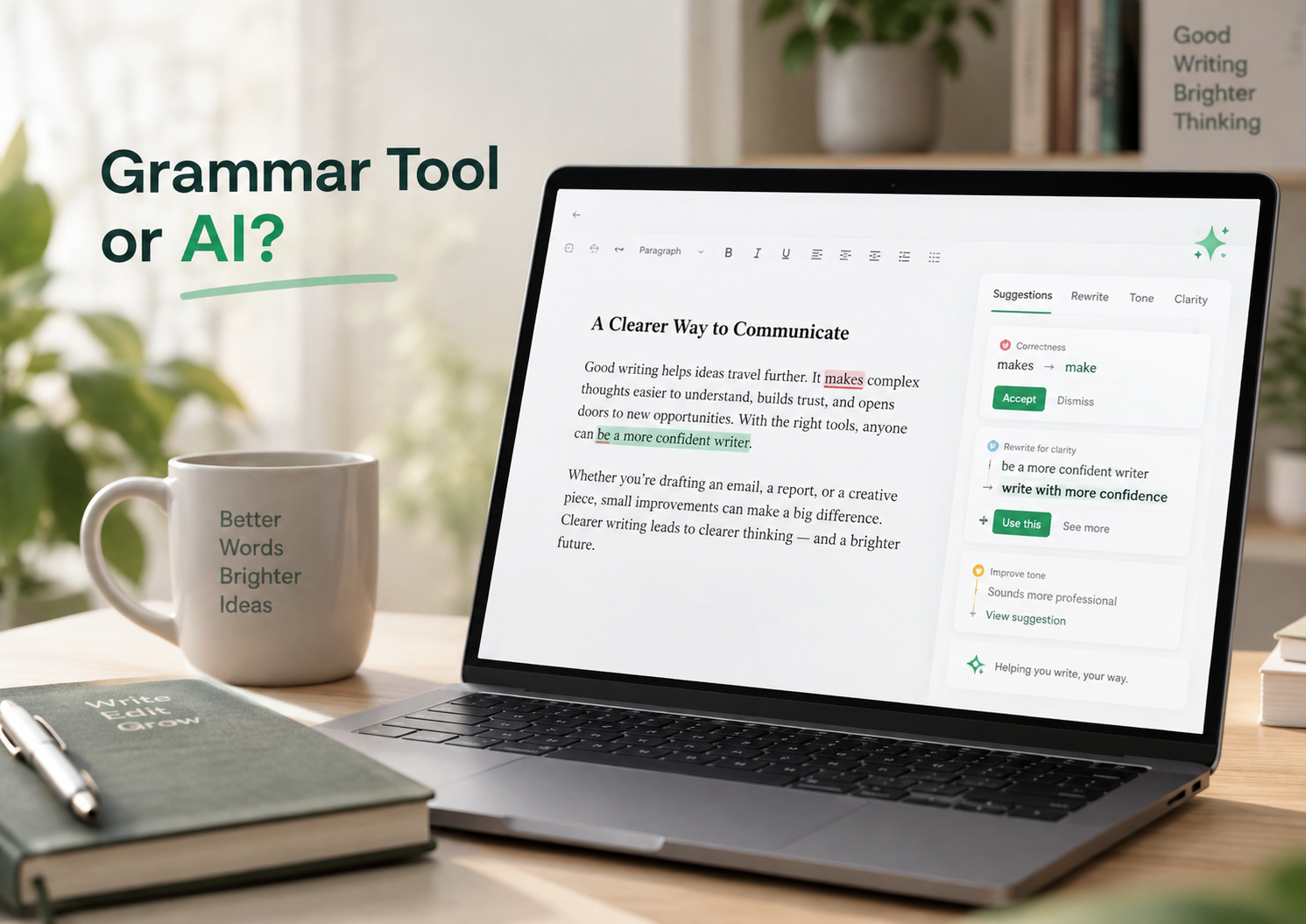
Does Grammarly Count as AI Writing?
It runs on AI and has a generative assistant built in, yet millions use it just to catch stray commas. The honest answer...
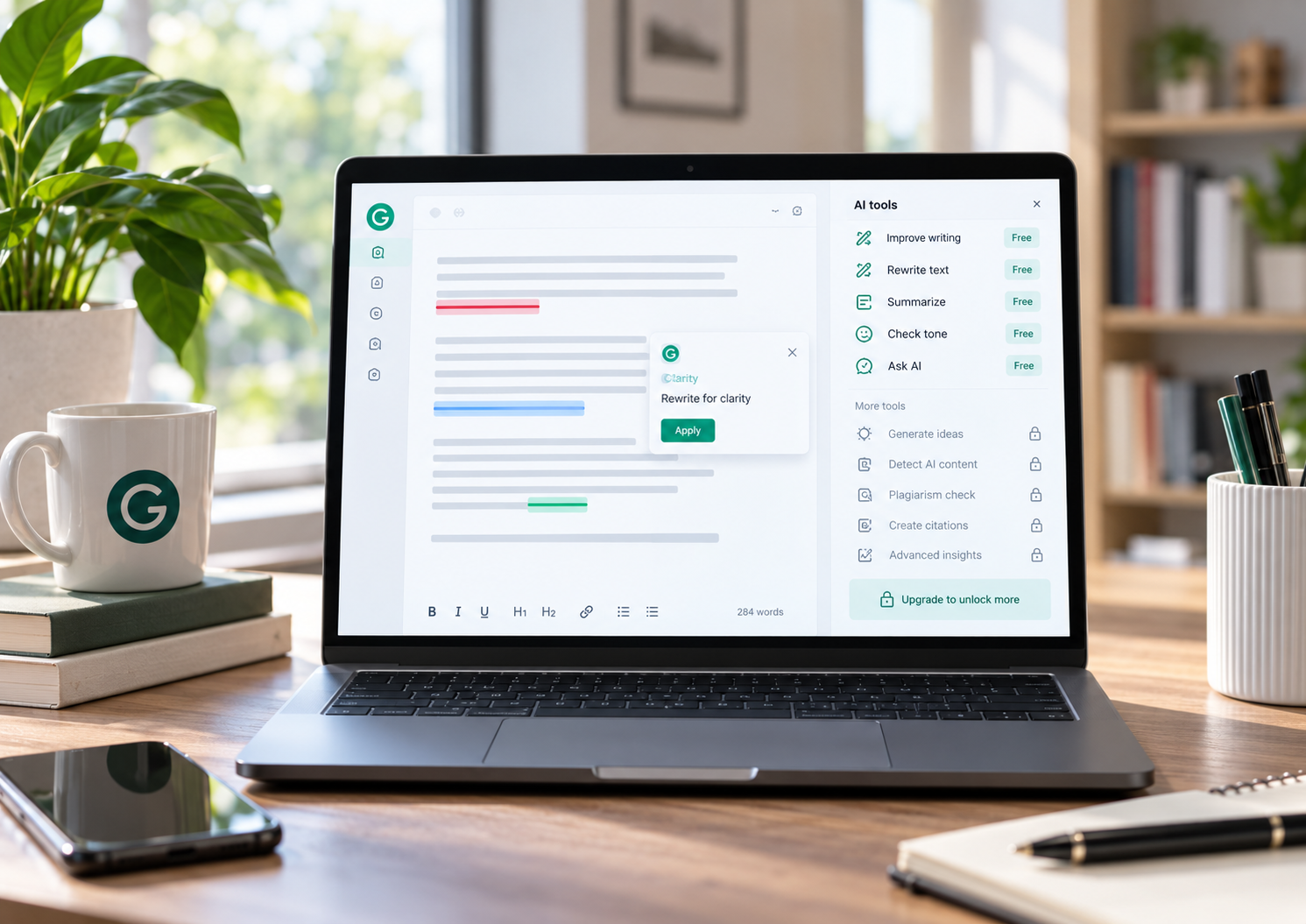
Grammarly’s AI suite on the free plan: what you get and what’s locked
Twelve tools sit inside the new editor. Here is the walkthrough, what each one does, and the exact point where Grammarly...

Can AI Detectors Be Trusted?
What these tools actually measure, where they break, and how much weight their verdicts really deserve.
Please log in or create an account to join the discussion.