
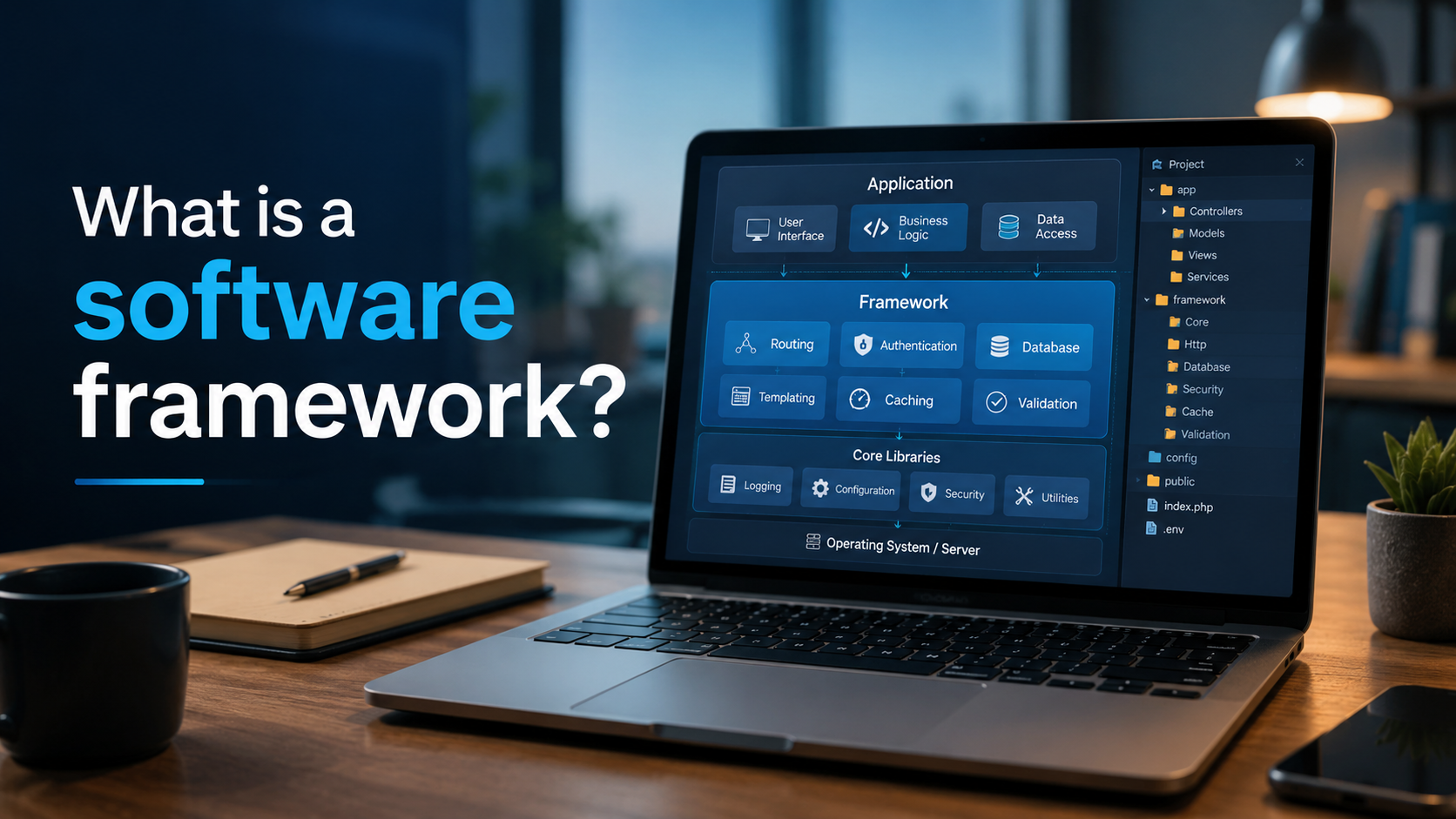
A framework is the skeleton your application grows around. This guide explains what that means in practice, how frameworks differ from libraries, where they came from, the main types you will meet, and how to choose one you won't regret.
The definition, in plain terms
Two kinds of problems in every app
Every piece of software solves two kinds of problems at once. The first is the problem you actually care about: letting a customer book a table, showing a doctor a patient's chart, recommending a song.
The second is the plumbing every application needs no matter what it does: receiving a request, checking who sent it, talking to a database, drawing a screen, logging what happened, and recovering when something breaks.
A software framework exists so developers can spend their energy on the first kind of problem while inheriting a tested, opinionated answer to the second. Wikipedia's entry on software frameworks describes them as generic functionality that can be selectively changed by user-written code. That phrase, "selectively changed", is the heart of the idea.
Working definition
A software framework is a reusable, partially complete application skeleton that defines the overall architecture and control flow of a program, and that you extend by plugging your own code into the places the framework has left open for you.
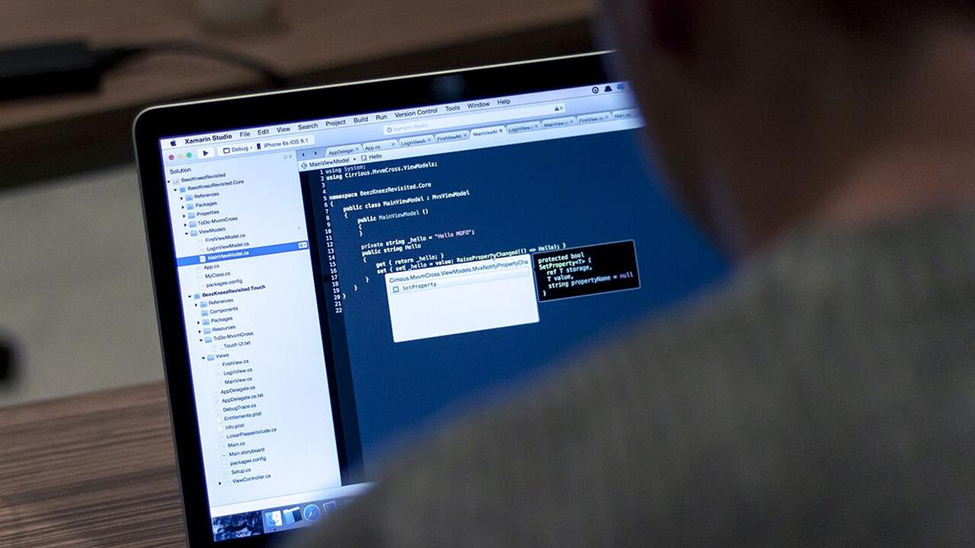
A framework hands you the plumbing so you can start on the part of the product that is actually yours.
Partially complete, by design
The "partially complete" part matters. A framework is not a finished product, and it is not a loose bag of helper functions either.
It is closer to a house built up to the frame and the wiring. The load-bearing decisions are made, the rooms are laid out, electricity runs to every wall, and what remains is deciding what goes in each room.
When you start a new project with a framework, you typically run one generator command and receive a working, if empty, application within seconds: folder structure, configuration, a development server, and conventions for where things live. From then on, your job is to fill in the blanks the framework left for you.

Most framework projects begin with a single scaffolding command that produces a runnable app before any business logic exists.
Every framework has opinions
Because frameworks decide so much for you, they are always opinionated to some degree. A framework has a view on how a request should travel through your code, how data is validated, how templates render, and how tests are organised.
Some hold those opinions loosely and let you swap out nearly every component. Others hold them tightly and expect you to do things their way. Developers call these "unopinionated" and "opinionated", but it is a spectrum, not two boxes.
Where a framework sits on that spectrum is one of the most important things to understand before committing to it. The MDN introduction to frameworks and libraries is a good companion if you want the same ideas explained specifically for the browser.
Framework vs library: who calls whom?
The one difference that matters
This question confuses almost every beginner and a surprising number of experienced engineers. Both a library and a framework are reusable code written by someone else. Both are installed with a package manager. Both save time.
The difference is not size, popularity, or even what the code does. It is the direction in which control flows.
When you use a library, your code is in charge: you decide when to call a function, you get the result, you carry on. When you use a framework, the framework is in charge: it runs the main loop, decides when things happen, and calls into your code at specific moments.
This reversal is called inversion of control. Martin Fowler's essay on inversion of control remains the clearest explanation of why it is the defining trait of a framework rather than an incidental detail.

A library is something you reach for on your own terms. A framework hands you the reading list and the schedule.
The Hollywood Principle
Engineers sum up inversion of control with a joke known as the Hollywood Principle: "Don't call us, we'll call you."
A library is a phone number you dial whenever you need something. A framework is a casting director that holds your number and rings you when there is a part to play.
In code, this means writing a function or class in the shape the framework expects, registering it (often just by putting it in the right folder or adding a decorator), and never calling it yourself. The router calls your handler when a URL matches; the test runner calls your test; the renderer calls your component when its state changes. Your code becomes a set of answers to questions the framework asks.
Side by side
| Aspect | Library | Framework |
|---|---|---|
| Control flow | Your code calls the library when it needs something. | The framework calls your code at points it defines. |
| Scope | Solves one focused problem (dates, HTTP, image resizing). | Provides an architecture for a whole class of application. |
| Opinions | Few. It rarely cares how the rest of your app is built. | Many. It defines structure, naming and lifecycle. |
| Replaceability | Usually easy to swap for an alternative. | Hard to remove once the app is built on it. |
| Learning curve | Read the API for the parts you use. | Learn the mental model, conventions and lifecycle. |
| Typical examples | Lodash, Requests, NumPy, Moment, Axios | Django, Spring, Angular, Rails, Flutter |
A concrete example
Python ships with an enormous standard library, documented at python.org. Import its json module, call json.loads() on a string, and you have used a library: you asked, it answered, your program continued where it left off.
Now write a view function in Django. You define the function, attach it to a URL pattern, start the server, and wait. You never call your view.
Django receives the request, parses it, consults the URL configuration, builds a request object, runs middleware, calls your function, takes the response you return, runs more middleware, and sends bytes back. You wrote ten lines; the framework did everything else and decided the order. That is inversion of control in practice.
Where the line blurs
The boundary is fuzzy in places. React calls itself a library for building user interfaces, and narrowly that is true: you can drop one React component into an existing page.
Yet React owns the rendering loop, decides when your components re-render, and imposes a component model that shapes the whole application. In daily use it behaves much like a framework, and most developers treat it as one.
When you see arguments about whether a tool is "really" a framework, the useful question is not what the project calls itself. It is whether it calls your code or your code calls it, and how much of the architecture it dictates.
A short history of frameworks
Smalltalk and the birth of MVC
Frameworks did not appear fully formed. They emerged from decades of developers noticing they were rebuilding the same scaffolding again and again.
The intellectual roots go back to the late 1970s at Xerox PARC, where Trygve Reenskaug, working on Smalltalk, formulated the Model-View-Controller pattern: a way of separating an application's data, its presentation, and the logic connecting them.
MVC was not itself a framework, but it was the first widely shared blueprint for structuring an interactive application, and almost every framework since has borrowed from it.

The ideas behind frameworks predate the web by decades; MVC dates from the Smalltalk era at Xerox PARC.
Desktop frameworks of the 80s and 90s
Through the 1980s and early 1990s, object-oriented languages made it practical to ship reusable application skeletons as class hierarchies.
Desktop frameworks such as Microsoft's MFC for Windows and Apple's early application kits gave programmers pre-built windows, menus and event loops, so they could concentrate on what their program actually did.

Early desktop frameworks grew up alongside the machines of the 1980s and 1990s.
The web changes the scale
As the late 1990s turned into the 2000s, companies were building dynamic websites in Java, Perl and PHP, and every team was inventing its own way to map URLs to code, manage sessions and render HTML.
The Java world responded first with Apache Struts, released in 2000, which brought MVC discipline to web applications and made "web framework" a mainstream term in enterprise development.
Around the same time, Rod Johnson's work on lighter-weight Java design led to the Spring Framework, whose dependency-injection container let developers assemble loosely coupled applications without heavy ceremony. Microsoft's .NET Framework, launched in 2002, played a similar role for Windows, bundling a runtime, a vast class library and, soon, ASP.NET.
Rails and convention over configuration
The single most influential moment in framework history was probably the public release of Ruby on Rails in 2004.
Rails, extracted by David Heinemeier Hansson from the project-management tool Basecamp, was built on the idea that a framework should make sensible decisions on your behalf so that you configure almost nothing. Its generators produced a working database-backed app in a few commands.
Rails made the productivity gains of frameworks visible to a huge audience and inspired imitators everywhere: Django in Python (2005), CakePHP and later Laravel in PHP, Grails in Groovy, and many more. The philosophy it popularised, convention over configuration, is now so common that most developers no longer notice they rely on it.
The client side, mobile and machine learning
The next shift happened in the browser. As browsers became application platforms, JavaScript frameworks arrived to bring structure to complex front ends: Backbone and Knockout around 2010, AngularJS the same year, React in 2013, Vue in 2014.
Mobile followed a parallel path. Native SDKs from Apple and Google were joined by cross-platform frameworks such as React Native (2015) and Flutter (2017) that let one codebase target both platforms.
Meanwhile, the machine-learning boom produced TensorFlow (2015) and PyTorch (2016), which did for numerical computation what Rails had done for web apps.

Meta-frameworks like Next.js and SvelteKit are built on top of earlier frameworks; the process of packaging repeated scaffolding never really stops.
Today, a newer generation of "meta-frameworks" such as Next.js, Nuxt and SvelteKit sit on top of earlier frameworks and handle routing, server rendering and deployment. The cycle of noticing repeated work and packaging it up has never stopped.
What a framework is actually made of
The core and its lifecycle
Once you look past the marketing, most frameworks are assembled from the same handful of parts. Recognising them makes new frameworks far easier to learn.
The first part is the core runtime or application object: the thing that starts when you launch the program and owns the main loop. In a web framework it listens for HTTP connections and dispatches requests. In a UI framework it is the render loop. In a testing framework it is the runner.
This core is where inversion of control lives. Understanding its lifecycle, from startup through handling work to shutdown, is usually the most valuable thing you can learn about any framework.

The core is the structural frame; everything else attaches to it at defined points.
Extension points and conventions
The second part is the set of extension points, sometimes called hooks, hot spots or slots. These are the places the framework deliberately left open: the base class you subclass, the interface you implement, the callback you register, the folder it scans at startup.
A well-designed framework makes these points obvious and stable, so a large application can be built from many small, predictable pieces.
Alongside them sit the conventions: the rules about naming and placement that let the framework find your code without explicit wiring. When Rails looks for ArticlesController in app/controllers/articles_controller.rb, or Next.js turns every file in an app directory into a route, conventions are doing the work configuration files used to do.
Built-in services
The third part is the bundle of services the framework ships so you do not assemble them yourself.
For a backend web framework that typically means a router, request and response objects that follow the HTTP rules in RFC 9110, a templating engine, form validation, sessions and authentication, database access through an ORM, caching, internationalisation, and protection against common attacks.
For a front-end framework it means a component model, state management, reactive data binding, a client-side router, and build tooling. The size of this bundle is what separates a "batteries included" framework like Django from a minimal one like Express.

Modern frameworks compete on tooling as much as runtime features, because tooling shapes the minute-to-minute experience of building.
Tooling and release process
The fourth part is the tooling around the framework: the CLI that scaffolds projects, the dev server with hot reloading, the migration tool, the test harness, and the build pipeline.
Finally, every serious framework has a governance and release process. Because so much of your app depends on it, versioning matters enormously. Most follow semantic versioning, publish long-term support releases and document upgrade paths. How well they do this predicts how painful your project's third year will be.
The life of one request
Put together, a request in a batteries-included web framework follows a predictable path.
- The server receives the request and hands it to the framework core.
- Middleware runs: parsing cookies, checking CSRF tokens, attaching the current user.
- The router matches the URL against your registered patterns and selects a handler.
- Your handler, the only custom code in the chain, reads the request, talks to the database, and returns a response.
- Middleware runs again on the way out, compressing the body or adding security headers.
- The core writes the bytes back to the socket.
Everything in that chain except your handler is the framework. That is why a five-line handler can safely serve a production website.
# A typical framework handler: you write this, the framework calls it.
# Django (Python)
from django.http import JsonResponse
def article_detail(request, slug):
article = Article.objects.get(slug=slug)
return JsonResponse({"title": article.title, "body": article.body})
# urls.py: register the extension point; never call article_detail yourself
urlpatterns = [
path("articles/<slug:slug>/", article_detail),
]
The main types of software framework
Frameworks are grouped by the kind of application they help you build. The categories overlap, but each has its own conventions, communities and trade-offs. Treat the named examples as landmarks rather than an exhaustive list; the ecosystem changes quickly.
Front-end web frameworks
Front-end frameworks run in the browser and exist to tame the complexity of interactive interfaces built from HTML, CSS and JavaScript.
Their central idea is the component: a self-contained unit bundling markup, behaviour and sometimes styling, composed with other components into a full app. The framework tracks state, works out what needs to change, and updates the DOM so you never write manual DOM code.
React, from Meta, popularised this approach with one-way data flow and a declarative model: describe what the UI should look like for a given state and let the framework reconcile the difference. Angular, from Google, ships a complete platform with dependency injection, a router, forms and a TypeScript-first structure suited to large teams.

Component-based front-end frameworks turn a page into a tree of small, testable pieces.
The middle ground belongs to Vue, designed to be adopted incrementally, from a small enhancement on one page up to a full single-page app with its official router and state library.
A newer generation rethinks runtime cost altogether. Svelte is a compiler that does most of its work at build time, producing small vanilla JavaScript instead of shipping a heavy runtime to the browser. Solid and Qwik push in similar directions.
Because rendering frameworks stop short of routing, server rendering and deployment, "meta-frameworks" grew on top of them. Next.js for React, Nuxt for Vue and SvelteKit for Svelte now provide the full-stack conventions most new production front ends use.
Back-end web frameworks
Back-end frameworks run on the server and handle the request-and-response cycle along with everything around it: routing, persistence, authentication, background jobs and APIs. They fall into two camps.
Full-stack or "batteries included" frameworks bundle a great deal so a small team can build a complete product fast. Django in Python is the archetype: an ORM, an auto-generated admin, forms, authentication and a security-conscious design out of the box.
Laravel plays the same role in PHP, wrapping an elegant syntax around routing, queues, the Eloquent ORM and a rich first-party ecosystem. Ruby on Rails remains the reference point in Ruby.

Back-end frameworks are the layer between raw infrastructure and your business logic.
In the enterprise Java world, Spring Boot is the default for services, layering auto-configuration on the Spring Framework so a production-ready app with embedded server, metrics and health checks starts with little setup. Microsoft's ASP.NET Core holds the same position for C#.
The other camp is the micro-framework: tools that deliberately do less and let you assemble your own stack. Express defined this style for Node.js with a tiny core and a middleware model; Flask did the same for Python.
A more recent entry, FastAPI, shows the category still evolving: it uses Python type hints to generate validation and interactive API docs automatically while keeping the core small.
Mobile application frameworks
Mobile development originally meant learning two separate native toolkits, and both platforms still maintain first-party frameworks with the most direct access to device features.
Apple's SwiftUI builds declarative interfaces across iPhone, iPad, Mac and Watch. Google's Jetpack Compose does the same for Android with Kotlin. Both borrow the component-and-state model that web frameworks proved out, a good example of ideas migrating between categories.
Cross-platform mobile frameworks let one team ship to iOS and Android from a shared codebase.
Because two native codebases are expensive, cross-platform frameworks have become extremely popular. React Native lets developers who know React write mobile apps in JavaScript or TypeScript that render genuine native UI components; it powers large parts of apps from Meta, Microsoft and Shopify.
Flutter, from Google, draws every pixel itself with its own rendering engine, which gives exceptional consistency across platforms and lets the same Dart code target mobile, web and desktop. Native components versus a self-drawn UI is the recurring trade-off in mobile framework debates.
Desktop and game frameworks
Desktop frameworks have a longer history than most categories and remain important for tools, creative software and internal business apps.
Qt is the long-standing choice for native, high-performance C++ applications across Windows, macOS and Linux, used in everything from car dashboards to design software.
At the other end, Electron packages a web app with Chromium and Node.js so teams can ship desktop software using web technologies. It underpins Visual Studio Code, Slack and many other daily tools; its lighter cousin Tauri suits developers who want a smaller footprint.

Desktop frameworks range from native C++ toolkits to web technologies wrapped in a browser shell.
Game development has its own family of frameworks, usually called engines. Unity and Unreal Engine dominate commercial work, and open-source Godot is growing fast.
Game engines are perhaps the purest expression of inversion of control: the engine owns the game loop, the physics step and the rendering pipeline, and your scripts are called once per frame to say what should happen.
Data science and machine learning frameworks
Machine-learning frameworks solve a different plumbing problem. Instead of routing requests, they provide efficient tensor operations, automatic differentiation, GPU acceleration, and the training-loop machinery that would otherwise be rewritten for every model.
TensorFlow, released by Google in 2015, brought this to a mass audience and remains widely used in production, particularly through its deployment tooling.
PyTorch, from Meta's AI research group, became the favourite of researchers thanks to its dynamic computation graph and Pythonic feel. It now dominates new model development, including most large language models.

ML frameworks handle tensors, gradients and hardware so researchers can focus on the model.
For classical machine learning and data preparation, scikit-learn provides one consistent estimator interface across hundreds of algorithms. Because every model exposes the same fit and predict methods, tools for pipelines, cross-validation and hyperparameter search work with all of them.
Higher-level libraries such as Keras and Hugging Face Transformers sit on top of these frameworks, so training or fine-tuning a state-of-the-art model can take a handful of lines.
Testing frameworks
Testing frameworks are often overlooked, yet they are among the clearest examples of the pattern. You write functions that follow a naming convention or carry an annotation; the framework discovers them, runs them, reports results and decides what counts as failure.
JUnit established this model for Java in the late 1990s and inspired a whole family of "xUnit" frameworks. In Python, pytest is the standard, largely thanks to its fixture system, which lets tests declare the resources they need and leaves setup and teardown to the framework.

A test runner discovers, executes and reports on your tests; the framework, not you, decides when each one runs.
Beyond unit tests, browser automation frameworks such as Selenium and its modern successors Playwright and Cypress drive real browsers through scripted interactions. Load, contract and property-based testing frameworks apply the same discover-and-run model to other kinds of verification.
If you want to understand inversion of control without the noise of a big web framework, reading the source of a small test runner is one of the best ways to see it in miniature.
Why teams use frameworks
Three kinds of speed
The most obvious benefit is speed, but it comes from several distinct sources worth separating.
The first is code you do not write. A routing layer, a database abstraction, form validation and an authentication flow represent months of careful work, and a framework hands them to you on day one.
The second is decision speed. Every project faces hundreds of small architectural questions, from folder layout to column naming. A framework answers most of them in advance, removing both deliberation time and team disagreement.
The third is onboarding speed. A developer who knows Django can be productive on a Django codebase they have never seen within hours. This portability of knowledge is a main reason companies standardise on one framework.
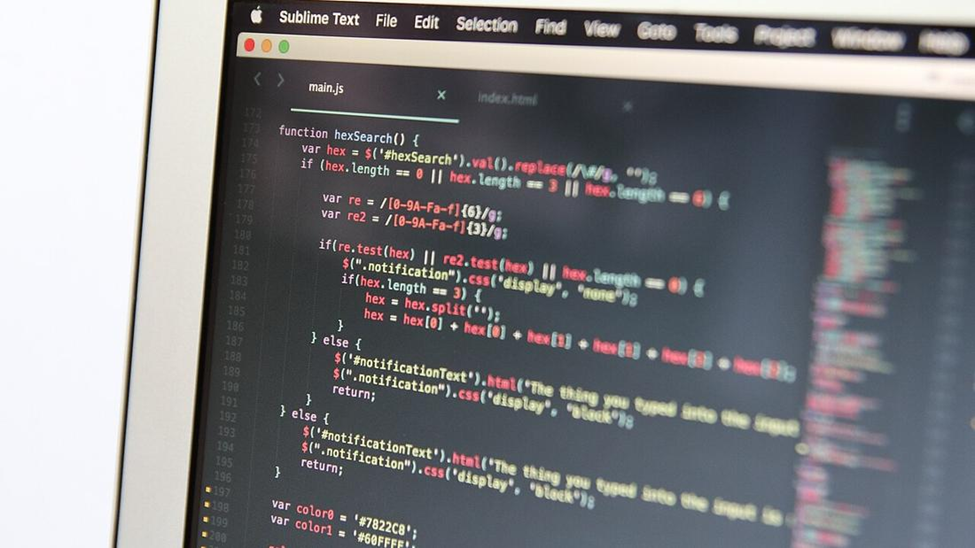
Frameworks compress months of infrastructure work into a starting point a new team member can navigate on day one. Photo via Wikimedia Commons (Unsplash).
Security by default
The less obvious benefit is quality, and in particular security. Application security is full of subtle mistakes: unescaped input in a template, SQL built by string concatenation, mishandled session tokens, forms accepted from a malicious site.
Mature frameworks have absorbed decades of hard lessons and default to safe behaviour, so a developer who has never heard of cross-site scripting is protected from it by the templating engine.
The OWASP Top Ten list of the most critical web risks reads, in many places, like a list of things a good framework quietly prevents. Frameworks are no substitute for security knowledge, and misconfigured ones cause plenty of breaches, but their baseline is far higher than most teams achieve alone.
Ecosystem, performance and maintainability
Once a framework reaches critical mass it attracts plugins, hosting with one-click deployment, tutorials, conference talks, hiring pools, and answers to nearly every error message you will ever see. For many teams the ecosystem is worth more than the framework's own features.
Performance is a related advantage. Framework authors spend enormous effort on optimisation that individual teams cannot afford, and guidance on sites such as web.dev increasingly assumes a framework is doing much of the heavy lifting.
Finally, frameworks make software more maintainable by keeping it uniform. Code that follows a framework's conventions is easier to review, refactor and hand over, which matters far more over a product's life than the initial speed of building it.
The costs nobody mentions in the tutorial
The real learning curve
Every benefit above has a shadow. The first cost is the learning curve, which is steeper than it looks, because learning a framework is not the same as learning its API.
To use a framework well you must absorb its mental model, lifecycle, idioms and assumptions. Until you do, you fight it: writing code that works but that the framework makes needlessly hard, or missing a built-in feature and reinventing it badly.
This friction is real, it lasts weeks or months for a large framework, and teams who saw a slick five-minute demo routinely underestimate it.

Structure that speeds you up early can constrain you later; a framework's opinions are a bargain until you need to break them.
Loss of control and bloat
The second cost is loss of control, the flip side of inversion of control. Because the framework owns the architecture, going against its grain is expensive.
The moment your requirements diverge from what it anticipated, an unusual authentication flow, a database the ORM handles poorly, a performance profile the default rendering cannot meet, you either bend your requirements to fit or fight through its internals. Developers call this the "golden cage".
Related is bloat. A batteries-included framework brings features you never use, and they cost binary size, memory, startup time and attack surface. Performance-sensitive services sometimes drop a full-stack framework for a micro-framework or plain language primitives for exactly this reason.

Frameworks rise and fall on a timescale of years; choosing one is a long-term commitment with an exit cost.
Churn and dependency risk
The third cost is churn. Your application's fate is now tied to a project you do not control. Frameworks ship breaking changes, deprecate features, and sometimes go through rewrites that split their communities; the AngularJS-to-Angular transition consumed enormous engineering time worldwide.
Frameworks can also fall out of fashion, leaving you with a codebase no new hire wants to touch. The annual Stack Overflow Developer Survey is a useful barometer, and reading several years in sequence shows how quickly fortunes change.
What abstraction hides
A subtler cost is what frameworks do to understanding. A developer who has only ever used a framework may not know what an HTTP request looks like on the wire, how a connection pool works, or why a component re-rendered.
That is fine until something breaks in a way the abstraction did not anticipate, at which point the missing knowledge becomes very expensive. The best framework users understand what the framework does on their behalf, and the articles in this series exist partly to build that understanding deliberately.
Framework, SDK, platform, API: untangling the vocabulary
API and SDK
The word "framework" lives in a crowded neighbourhood. An API, or application programming interface, is the contract describing how one piece of software talks to another: functions, endpoints, data formats and rules. Every framework exposes an API, but so does every library, operating system and web service.
A software development kit, or SDK, is a bundle of tools for building software for a specific platform or service: usually one or more libraries, documentation, sample code and often a compiler or emulator. The Wikipedia article on SDKs shows how varied they are, from the Android SDK with its full emulator to a payment provider's single client library.
An SDK may include a framework, but many do not. An SDK is about what you are given; a framework is about how control flows through what you build.

A platform is where your code runs, an SDK is the kit you build with, a framework is the structure you build in.
Platform, toolkit, pattern, boilerplate
A platform is the environment your software runs on: an operating system, a browser, a cloud provider, or a runtime such as the JVM or Node.js. Platforms sit beneath frameworks; Rails runs on Ruby, ASP.NET on .NET, React in the browser. Some products call themselves platforms when they bundle a framework with hosting, which is marketing rather than a technical distinction.
A toolkit, especially in GUI programming, is usually a library of widgets without a prescribed architecture, so it sits closer to a library. A design pattern such as MVC is a reusable idea rather than reusable code; frameworks are often concrete implementations of several patterns at once.
A boilerplate or starter template is a project skeleton you copy and then own entirely, giving the initial speed of a framework without the ongoing inversion of control. Keeping these terms straight helps you judge what a new tool really offers when it arrives wrapped in ambitious language.
How to choose a framework
Start with the problem, not the tool
Choosing a framework is one of the highest-leverage decisions in a project, and it is usually made badly: by picking what the lead used last, or what is trending this quarter.
A better approach starts with the problem. What kind of application is it? What are its non-negotiable requirements? How long must it live? Who will maintain it?
A content-heavy marketing site, a real-time collaboration tool, an internal admin dashboard and an ML inference service are four different problems, and the right framework for one may be wrong for the others. The goal is the framework whose opinions match your needs, not the longest feature list.

The framework you pick will still be with the project years from now; the decision deserves more than a glance at this year's popularity charts.
Then look at the team
A framework your developers already know is worth a great deal, because the learning curve is the biggest hidden cost. A slightly less ideal framework the team uses fluently will nearly always beat an ideal one they must learn under deadline pressure.
Hiring matters too. If you expect to grow, weigh the size of the talent pool and how quickly new people become productive.
And remember the language comes with the framework. Rails means Ruby, Spring means the JVM, Next.js means TypeScript or JavaScript, with all the ecosystem and performance consequences that follow.

Documentation is the surface you will spend the most time with; check whether it explains the mental model or merely lists the API.
Examine the framework sceptically
Look at its release history: how often it ships, how it handles breaking changes, whether it offers long-term support versions, and how painful past major upgrades were.
Look at governance: is it backed by a company, a foundation or a single maintainer, and what happens if that backing disappears? Look at the documentation, and at whether the ecosystem contains maintained extensions for the things you know you need, such as payments, search or an admin interface.
Look at performance against your real workload rather than synthetic benchmarks, and at security history: not only how many vulnerabilities were found, but how quickly and transparently they were fixed.
Prototype before you commit
A day or two building a thin vertical slice of your real application, including the awkward parts, in two candidate frameworks will teach you more than any comparison article, including this one.
Pay attention to where each framework fights you, because those friction points multiply over the life of the project. Be honest about the difference between unopinionated and merely incomplete, and between opinionated and simply inflexible.
When you have chosen, write down why: the requirements you optimised for and the trade-offs you accepted. In three years the team can then tell whether the decision still holds.
Where frameworks are heading
The front-end and back-end divide collapses
Meta-frameworks now let a single codebase decide, component by component, whether something renders on the server, at the edge or in the browser. The resulting hybrid rendering models blur categories that were clean five years ago.
The runtime itself is becoming portable. WebAssembly lets code written in Rust, C++, Go and other languages run in the browser and in lightweight server environments, and frameworks built on it challenge the assumption that the web belongs to JavaScript alone.
Edge computing pushes framework code out to hundreds of locations close to users, which changes what "the server" means and favours frameworks with small, fast-starting runtimes.
Compilers, edge runtimes and AI tooling are shifting how much of a framework runs at build time versus run time.
From runtime to compile time
Instead of shipping a large framework that interprets your code in the browser, tools increasingly analyse your code at build time and generate lean output. That is the philosophy behind Svelte, behind React's compiler work, and behind the broad push to ship less JavaScript.
This changes the economics of features: capabilities that once cost bytes and milliseconds in production can now be paid for once during the build.
Type safety has become table stakes as well. TypeScript has moved from optional to default across the JavaScript world, Python frameworks lean on type hints for validation, and end-to-end typed contracts between client and server are a standard feature rather than an add-on.
Artificial intelligence, in two senses
AI-assisted coding is changing the calculus of "batteries included" versus minimal, because generating boilerplate has become cheap. A framework's value is shifting from the code it saves you writing to the architectural guarantees it provides and the conventions that keep AI-generated code consistent and reviewable.
A new category of framework is also appearing for building on language models, handling prompt management, tool calling, retrieval, evaluation and agent orchestration the way web frameworks once handled routing and sessions.
These are young and churning rapidly, and they follow the historical pattern exactly: practitioners repeat the same scaffolding, someone packages it, a framework is born. Whatever comes next, the core idea, a reusable skeleton that calls your code at well-defined points so you can focus on what makes your application unique, is likely to endure.
The bottom line
A software framework is a reusable application skeleton that owns the control flow and calls your code at points it defines. That single reversal, the framework calling you rather than you calling it, is what separates a framework from a library.
Frameworks exist because every application needs the same plumbing, and rebuilding it each time is slow, error-prone and insecure. A good framework gives you that plumbing on day one, along with conventions that make a team's code uniform and a newcomer productive within hours.
The price is real. You inherit the framework's opinions, its learning curve, its release cycle and its eventual decline. The decision to adopt one is a long-term commitment with an exit cost, and it should be made against your actual problem, your actual team and a working prototype, not against a popularity chart.
If you take one thing from this guide, make it this: learn what your framework does on your behalf. Developers who understand the request lifecycle, the extension points and the conventions beneath the abstraction are the ones who move fastest when the abstraction leaks, and every article in the series below is written to build exactly that understanding.
Discussion 0
More posts

Best AI Detectors for Writers in 2026
Four tools. Real prices, real accuracy, real limits.
Does Grammarly Count as AI Writing?
It runs on AI and has a generative assistant built in, yet millions use it just to catch stray commas. The honest answer...

Can AI Detectors Be Trusted?
What these tools actually measure, where they break, and how much weight their verdicts really deserve.
Please log in or create an account to join the discussion.