

A hands-on NovelAI review: the broken sign-up, the encryption catch, real pricing, the models, real user reviews, and whether a fiction-trained AI can be funny.
I hadn't intended to document any of this.
I signed into NovelAI to put an argument to rest. Every AI writing tool I'd sampled failed the same way: ask for something funny and you're handed something agreeable. Capable. Polished until there were no edges left. I wanted to find out whether a model raised almost entirely on fiction could actually deliver a joke. So I fed it the most trivial, petty prompt I could dream up.
What I ended up with was an hour of scribbled notes, because nearly everything worth mentioning happened before any writing began. The registration broke. The workaround I found taught me something genuine about where my drafts actually live. And a hint tucked into the corner of the editor was pushing a feature the default model can't even run.
None of that shows up in the marketing. Most of it is missing from the reviews too, because reviews only begin once the account exists. So here's the full sequence, start to finish: what I clicked, what failed, what it costs, what came out the other end, and whether I'd hand over money.
NovelAI, Explained
What it is. Two products sharing a single tab and a single invoice: a fiction-tuned text model, and an anime-trained image model.
Who builds it. Anlatan, a small Delaware-registered US studio.
How old it is. The text beta went live in June 2021. Image generation followed on 3 October 2022.
Where it runs. Browser only. You can install it as a progressive web app. There's no native mobile app.
Free entry. 50 text generations, 30 images up to 1024x1024, and 100 text-to-speech clips. You'll need a verified email.
Paid entry. $10/mo Tablet, then $15 Scroll, then $25 Opus. No yearly discount. Billing cycles every 30 days.
Privacy stance. Your stories are encrypted inside your browser before they ever reach a server. Anlatan says reading them is impossible on their end.
The catch. That encryption hangs off your password. Reset it and the stories stored on their servers vanish.
One more thing worth knowing: who already occupies this space. Similarweb pegs novelai.net's visitors at roughly 78% male, leaning heavily toward 18 to 24, with Japan topping the charts for desktop traffic and around 78% of visits landing directly. People type the address in. That's the profile of a destination, not something stumbled upon.
How I Put It Through Its Paces
| FIELD | DETAIL |
|---|---|
| Tier | Free trial. No card, no subscription, no gift key |
| Entry route | Email sign-up first, then Google sign-in once that broke |
| Mode | Storyteller, not Text Adventure |
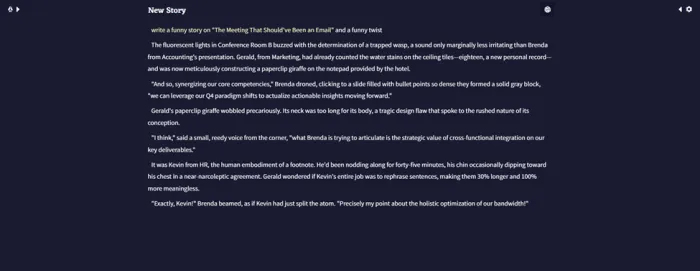
| Prompt | write a funny story on "The Meeting That Should've Been an Email" and a funny twist |
| Not tested | Image generation, text-to-speech, Lorebook at scale, any paid tier |
Six Steps From Homepage to Finished Story
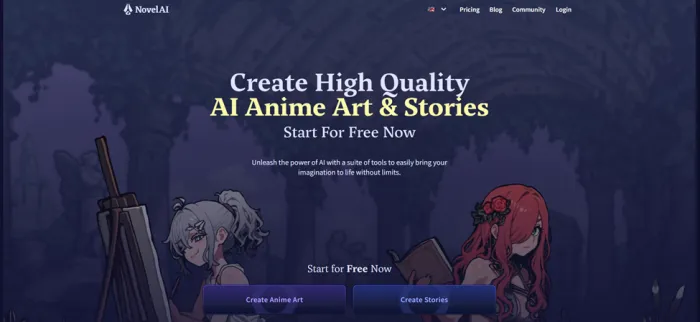
The landing page shows its hand
Two buttons sit there: Create Anime Art and Create Stories. That division is the honest truth of the product. NovelAI genuinely is two separate tools wearing one subscription, and the homepage makes no attempt to disguise it.
Read "free" carefully, though. What you get is a fixed ration, not an ongoing free tier, and Anlatan has stated it has no intention of ever offering a permanent free version.
Getting in: a broken captcha, a Google workaround, and the screen that matters most
Here's where the whole sign-up lives, and where it stopped being routine.
Registration opens as a modal: email, password, confirm password, plus a newsletter toggle that's already switched on when it appears. I filled everything in, clicked Start Creating!, and was rewarded with a red line of text, error code [M55wNs], and no path forward.
This is a Google reCAPTCHA failure, not a NovelAI one. The site is a bystander taking the blame. The typical culprits, roughly in order of likelihood:
- A stale token. They survive about two minutes and can only be used once. Dawdle on the form and it expires without a sound.
- A browser extension. Ad blockers, script blockers and privacy add-ons can prevent Google's script from executing.
- A VPN or shared IP that Google's behavioural scoring interprets as bot-like.
- Stale cache and cookies interfering with token validation.
The fixes are dull and effective: reload, refill quickly, whitelist the tab, switch off the VPN, swap browsers. The modal mentions none of that. It gives you an error code and a dead end.
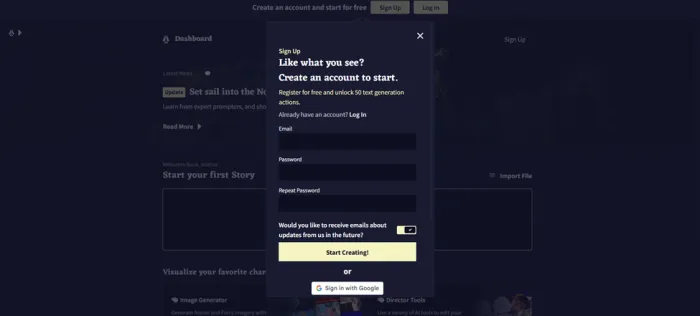
So I took the other door: Sign in with Google. One consent screen, one button. Google passes along your name, profile picture and email, and nothing else. No card, no verification email to chase. It works because the Google path sidesteps the reCAPTCHA widget altogether.
But it also reshapes what comes next, and this is the part that matters. Immediately after the Google login, NovelAI halts and requests a password regardless. Not a login password. An encryption password, on a screen titled Password Setup Required.
This reads as friction. It's actually the product being refreshingly candid. According to Anlatan's own engineering notes, your device generates two things from your credentials: an auth token that goes to the server, and an encryption key that never leaves your hardware. Stories are sealed in the browser before upload. That's the mechanism behind Anlatan's claim that it can't read your work, and it's a textbook case of zero-knowledge, client-side encryption.
Google can supply an identity. What it can't supply is a secret only you hold. Without a password somewhere in the flow, there's nothing to derive a key from, so NovelAI asks you to invent one.
The downside is spelled out plainly in NovelAI's FAQ: the most frequent way people lose their stories is resetting the password on the login screen. A reset wipes the key, and the stories go with it. No back door. That's the whole point.
DO THIS ON DAY ONE. User Settings, then Account, then Download All Stories pulls everything down as a .zip. Then stash that encryption password somewhere a password manager can retrieve it. It's the one step here I'd actually pester you about.
The dashboard respects your time
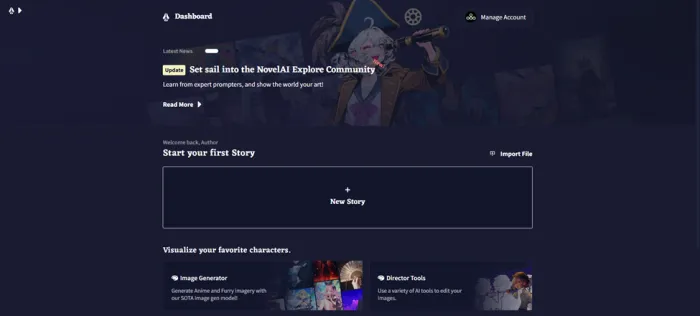
A news strip pointing toward Explore, a prominent Start your first Story, an Import File option, and two cards for the product's other half: Image Generator, and Director Tools (background removal, line art, sketch, colorize, emotion, declutter).
No tour, no checklist, no five-step popup parade. For once, that counts as praise.
Storyteller or Text Adventure: choose with intent
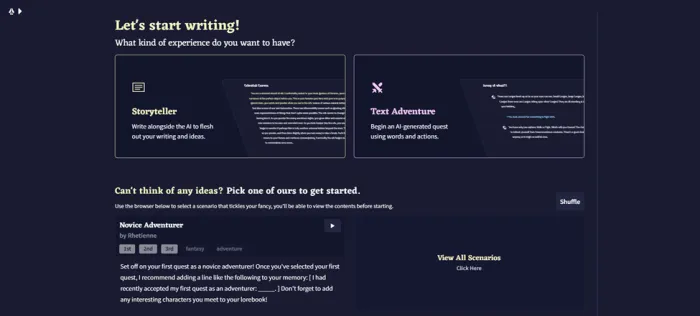
This is the fork that determines what the tool becomes for you, served as two equal cards with zero guidance. In plain terms:
| STORYTELLER | TEXT ADVENTURE | |
|---|---|---|
| What it is | The default. Continuous prose. | Quest mode with its own interface. |
| How it reads input | No separation between your action and the AI's reaction. One document. | Separates your commands from the AI's responses. |
| Pick it to | Write. | Play. |
Below it sits a browser of community-made starting points, tagged by perspective and genre, each with a preview before you commit. I chose Storyteller. If you want a co-writer rather than a dungeon master, so should you.
The editor is blank by design, but its tips aren't trustworthy
Empty page. "Enter your prompt here..." A Send button. The emptiness is the design; there's nothing to study before you start.
Along the bottom, though, tips rotate through. Mine cycled past Banned Tokens, Stop Sequences and Telepathy. Here's the problem: NovelAI's own docs say Banned Tokens isn't available on Xialong or GLM-4.6, the current models, including the one the free trial uses. The editor was promoting a feature the default model doesn't support.
It's minor. It's also exactly the kind of thing that costs a newcomer twenty minutes and a slice of their trust.

The output: it discovered a structure I never requested
Conference Room B. Fluorescent lights buzzing "with the determination of a trapped wasp." Gerald from Marketing tallying water stains on the ceiling (eighteen, a personal best) while building a paperclip giraffe. Kevin from HR, "the human embodiment of a footnote."
Then it did something I hadn't asked for: it built architecture. The giraffe grows into a running gag and a payoff, its neck too long for its body, buckling into a pile of metallic shame at precisely the moment the meeting does the same. Susan from IT delivers the real punchline, the question every office comedy circles: what, exactly, are we doing here?
A handful of Sends got me to that point, and that's the fundamental difference between this and a chatbot. Each press continues rather than answers. It isn't replying to you. It's carrying on from you.
The finished piece ran 599 words, unedited. And what no tool can really measure is whether it's funny. It is, in a dry, observational register. Not a punchline factory. A noticing machine.
What the Free Trial Actually Hands You
| ALLOWANCE | AMOUNT | NOTES |
|---|---|---|
| Text generations | 50 | Verified email required. Each Send spends one. |
| Image generations | 30 | Up to 1024x1024. |
| Text-to-speech | 100 | Anlatan's own customisable voice models. |
| Settings & features | Full | Presets, samplers, Memory, Author's Note, Lorebook, all unlocked. |
| Your stories | Kept | Anything made during the trial carries over if you subscribe. |
Two things people routinely misjudge:
- 50 generations is smaller than it sounds. My 599-word story consumed a handful. Once you start retrying outputs (and you will, retry is the workflow) you'll hit zero before the evening's out.
- The trial isn't a crippled model. Since 15 October 2025, GLM-4.6 has been live on every tier, free trial included. What you're testing is close to what you'd pay for. That's unusually fair, and genuinely rare.
The Half I Didn't Test
I spent the evening on the writing side, so treat this as documentation rather than a verdict. But you can't reasonably assess a $25 tier whose central pitch is free image generation without knowing what's on the other side of the tab.
Six image models are live right now. The current pair are NovelAI Diffusion V4.5 Full and V4.5 Curated, both available to every subscribing tier. Full draws on a broader, less filtered dataset. Curated uses a smaller, cleaner one, which Anlatan recommends if you'd prefer not to produce anything sensitive by accident, their example scenario being streaming. Behind those sit V4 Full, V4 Curated, and the older Anime V3 and Furry V3.
The generational divide matters more than the version numbers imply. V3 was built on SDXL. The V4 family was trained from scratch with no public base model. That's an unusual amount of money to pour into an anime generator, and it's why this product has a signature look rather than a Stable Diffusion accent.
Three things worth knowing before you budget:
- Prompts cap at roughly 512 T5 tokens, shared across your base prompt and every character prompt combined. Generous, but finite.
- The tokenizer is a real constraint. Because V4 and V4.5 use the T5 tokenizer, most Unicode characters aren't supported in prompts. Emoji and Japanese characters won't behave as you'd expect. For a product whose biggest desktop audience sits in Japan, that's a genuinely strange corner.
- Two dataset toggles do heavy lifting. A Furry mode toggle inserts a furry dataset tag at the front of your prompt, and opening a prompt with a background dataset tag steers it toward landscapes, animal portraits and still lifes in a photographic style, meaning images without people.
Opus's free-generation benefit applies to the current V4.5 models under the same rules as everything else: one at a time, no base image, normal size or larger, 28 steps or fewer.
Pricing
| PAPER (TRIAL) | TABLET | SCROLL | OPUS | |
|---|---|---|---|---|
| Price | Free | $10/mo | $15/mo | $25/mo |
| Text generation | 50 total | Unlimited | Unlimited | Unlimited |
| Context (memory) | Smallest | Larger | Larger still | 28,672 tokens, about 144,000 chars |
| Monthly Anlas | None | 1,000 | 1,000 | 10,000 |
| Free single images | No | No | No | Yes* |
| Exclusive models | None | None | None | Xialong, Erato, Krake |
| Anlas top-up discount | n/a | 20% | 20% | 20% |
*Opus images are free only when generated one at a time, at normal size or above (to 1024x1024), at 28 steps or fewer, with no base image. Batches always cost Anlas.
The Anlas question nobody answers cleanly. Anlas is the image currency. Text and text-to-speech never touch it. Anlatan doesn't publish a per-image price, but the community estimate for a standard 1024x1024 at 28 steps lands around 13 Anlas, roughly 75 images out of a 1,000-Anlas allowance. Produce more than a couple a day and the $10 and $15 tiers drain fast, at which point Opus stops looking expensive and starts looking inevitable.
Two mechanics worth burning into memory. Subscription Anlas refill to your tier's amount rather than stacking, so burn leftovers before renewal. And purchased Anlas behave unlike the monthly kind: they're only spent once your refillable balance hits empty, and they don't count toward the refill calculation. The trap nobody flags until it bites: cancelling your subscription removes your ability to buy Anlas at all. Your existing balance stays, but the top-up button disappears. If you're winding down and want a stockpile for later, buy before you cancel, not after.
What Scroll actually buys over Tablet: context size. That's basically the entire gap. If you write long, it matters. If you write scenes, it doesn't, which makes the middle tier an odd place to settle.
The Model Lineup, Labelled Honestly
| MODEL | BASE & SIZE | CONTEXT | WHO GETS IT |
|---|---|---|---|
| Xialong | Anlatan's finetune of GLM-4.6 · 355B | 28,672 + 8,192 rollover | Opus only |
| GLM-4.6 | ZhipuAI open-source MoE · 355B, untuned | 28,672 + 8,192 rollover | Every tier, trial included |
| Erato | Llama 3 70B base, retrained on Anlatan's fiction data | 8,192 | Opus |
| Kayra | In-house · 13B | 8,192 | Paid tiers |
| Clio | In-house · 3B | 8,192 | Paid tiers |
- The rollover window is real, not spin. Your story grows to around 36,864 tokens, then trims back to 28,672, giving you more usable memory without sluggish generations.
- Xialong retries differently. Anlatan says it wasn't trained with reinforcement learning, so Retry produces genuinely different outcomes rather than the same answer in a new coat. If you've ever rerolled a chatbot and gotten five paraphrases, you understand the appeal.
- The gap between Paper and Opus is memory and model choice, not raw quality per sentence.
Five Features That Change Your Output
| FEATURE | WHAT IT DOES | REACH FOR IT WHEN |
|---|---|---|
| Memory | Text pinned to the top of context, always visible | Facts that must never drift: names, setting, rules |
| Author's Note | Injected near the end of context, so it lands harder | Steering tone or the next beat right now |
| Lorebook | Entries that fire only when their keywords appear | Worlds too big to hold in context at once |
| Config Presets | Bundled sampler settings, tuned per model | The AI loops or derails. Switch preset first |
| Writer's Toolbox | Rewrite, Transform, Expand, Condense, Custom on selected text | Editing what exists rather than generating more |
The Scripting System Nobody Mentions
Somewhere between my captcha brawl and the paperclip giraffe, I overlooked the most consequential thing on the platform. NovelAI has a scripting API. Not a settings panel with extra dials. An actual programmable extension layer, written in TypeScript, with its own multi-page documentation.
You open it with Alt+X, or via the goose menu in the left sidebar. Scripts come in two flavours: account scripts, which load with every story you open, and story scripts, which are baked into a single story file and travel with it. That second one is the clever design call. A scenario you share can carry its own custom behaviour along for the ride.
What it can actually do:
| CAPABILITY | WHAT THAT MEANS IN PRACTICE |
|---|---|
| Generation hooks | Intercept what happens before and after the model writes |
| Document manipulation | Read and rewrite the story text programmatically |
| Custom UI components | Add your own panels, modals and windows |
| Context building | Influence what actually gets sent to the model |
| Lorebook and story settings APIs | Automate the parts of setup that are pure admin |
| Text to speech API | Drive voice generation from a script |
| Persistent storage | Keep data between sessions, since scripts unload constantly |
Anlatan ships example scripts to build from, and they're a decent map of what people actually want: a Smart Summarizer that adds a right-click summarise option, Bookmarks for saving and jumping back through story history, a Find and Replace panel, and Retry Harder, an alternative retry button with different prompting behind it. There's a public GitHub repository of examples and a type-definitions file for editor autocompletion.
What Real Users Say
Before writing any of this up I did the obvious thing: checked the aggregate scores. They're high. They're also thin. Add up the main star-rating platforms and the published verdict rests on fewer than twenty reviews. The two community rooms (r/NovelAi at around 44,000 members and the Anlatan Discord at roughly 55,700) hold a hundred times that, which is where the real signal lives. Here's what actual named users wrote, not the star counts.
G2, roughly 4.6 from about 13 reviews. A verified reviewer in the oil and energy sector, writing in January 2026, rated it a powerful storytelling tool and singled out the level of control over the narrative as very good for long-form work. An organic reviewer, Bikash D., echoed the point about flexibility, noting he leans on it most when stuck with writer's block and unsure how to continue a story. Another reviewer praised the storytelling section and said the tutorial worked well. The recurring criticism is money: one reviewer flagged that the current pricing may be prohibitive for users on limited budgets, especially newcomers.

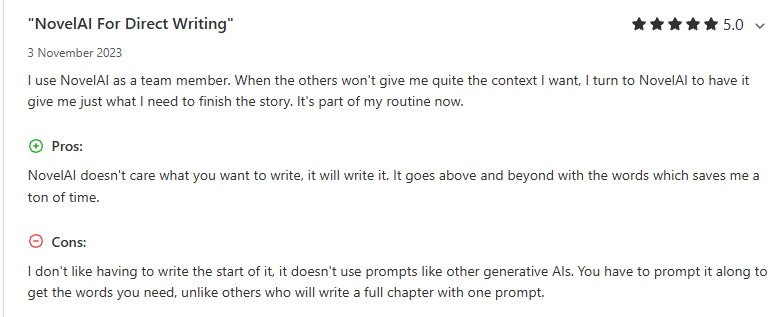
Capterra and SoftwareAdvice, 5.0 from a single review. The lone "NovelAI For Direct Writing" entry, from an author, is blunt in the best way: its standout pro is that NovelAI doesn't care what you want to write, it will write it. The same reviewer's gentle warning is that it won't produce a whole chapter from one prompt, because that isn't what it's built for. Note the listing is marked incentivized.
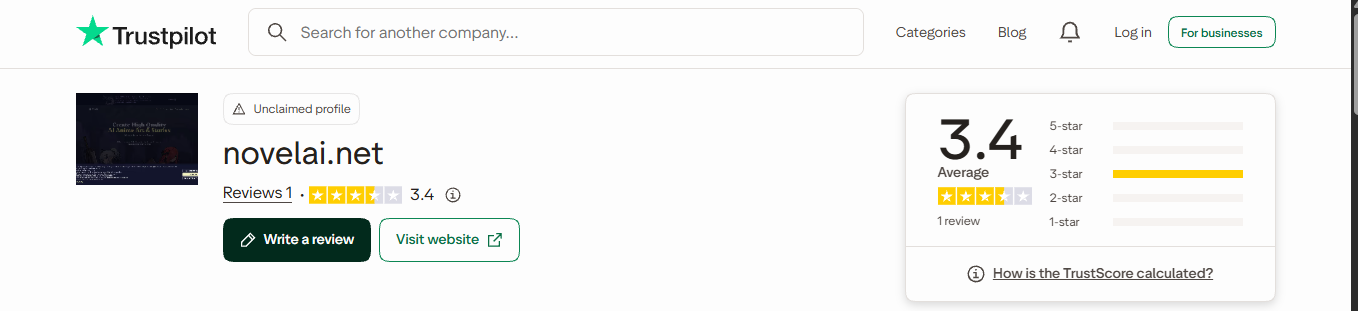
Trustpilot, 3.4 from one rating. The score looks middling, but the sample is a single review and, as Trustpilot itself notes, this company hasn't invited its customers to review, so the number carries almost no weight either way.
The App Store, wrong product entirely. Anlatan has never shipped an iOS app. The App Store nonetheless returns a "NovelAI | AI Story Generator" from an unrelated developer charging $4.99 a week, plus a second app, Rabi, that name-drops NovelAI as search bait. Install either expecting Anlatan and you've bought a stranger's product.
Strip out the noise and the consensus narrows to three points, and they're the same three my evening produced: the prose is good, the price stings, and the interface makes you work.
The Friction Log
| WHAT ANNOYED ME | SEVERITY |
|---|---|
| reCAPTCHA failure handing you a code and no guidance | High. It's the front door |
| Password reset silently means losing server-stored stories | High. Warned about, but still the sharpest edge |
| Editor tips promote Banned Tokens, unsupported on current models | Medium. Sends new users chasing a ghost |
| No per-image Anlas price published anywhere obvious | Medium. You can't budget what you can't price |
| Newsletter toggle defaults to on | Low. But it's a default working against you |
| No native app, progressive web app only | Low. The PWA is decent |
Who This Is Actually For
Worth your evening if any of these fit:
- Fiction is your thing and you want a model that continues a draft rather than replying to it
- The tone that survives should be the one you set, not the one a safety layer prefers
- Privacy is load-bearing, and no vendor should be able to read your draft
- Prose and art on one bill sounds like good value
- Knobs are a feature, not a chore: samplers, presets, phrase bias, token probabilities
Skip it if any of these are true:
- What you want is an assistant that answers questions and drafts emails
- The expectation is that it writes the book for you; this one needs steering
- Only the images interest you, since the subscription pays for both halves regardless
- A native app, offline access, or a mainstream public API is a requirement
- A permanent free tier is the dealbreaker. There isn't one, and there won't be
Final Draft
Here's the honest shape of my evening: ten minutes wrestling a captcha and the login flow, five of which went to reading a password warning that turned out to be the most important screen on the site, and a few minutes earning 599 words that made me laugh out loud exactly once, at a paperclip giraffe, of all things.
I didn't see the giraffe coming. That's what I keep returning to. I asked for a funny story about a bad meeting; I didn't ask for a recurring metaphor that collapses at the precise moment the meeting does. The model found that on its own, because it has read an enormous volume of fiction and very little else, and structure is what fiction teaches.
So: yes, for the writing. Ten dollars is less than the lunch I'd squander sitting in that meeting, and I'd jump to Scroll the instant a story ran long, because context is the one thing that truly separates the tiers. For the art, only at Opus, where images stop metering.
Would I recommend it to everyone? No, and I'd be wary of anyone who does. It isn't trying to be a helpful assistant, and if that's what you want, it'll feel stubborn. It's a writing surface with a very good ghostwriter behind it, and it expects you to keep hold of the pen.
If you try it: use Google when the captcha bites, store the encryption password somewhere you can't lose it, download your stories on day one, pick Storyteller. Then go write something that should've been an email.
Discussion 0
More posts

StealthWriter AI : Hands-On Test of the Humanizer and AI Detector
I put StealthWriter AI through a real test: a Wikipedia paragraph that its detector scored 0% human was rewritten to 100...

Originality.ai: I Tested It and It Flagged Wikipedia as 100% AI
I pasted a plain Wikipedia paragraph into Originality.ai and it came back "Likely AI – 100% Confidence." Two scans later...

I Tried Undetectable AI So You Don't Have To. Here's What Actually Happened
Every student, freelancer and content marketer has heard the pitch: paste in ChatGPT text, click one button, and it come...
Please log in or create an account to join the discussion.