I Tried Undetectable AI So You Don't Have To. Here's What Actually Happened


Every student, freelancer and content marketer has heard the pitch: paste in ChatGPT text, click one button, and it comes out "human." Undetectable AI is the loudest name in that space. Its homepage leads with a "Rated #1 Best AI Detector by Forbes" badge and a BuzzFeed quote before you even scroll.
So I ran a real test. No marketing demo, no cherry-picked prompt. I took a plain paragraph from Wikipedia (written by actual humans), pushed it through the AI Humanizer, then ran the same text through the built-in AI Detector. The output was not what the landing page promised, and one part of it made me laugh out loud.
Below you get every step with screenshots, the pricing nobody explains clearly, the full list of 13 tools hiding in the Products menu, what real users are saying on Trustpilot and Reddit, and a straight answer on whether it is worth $19 a month.
The 30-Second Verdict
Undetectable AI has a polished interface and a detector that got my human-written sample right. The free Basic humanizer, however, rewrote a university-level paragraph into something that reads like a middle-school summary, and the tool itself warned me the result might still get flagged. The good model sits behind the paywall.
| What I rated | Score (out of 5) | One-line reason |
|---|---|---|
| Interface and ease of use | 4.5 | Paste, pick a model, click. Zero learning curve. |
| Humanizer output (Basic model) | 2.5 | Meaning survived, but the writing level dropped hard and two formatting glitches appeared. |
| AI Detector accuracy | 4 | Correctly scored a Wikipedia paragraph as 14% AI, "human written." |
| Pricing and value | 3.5 | Yearly plans are cheap ($5/mo entry); monthly is pricey and the best model is an upsell. |
| Tool breadth | 4.5 | 13 tools, from deepfake detection to an essay writer, under one login. |
| Overall | 3.5 | Great toolbox, average free humanizer, pay to unlock the real thing. |
Best for: writers who want a detector and a humanizer in one dashboard and are fine paying yearly. Skip it if you expect the free tier to produce publishable text.
What Is Undetectable AI, Really?
Undetectable AI (undetectable.ai) is a web app with two headline tools: an AI Detector that scores how likely a text is machine-written, and an AI Humanizer that rewrites AI text so detectors score it as human. Everything else in the product (essay writer, SEO writer, deepfake detection, Chrome extension) orbits those two.
The tool was built specifically to get past AI content detectors and promises output that reads as human to all of them. That is a bold claim, and it is the one I set out to test.
Three things to know before you paste anything in:
- The humanizer has three tiers: Basic (free, public model), Stealth, and Undetectable (labelled "BEST" in the app). Only the paid tiers are the ones the marketing is talking about.
- The free tier is a demo. You get a small bucket of trial credits, then the app pushes you to "Activate" a plan.
- Tabs on the detector let you test sample text from ChatGPT, Claude, Gemini and a human writer, so you can see how it scores each before you trust it with your own work.
Step 1: Landing on the Dashboard (and the First Red Flag)
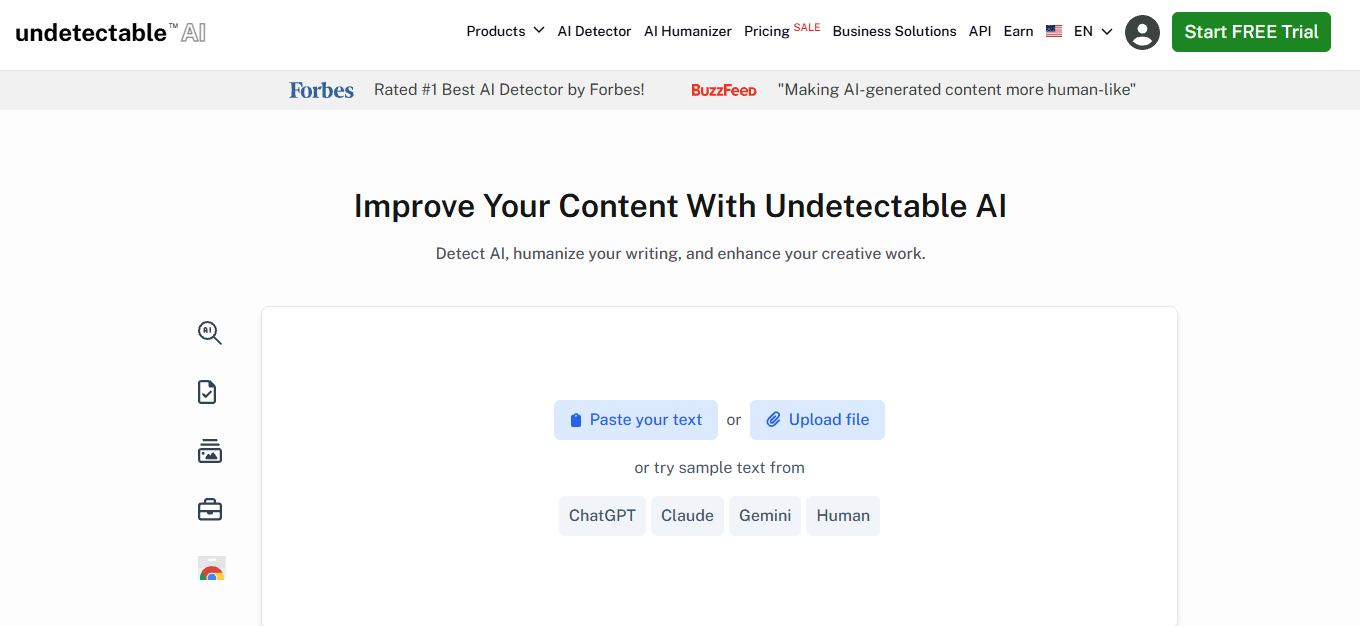
The first thing you see is a big text box under the headline "Improve Your Content With Undetectable AI," with two options: paste your text or upload a file. Right under that, four sample buttons let you load text from ChatGPT, Claude, Gemini or a human. No signup wall before you can try it, which is rare in this category.
The left rail has five icons (detector, humanizer, image tools, business, Chrome extension) with no labels until you hover. A Forbes badge and a BuzzFeed quote run across the top in a trust strip, and a bright green "Start FREE Trial" button sits in the corner of every page.
What stood out to me here: the layout is clean, but the social proof is doing a lot of heavy lifting before you have typed a single word. A "Pricing SALE" tag in the nav bar flashes red the entire time. The whole page is built to move you from "curious" to "card entered" in under a minute. Keep that in mind when you hit the trial button later.
Step 2: The Test Paragraph (Written by Humans, Not ChatGPT)
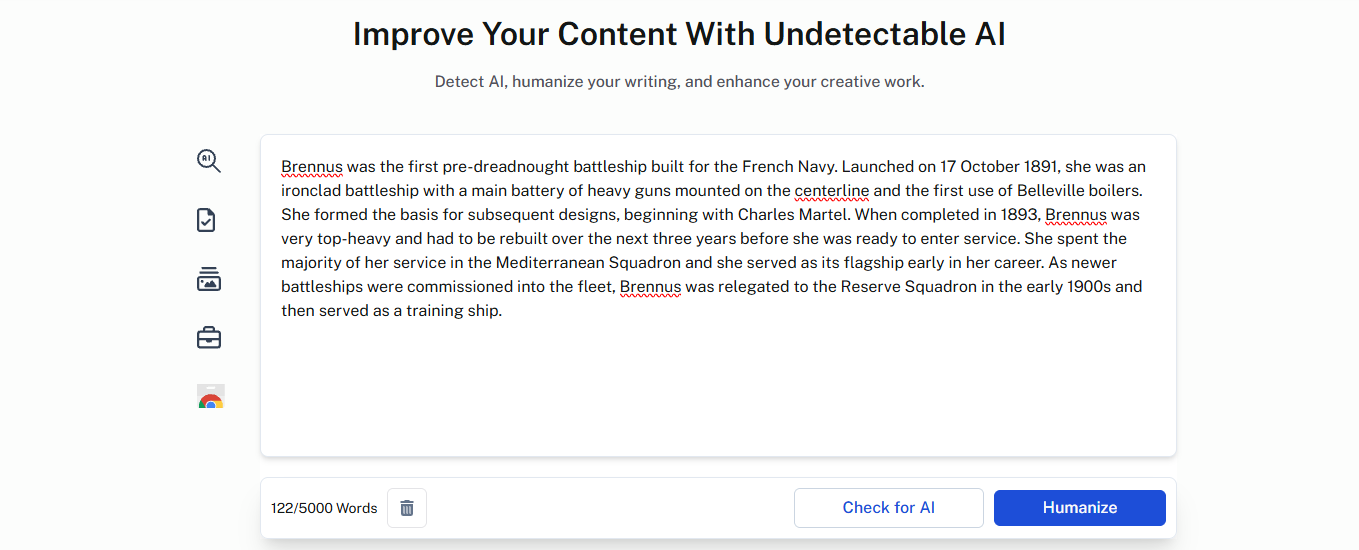
I wanted a control sample that was unambiguously human. So I grabbed the opening paragraph of the Wikipedia article on Brennus, the French Navy's first pre-dreadnought battleship. It is one of Wikipedia's featured articles, meaning it has survived the site's toughest round of human editorial review. The paragraph is 122 words of dry, factual, encyclopedia prose: launch date (17 October 1891), Belleville boilers, a top-heavy rebuild, flagship duty in the Mediterranean Squadron, then a quiet retirement as a training ship.
Why this paragraph? Three reasons:
- It was written and edited by real people over years, so any detector calling it AI is wrong.
- It is dense with proper nouns and dates, which is exactly where sloppy rewriters tend to break things.
- It is written at roughly a university reading level, which matches the "University" readability setting the humanizer defaults to.
The editor counted it as 122 of 5,000 words, so the free box has room for a short essay. The text was flagged by the browser's spellchecker on "Brennus" and "centerline," which the humanizer would later treat as words to replace.
Why this matters: most reviews you will find online test the humanizer on ChatGPT output, which is the easy case. Feeding it human text shows you what the rewrite does to writing that was already fine. Then I clicked Humanize.
Step 3: The Humanized Output. This Is Where It Gets Weird
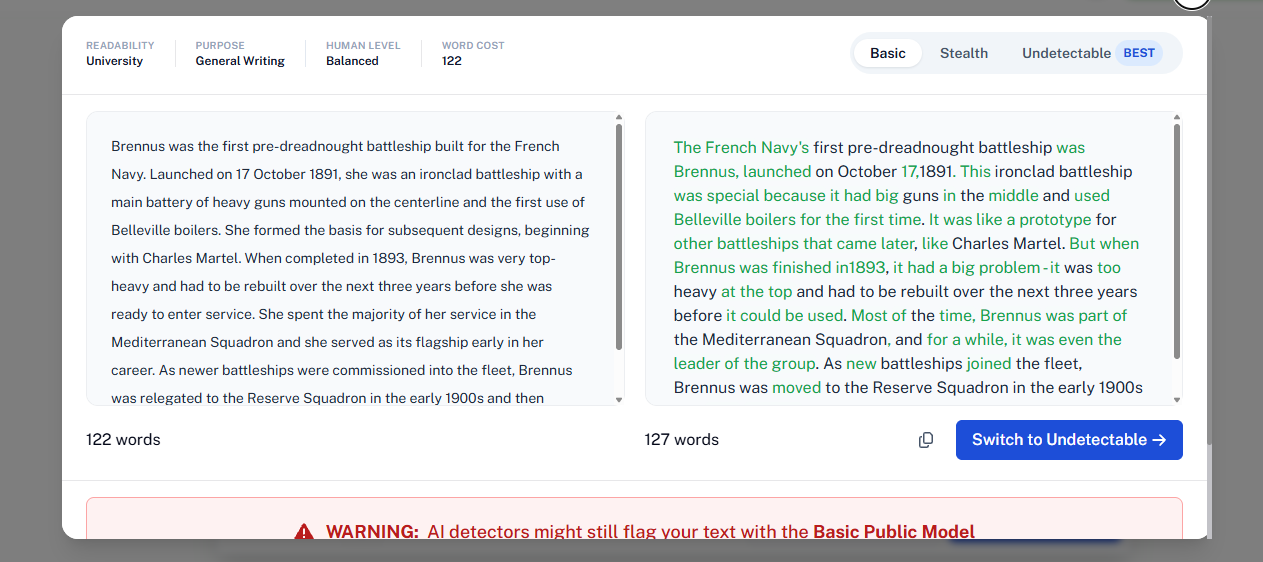
The rewrite came back in a few seconds, 127 words long, with every changed phrase highlighted in green. The settings bar at the top read Readability: University, Purpose: General Writing, Human Level: Balanced, and a "Word cost" of 122. The model selector showed Basic selected, with Stealth and Undetectable (tagged "BEST") greyed out behind the paywall.
Then I read it. A naval history paragraph had been turned into something you would read to a ten-year-old.
| Original (Wikipedia) | Humanized (Basic model) | What happened |
|---|---|---|
| a main battery of heavy guns mounted on the centerline | it had big guns in the middle | Technical term flattened into toddler-speak |
| formed the basis for subsequent designs | It was like a prototype for other battleships that came later | Meaning kept, register dropped two grade levels |
| served as its flagship | it was even the leader of the group | "Flagship" is a real word; this is not a synonym |
| relegated to the Reserve Squadron | moved to the Reserve Squadron | Lost the connotation of being sidelined |
| Launched on 17 October 1891 | launched on October 17,1891 | Missing space after the comma |
| When completed in 1893 | when Brennus was finished in1893 | Missing space again. Two typos in 127 words |
Three things jumped out:
- The "University" readability setting did nothing I could see. The output reads like a middle-school book report.
- The spacing glitches ("17,1891", "in1893") would be the first thing any editor or teacher notices. A tool whose whole job is sounding human should not introduce typos a human would never make.
- The facts survived. Dates, names and squadron references were all intact. If you only care about meaning, it passes. If you care about sounding like yourself, it fails.
And then the kicker: a red warning box under the result said that AI detectors might still flag the text because I was using the Basic Public Model, with a bright blue "Switch to Undetectable" button next to it. In other words, the free humanizer tells you up front that it may not do the one thing the product is named for.
My take: this is not a humanizer on the free tier, it is a simplifier. It would make a dense paragraph easier to read, but it would also make a competent writer sound less competent.
Step 4: The AI Detector Gets It Right (With One Caveat)
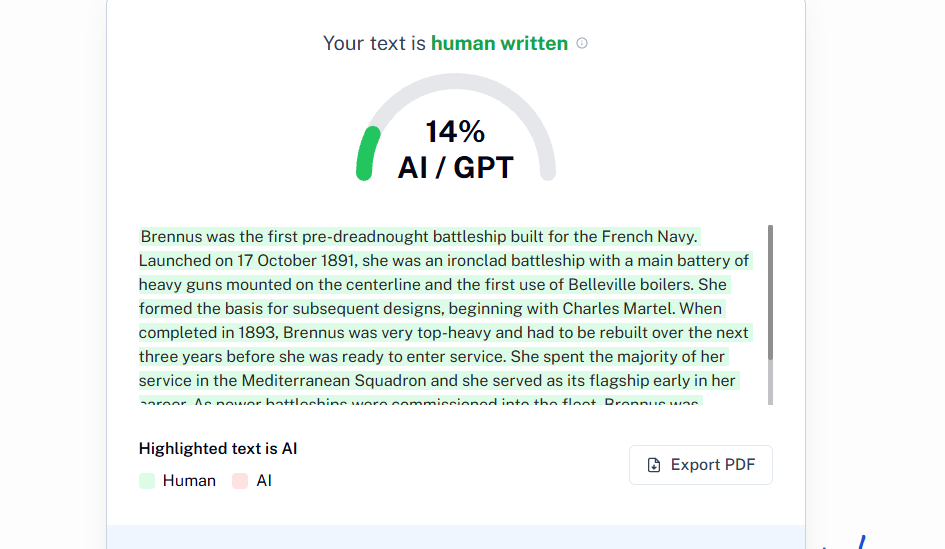
Next I ran the original Wikipedia paragraph, untouched, through the Check for AI button. Result: a green gauge reading 14% AI / GPT, with the verdict "Your text is human written." The entire paragraph was shaded green (human), with no red (AI) highlights anywhere. There is an Export PDF button if you want a report to attach to client work.
This is the correct answer. The text is human. A detector that flagged a Wikipedia paragraph as AI would be useless, and plenty of free detectors do exactly that with formal, factual prose.
What the 14% actually tells you: the detector does not output a binary yes/no. It gives a probability, and 14% is low but not zero. That matters because:
- Formal, structured writing (history, science, legal) naturally scores higher than casual writing on most detectors. A 14% on encyclopedia prose is a reasonable floor.
- If your own writing scores 30% to 40%, you are not "caught," you are in the grey zone where no detector is reliable. Do not panic-humanize text that was yours to begin with.
- One paragraph is a small sample. Detectors get more confident with 300+ words, so treat short-text scores as a hint, not a verdict.
The bit I found interesting: the detector and the humanizer disagree with each other. The detector said my text was already human. The humanizer rewrote it anyway and then warned me the rewrite might get flagged. If you take both tools at their word, the free humanizer made a human paragraph more likely to look like AI. That is the opposite of the product name.
13 Tools Hiding in the Products Menu
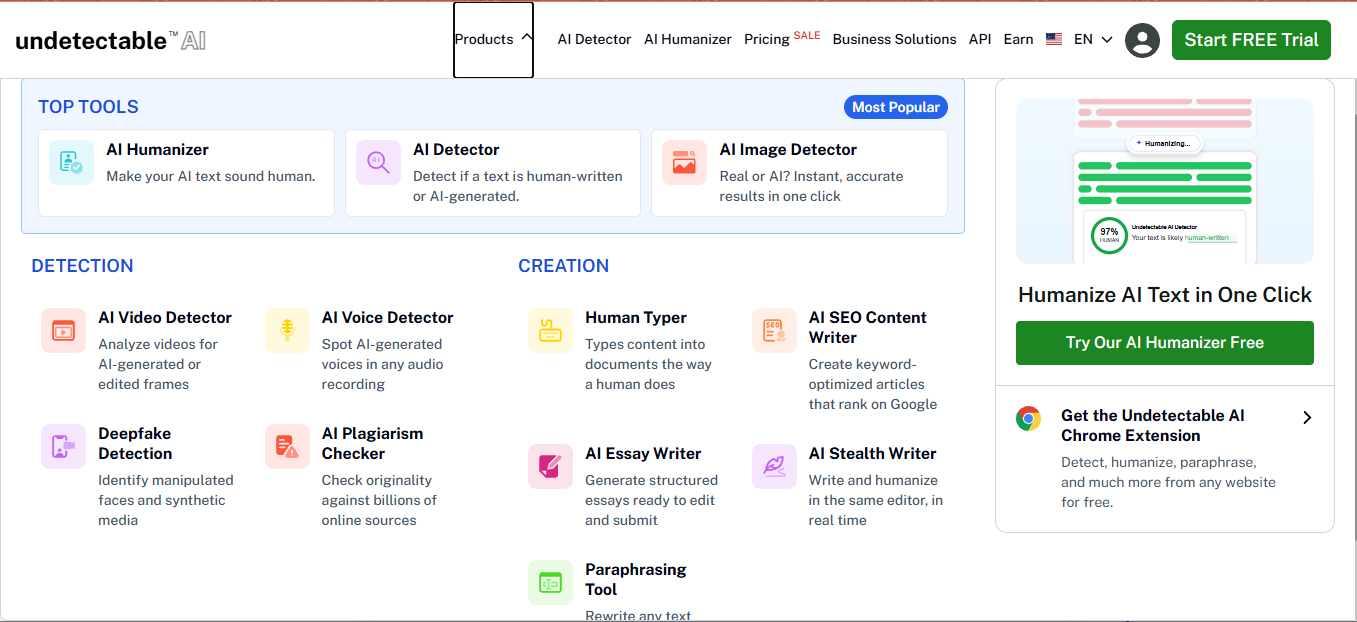
Most people never click the Products dropdown and assume Undetectable AI is a two-button app. It is not. The menu splits into Detection and Creation, with three "Top Tools" pinned at the top. Here is everything on offer and what each one claims to do.
| Tool | Category | What it does (per the menu) | Who it is for |
|---|---|---|---|
| AI Humanizer | Top tool | Rewrites AI text to sound human | Writers, students, marketers |
| AI Detector | Top tool | Scores text as human- or AI-written | Editors, teachers, agencies |
| AI Image Detector | Top tool | Flags real vs AI-generated images in one click | Journalists, moderators |
| AI Video Detector | Detection | Analyses video for AI-generated or edited frames | Newsrooms, trust and safety |
| AI Voice Detector | Detection | Spots AI-generated voices in audio | Podcasters, fraud teams |
| Deepfake Detection | Detection | Identifies manipulated faces and synthetic media | Anyone verifying a clip |
| AI Plagiarism Checker | Detection | Checks originality against billions of online sources | Students, publishers |
| Human Typer | Creation | Types content into documents the way a human would | Google Docs users worried about edit history |
| AI SEO Content Writer | Creation | Generates keyword-optimised articles | Bloggers, SEO agencies |
| AI Essay Writer | Creation | Produces structured essays ready to edit | Students |
| AI Stealth Writer | Creation | Writes and humanises in the same editor in real time | Anyone drafting from scratch |
| Paraphrasing Tool | Creation | Rewrites any text | General use |
| Chrome Extension | Add-on | Detect, humanise and paraphrase from any website | Everyone, free |
Worth noticing: the detection side is surprisingly deep. Video, voice and deepfake detection are tools you would normally pay a separate vendor for, and here they come bundled. The creation side is where the ethics get murky. A "Human Typer" that fakes keystroke history exists for exactly one reason, and it is not productivity. If your school or employer tracks document history, using that tool is a policy problem, not a software one.
I only tested the humanizer and detector for this review. The other eleven are listed so you know what the subscription actually buys.
Undetectable AI Pricing: The Yearly Plan Is Half Price, But Read This First
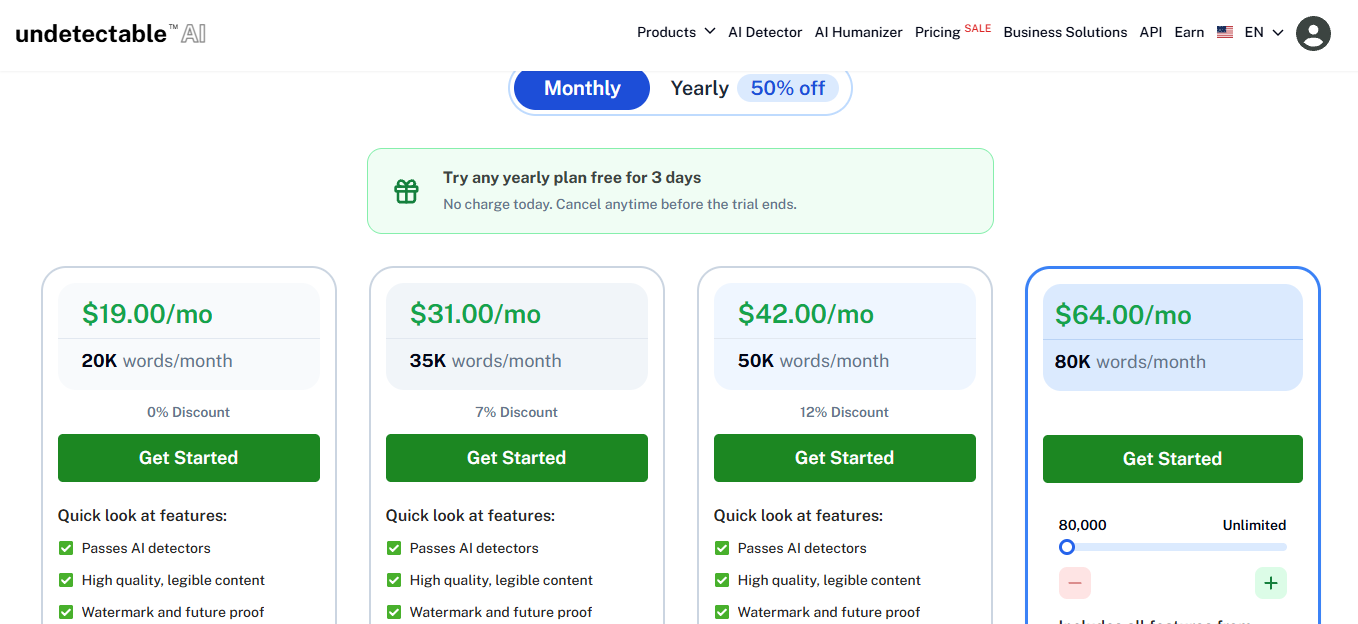
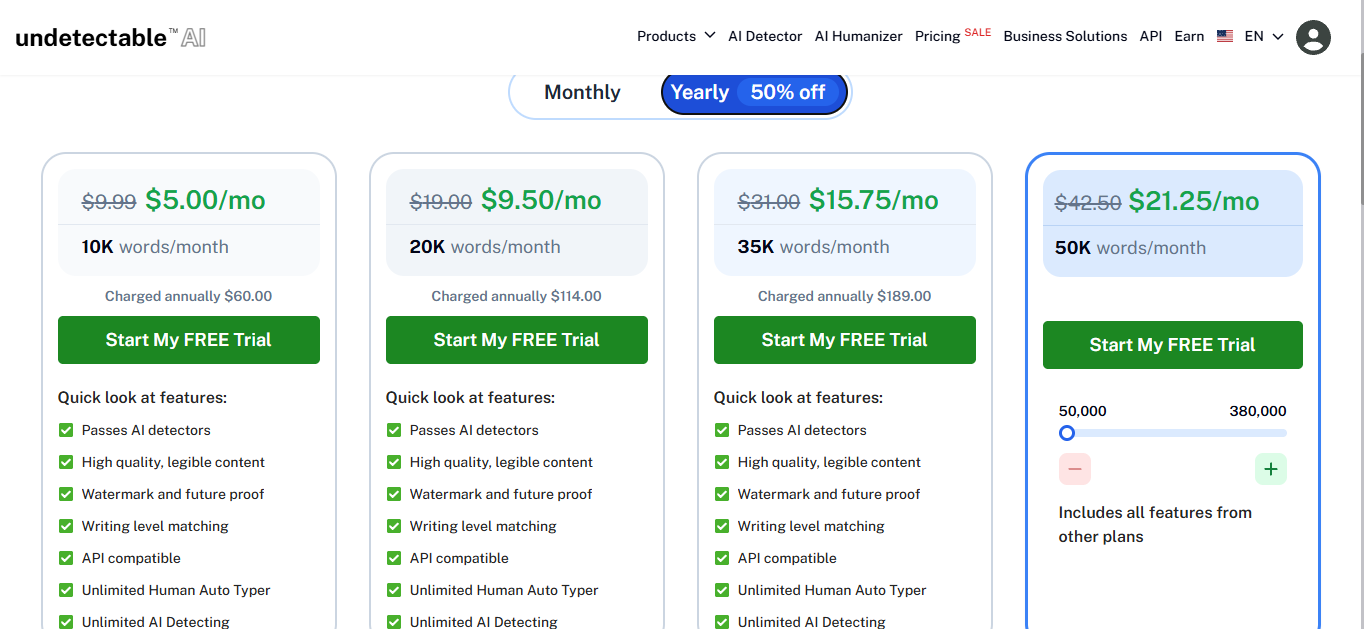
The pricing page has a Monthly / Yearly toggle, and the two are very different deals. Yearly is advertised at 50% off and comes with a 3-day free trial; monthly has no trial and no discount at the entry tier. All plans list the same feature set: passes AI detectors, legible output, watermark and future proof, writing level matching, API access, unlimited Human Auto Typer and unlimited AI detection.
Monthly plans (as shown on 17 October 2026)
| Plan | Price per month | Words per month | Cost per 1,000 words | Discount shown |
|---|---|---|---|---|
| Starter | $19.00 | 20,000 | $0.95 | 0% |
| Mid | $31.00 | 35,000 | $0.89 | 7% |
| Pro | $42.00 | 50,000 | $0.84 | 12% |
| Max | $64.00 | 80,000 (slider up to Unlimited) | $0.80 | custom |
Yearly plans (billed once a year, 3-day free trial)
| Plan | Price per month | Charged annually | Words per month | Cost per 1,000 words | Struck-through price |
|---|---|---|---|---|---|
| Entry | $5.00 | $60.00 | 10,000 | $0.50 | $9.99 |
| Starter | $9.50 | $114.00 | 20,000 | $0.48 | $19.00 |
| Mid | $15.75 | $189.00 | 35,000 | $0.45 | $31.00 |
| Pro | $21.25 | $255.00 | 50,000 (slider up to 380,000) | $0.43 | $42.50 |
The math nobody puts on the page: the 20K-word tier costs $228 a year on monthly billing and $114 on yearly. Same words, same features, half the money. The 10K Entry plan does not even exist on monthly billing. If you are going to pay at all, there is no rational reason to pay monthly unless you need it for exactly one month.
Four gotchas from the fine print and from real customers:
- "Charged annually" means the whole year leaves your card in one go, $60 to $255 at once, the moment the 3-day trial ends. Several Trustpilot reviewers said they expected a monthly charge and got the full annual amount.
- The free trial asks for a card up front. According to the company's own reply on Trustpilot, you get 250 trial credits, and clicking "Activate" on a plan charges you immediately, even if the trial is only two days old.
- The Basic humanizer model is what you get free. The Stealth and Undetectable models, the ones that are supposed to actually beat detectors, are paid-only.
- Words are per month, and a "Word cost" is deducted every time you humanize. My 122-word test cost 122 words. Re-running the same text to get a better result costs you again.
Value verdict: at $5 a month, the yearly Entry plan is among the cheapest paid humanizers you can buy. At $19 a month, the monthly Starter plan is hard to justify for the output quality I saw on the free tier. Try the yearly trial, test the Undetectable model on your own writing, and cancel before day three if it does not impress you.
What Real Users Say: 856 Trustpilot Reviews Tell a Split Story
My test is one data point. So I read through the review sites. The pattern is consistent: people love the support team and distrust the billing, and opinions on the humanizer itself are all over the map.
| Review site | Score | Review count | Standout theme |
|---|---|---|---|
| Trustpilot | 3.5 / 5 | 856 | Support praised, free-trial billing heavily criticised |
| G2 | 4.4 / 5 | 36 | Ease of use, detector accuracy |
Trustpilot ranks the company #293 of 335 in its Software Company category and notes it replies to 7% of negative reviews, typically within two weeks.
The happy customers (mostly about support, not the product)
[Screenshot tip: grab the four 5-star reviews dated 31 March to 5 April 2026 on Trustpilot page 2. Three of them name the same agent, Ava.]
- A reviewer on 5 April 2026 had been charged for three months without noticing; support cancelled the plan and refunded the last month.
- Another on 31 March 2026 got a cancellation confirmed and a request escalated to roll leftover words into non-expiring credits.
- A 4-star reviewer praised agent Kate as professional but added that humanized text still showed AI detection scores.
- On G2, a reviewer titled their write-up "One of the best AI Detector and Humanizer we have now!" and said it helps emails feel personal rather than machine-made.
Read those again. The 5-star reviews are about getting money back and cancelling. That is a support team doing good work, but it is not a product review.
The angry customers (almost all about the trial)
[Screenshot tip: the 1-star reviews dated 2 April and 5 April 2026, and the company's reply under the first one, make the strongest visual.]
- 2 April 2026, 1 star: the trial advertises a high word limit but gives 250 credits; hitting "Activate" charged the card instantly; the refund kept $4. The company replied that it charges no processing fee, only for credits used beyond the 250 free ones, and that the activation popup explains the charge.
- 5 April 2026, 1 star: same complaint, same 250 credits versus a promised 10,000 words. This reviewer's bank blocked the charge.
- 6 April 2026, 1 star: called it a scam, charged during the trial, hard to cancel.
- 21 January 2026, 1 star: locked out of the account while recurring billing kept running.
- 1 March 2026, 2 stars: a long-time user said the tool used to be solid but the output had become random, inconsistent and sometimes off-topic since recent changes.
The review that accidentally says everything
That 2-star review from 1 March 2026 opens with the line "Here's a clean, natural review you can use:" followed by a horizontal rule. The reviewer pasted the AI's preamble along with the review. Someone complaining that an AI humanizer no longer sounds human, in a review that was visibly written by an AI and not humanized. Screenshot that one. It is the whole 2026 content industry in one Trustpilot card.
What paid users say about detection scores
On a community forum thread, a user who ran a paid plan for months on client blogs reported humanized output still scoring 20% to 50% AI on GPTZero and 40% to 70% on Originality.ai, and warned that pushing the "human" setting too high sometimes raised the AI score above the raw ChatGPT draft. Their summary: it helps with detection scores, but you pay for it in quality. That matches exactly what I saw on the free tier.
Pros and Cons After Testing It Myself
| Pros | Cons |
|---|---|
| No signup needed to try the detector and Basic humanizer | Basic humanizer flattened university-level prose into middle-school prose |
| Detector correctly scored human text as human (14% AI) | Rewrite introduced spacing typos ("17,1891", "in1893") |
| Facts, names and dates survived the rewrite intact | The tool itself warns Basic output may still be flagged |
| 13 tools under one login, including video, voice and deepfake detection | The models that supposedly beat detectors are paid-only |
| Yearly Entry plan is $5/mo, one of the cheapest in the category | Monthly billing costs double for the same words |
| Side-by-side view with green highlights shows exactly what changed | Free trial requires a card; "Activate" charges immediately per user reports |
| Chrome extension works on any site for free | Every re-run deducts words from your monthly quota |
| Support team gets consistent praise for refunds and cancellations | Company replies to only 7% of negative Trustpilot reviews |
Who Should Buy Undetectable AI (and Who Should Close the Tab)
Buy it if you are:
- A content marketer or agency that needs a detector plus a humanizer in one dashboard and will commit to a yearly plan. At $5 to $21 a month it is cheap insurance.
- An editor who wants a quick second opinion on whether a freelancer's draft is machine-written. The detector held up in my test.
- A team that would otherwise pay separately for deepfake, voice and video detection. The bundle alone may justify the Pro tier.
One more thing for the marketers. Google's own guidance on AI-generated content says Search rewards helpful content whatever tool produced it, and that using AI earns no special ranking gain. Humanizing a draft to hide that it was AI-written does nothing for your rankings. Fact-checking and editing it does.
Close the tab if you are:
- A student planning to run essays through it. Several universities treat humanizer use itself as misconduct, and a detector score is not a defence. The tool does not change your institution's policy.
- A writer who likes their own voice. The Basic model rewrote competent prose into simpler prose. Unless the paid models are dramatically better, you will spend as long fixing the output as you saved.
- Anyone who does not read billing pages. The annual charge lands in one lump, and the trial converts the moment you click Activate.
Alternatives people compare it with:
| Tool | Main strength | Compare it when |
|---|---|---|
| GPTZero | Detection, popular with educators | You only need a detector, not a rewriter |
| Originality.ai | Detection plus plagiarism, publisher-focused | You run a content site and need both checks |
| Copyleaks | Enterprise detection and LMS integrations | You are buying for a school or large team |
| Winston AI | Detection with OCR for scanned documents | You check printed or handwritten work |
| HIX AI, WriteHuman, Humbot | Humanizer-first tools | You want to A/B the rewrite quality against Undetectable's paid models |
I have not benchmarked these head-to-head for this article; the table is a shortlist, not a ranking. Run your own paragraph through two or three before paying for any of them.
Final Verdict: 3.5 Out of 5, and the Free Tier Is Not the Product
Undetectable AI is two different products wearing one name. The detector is good: it read a human paragraph as human, showed its work with highlights, and exported a report. The free humanizer is not good: it dumbed down a university-level paragraph, added two typos, and then warned me the result might get flagged anyway.
The real humanizer, the Undetectable model, is behind a paywall I did not cross for this test. The $5-a-month yearly plan and the 3-day trial make it cheap to find out for yourself. Do that with your own writing, not a ChatGPT draft, and check the output in two outside detectors before you decide.
Three rules if you sign up:
- Choose yearly, never monthly. Same features, half the price.
- Set a calendar reminder for day two of the trial. The annual charge is a lump sum.
- Do not click Activate until you have read what it does. Multiple reviewers learned that one the expensive way.
Would I pay for it? For the detector and the bundled media-detection tools, yes, on the yearly Entry plan. For the humanizer alone, not until the paid model proves it can rewrite a paragraph without making the writer sound worse.
Discussion 0
More posts

NovelAI: An Hour of Notes Before I Wrote a Single Word
A hands-on NovelAI review: the broken sign-up, the encryption catch, real pricing, the models, real user reviews, and wh...

StealthWriter AI : Hands-On Test of the Humanizer and AI Detector
I put StealthWriter AI through a real test: a Wikipedia paragraph that its detector scored 0% human was rewritten to 100...

Originality.ai: I Tested It and It Flagged Wikipedia as 100% AI
I pasted a plain Wikipedia paragraph into Originality.ai and it came back "Likely AI – 100% Confidence." Two scans later...
Please log in or create an account to join the discussion.