Why AI Is Changing the Editing Process More Than the Writing Process

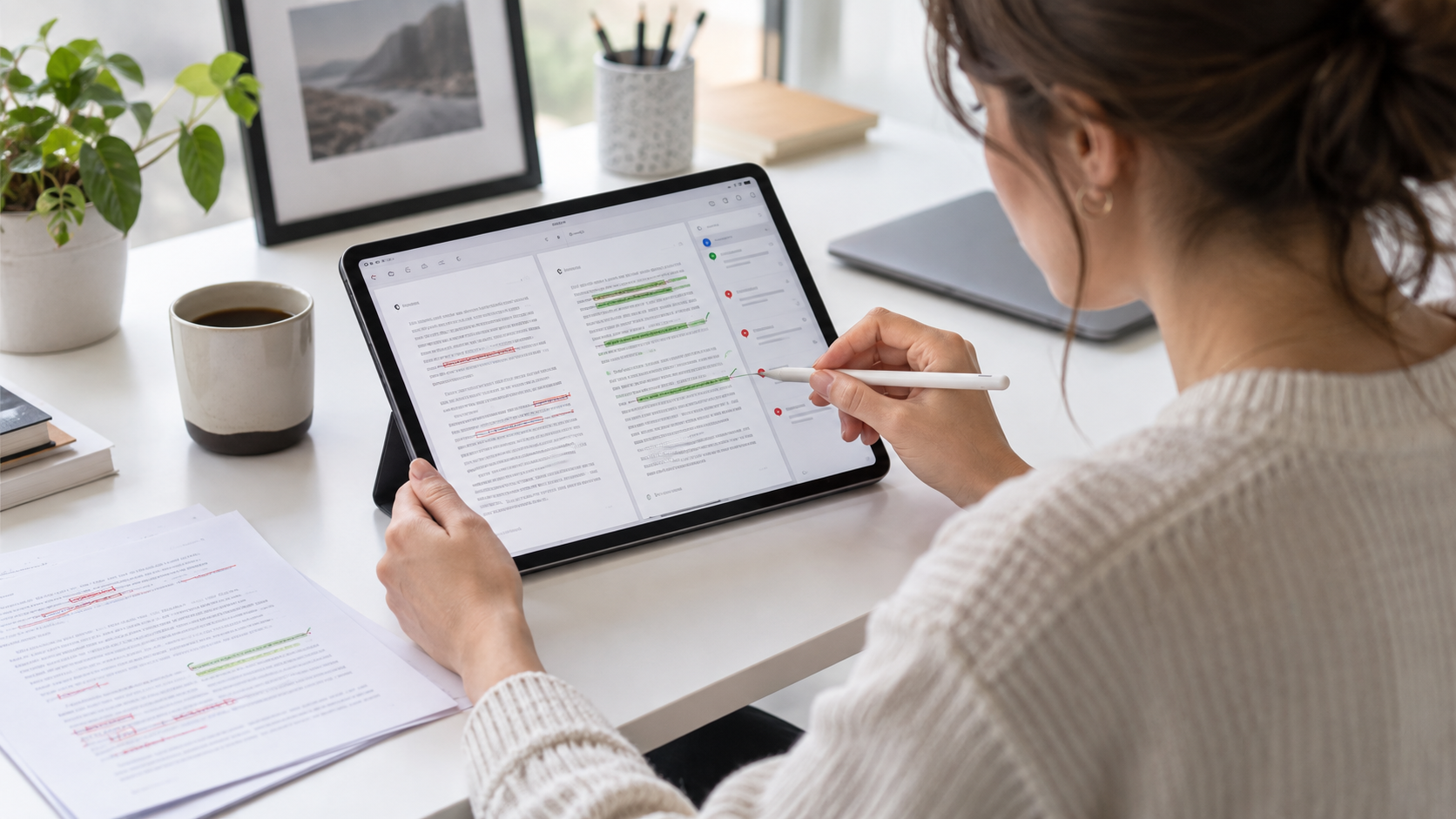
AI can fill a blank page in seconds. It cannot tell you whether the page is true, useful, or yours. That job is editing, and it has just become most of the work.
The short answer
AI made first drafts fast and cheap, so the hard part of writing has moved. It used to be getting words onto the page. Now it is deciding which words deserve to stay. Checking facts, cutting filler, fixing the voice, and answering for the result are all editing jobs, and they now take most of the time and most of the skill.
What actually changed?
For most of history, the slow part of writing was the first draft. You stared at a blank page, and every sentence cost effort. Editing came last, and it often got whatever time was left.
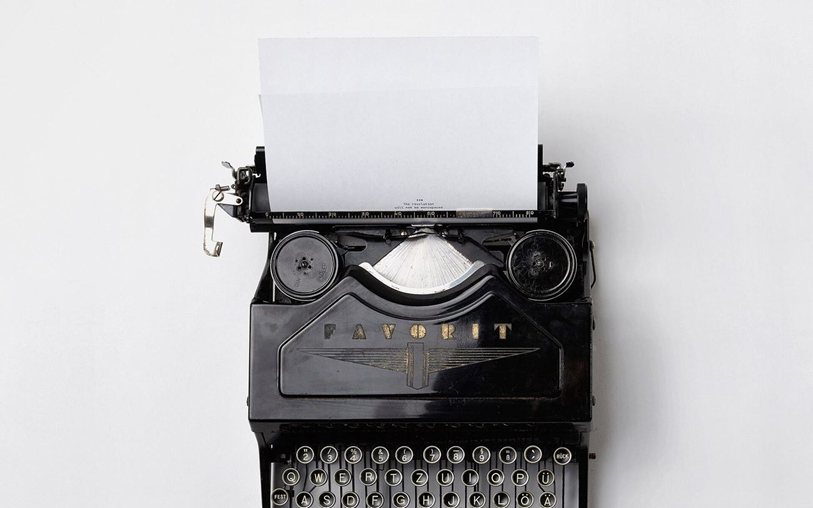
The blank page used to be the hard part. Today an AI tool can fill it in seconds.
Drafting got cheap. Judgment did not.
AI turned that around. Ask for a draft and you get 600 tidy words before your coffee cools. Drafts are no longer scarce. What is scarce is someone who can look at a draft and say what is wrong with it.
That is why the bigger change is on the editing side. Writing with AI still starts the same way: you decide what you want to say. What happens after the draft appears is completely different.
What the research shows
In an experiment by two MIT economists, 444 professionals did realistic writing tasks such as press releases and short reports. Half of them could use ChatGPT.
Without AI, people spent about 25 percent of their time planning, 50 percent writing a rough draft, and 25 percent editing. With AI, the share spent on the rough draft fell by more than half, and the share spent on editing more than doubled.
Where the writing time goes
Shares of writing time in the MIT experiment. The top bar uses the figures the study reports. For the bottom bar the study reports the size of the change, not exact shares, so the segment widths are approximate. |
The same study carried a warning. 68 percent of the people who used ChatGPT said they handed in its first answer without editing it at all. The work had moved to editing, and most people skipped it.
Why did editing change more than writing?
Four things explain it.
1. Drafts are cheap now, so judgment is the scarce skill
When a draft took three hours, you worked with the one you had. Now you can ask for five versions in a minute. Someone has to choose between them, combine the best parts, and notice what all five missed. That is an editor's job, even if your job title says writer.
2. AI drafts fail in new ways
Correct and empty is the new typo.
A human first draft is usually messy: typos, tangled sentences, a missing section. An AI draft is the opposite. It is smooth, confident, and well punctuated, and that is exactly what makes its problems easy to miss.
- It can be wrong in a calm, sure voice. A made up number looks the same as a real one.
- It pads. Warm up sentences, repeated points, and a summary of what it just said.
- It sounds like everyone else. A study in Science Advances found that stories written with AI ideas were rated as better written, but they were also more similar to each other than stories people wrote alone.
Old editing hunted for clumsy sentences. New editing hunts for smooth sentences that are wrong, empty, or generic. That takes a different eye.
3. Editors gained a tireless assistant
AI is often more useful as a second reader than as a first writer. It will scan a 3,000 word draft for repeated points, long sentences, or a term you never explained. It does this in seconds and never gets bored. So the editing process itself has new tools and new steps. Treat its notes as suggestions, though. It makes mistakes here too.
4. Your name is still on it
An AI tool does not get the angry email when a number is wrong. You do. The more of the drafting a machine does, the more your role becomes approval: reading closely, checking, and deciding that this is good enough to publish. Approval is editing.
This has happened before
In the 1880s, the Linotype machine took over the slow job of setting type by hand. Newspapers did not stop needing editors. They printed more pages, faster, and every page still had to cross an editor's desk. When a machine speeds up production, checking matters more, not less.
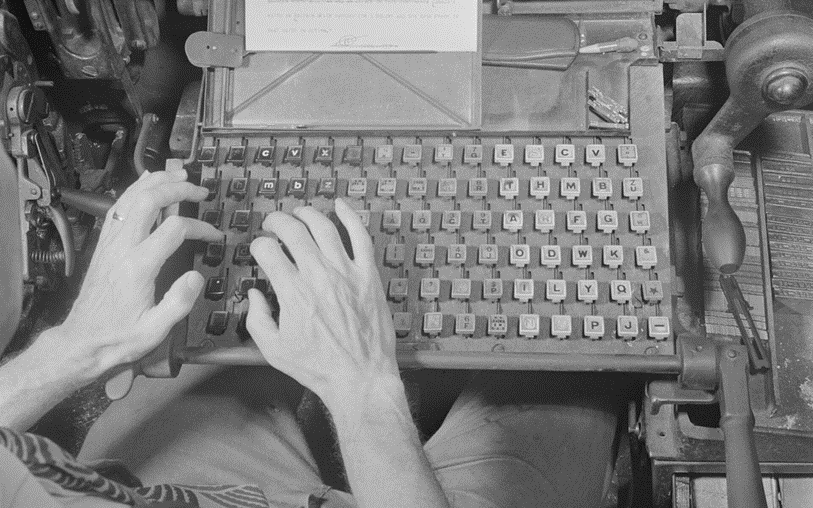
Hands on a Linotype keyboard in a newspaper composing room, 1942. The machine made type fast. People still decided what went on the page.
What does the change look like on the page?
Editing has always been where good writing gets made. Even the most famous sentences in history went through it.
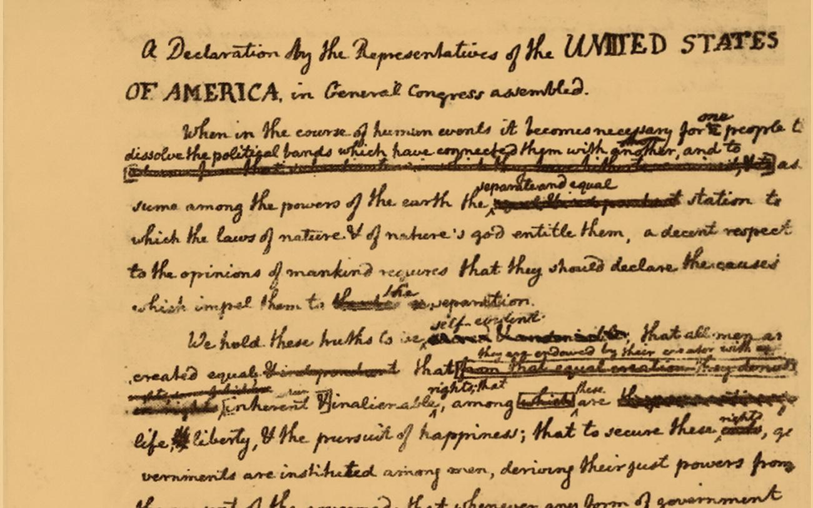
Even the Declaration of Independence needed an editor. This is Thomas Jefferson's draft, with words crossed out and better ones written above them.
Here is the same process with a modern draft. The first paragraph below is typical of what an AI tool writes for a marketing blog. The second shows the editor's marks. The third is the clean result.
| One paragraph, three views |
|---|
1. AI draft 76 words. Nothing in it is wrong, and nothing in it is useful. In today's fast paced digital world, email remains one of the most important communication tools for businesses of all sizes. Many studies show that a well written subject line can dramatically increase open rates. It is important to note that keeping subject lines short, clear, and engaging is a best practice that can help your message stand out in a crowded inbox. By following these tips, you can unlock the full potential of your email marketing. |
2. The edits Struck text is cut, blue text is new, red notes are the editor's queries. In today's fast paced digital world, email remains one of the most important communication tools for businesses of all sizes. [warm up, cut] The subject line is the one part of your email that everyone sees. Many studies show that a well written subject line can dramatically increase open rates. [which studies?] Last month we tested two subject lines on our own newsletter. The shorter one was opened by 31 percent of readers. The longer one reached 22 percent. It is important to note that keeping So keep subject lines short, clear, and engaging is a best practice that can help your message stand out in a crowded inbox.and say what is inside.By following these tips, you can unlock the full potential of your email marketing. [slogan] If a word is only there to sound clever, cut it. |
3. Clean result 61 words, one real number, and an instruction the reader can use. The subject line is the one part of your email that everyone sees. Last month we tested two subject lines on our own newsletter. The shorter one was opened by 31 percent of readers. The longer one reached 22 percent. So keep subject lines short and say what is inside. If a word is only there to sound clever, cut it. |
What the editor did
- Cut the warm up. The first sentence told readers nothing they did not already know.
- Swapped a vague claim for a real one. "Many studies show" became a number the writer could stand behind.
- Turned advice into an instruction. Seven words of throat clearing became two: "So keep".
- Ended on something useful. The closing slogan became a test the reader can apply today.
Notice what the editor did not do: fix grammar. There was nothing to fix. The draft was correct and empty. The edit made it specific and useful, and only a person who knew the facts could have done that.
How is the new editing job different from the old one?
Editing used to be the last stop before print, a final check on work a person had already thought through. With AI in the loop, the editor is often the first human to think hard about the text at all.
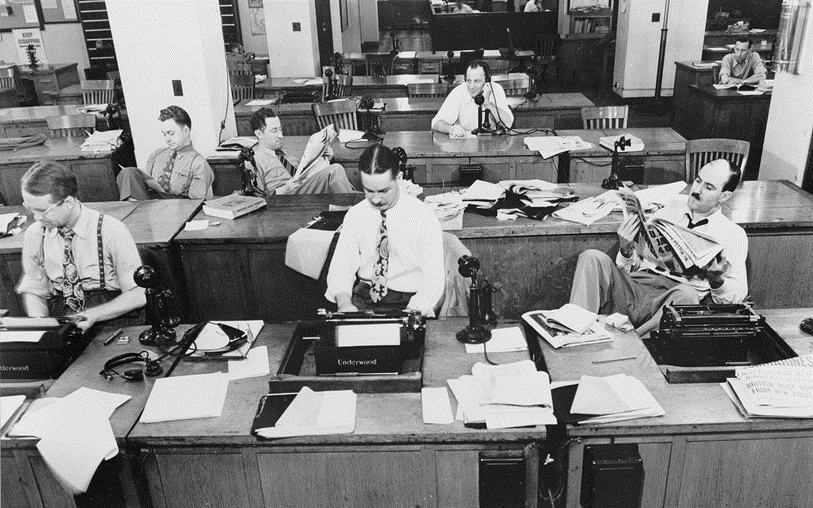
A newspaper newsroom in 1942. Every story passed through desks like these before it reached a reader.
| Editing a human draft | Editing an AI assisted draft | |
|---|---|---|
| The main question | Is this well written? | Is this true, and is it ours? |
| The usual problem | Clumsy sentences and typos | Smooth sentences that are wrong, padded, or generic |
| What you add | Polish | Facts, examples, and a point of view |
| What you cut | A little | A lot |
| Your first reader | A colleague, if you are lucky | An AI critique in seconds, then a colleague |
| Where the time goes | Mostly drafting | Mostly editing |
How should you edit an AI assisted draft?
One pass, one job.
Do not try to fix everything in one read. Editors have long worked in passes, each with a single job. The Writing Center at the University of North Carolina gives the same advice: look for one kind of problem at a time, because trying to catch everything at once makes you lose focus.
For AI assisted drafts, five passes work well. The order matters. There is no point polishing a sentence you will cut in pass two, or perfecting a paragraph built on a number that fails pass one.
Two editors at work under a desk lamp, 1942. The tools have changed. The job of reading closely and marking what is wrong has not.
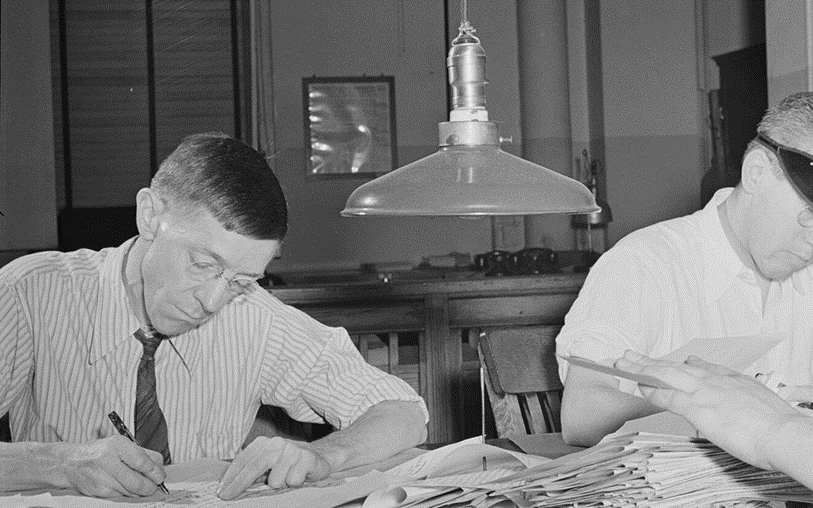
Photo: Marjory Collins, Library of Congress, public domain.
Pass 1: The truth pass
Is every fact right?
Start here, because nothing else matters if the facts are wrong. Check every name, number, date, quote, and link. AI tools can state false things in a confident voice, so do not trust anything just because it reads well.
Ask yourself
- Where did this number come from? Can I open the source?
- Did this person really say this?
- Would I repeat this claim to an expert?
Let AI help Ask it to list every factual claim in the draft as a checklist. | Keep for yourself Checking each claim against a real source. Delete what you cannot confirm. |
Pass 2: The purpose pass
Does it answer the reader's question?
Now look at the whole piece. AI drafts cover a topic. Good writing makes a point. Decide what the point is, move it to the top, and cut whatever does not serve it.
Ask yourself
- Can I state the point in one sentence?
- Does the first paragraph deliver it?
- Which sections could go without anyone noticing?
Let AI help Ask it to sum up the draft in two sentences. If the summary misses your point, so does the draft. | Keep for yourself Deciding what the piece is for and what gets left out. |
Pass 3: The voice pass
Does it sound like us?
This is where a generic draft becomes yours. Remove stock phrases. Add the things no AI tool could know: a customer story, a number from your own work, an opinion you are willing to defend.
Ask yourself
- Could a competitor publish this exact paragraph?
- Where is the detail only we have?
- Would I say this sentence out loud?
Let AI help Ask it to flag cliches, filler, and sentence patterns that repeat. | Keep for yourself Supplying the specifics and the point of view. |
Pass 4: The clarity pass
Is every sentence easy to read?
Only now work line by line. Shorten long sentences, swap jargon for plain words, and fix the joins between paragraphs. This is the pass where AI helps the most.
Ask yourself
- Is any sentence doing two jobs?
- Is there a simpler word?
- Does each paragraph lead to the next?
Let AI help Ask it to find long sentences, passive voice, and terms you never explained. | Keep for yourself Accepting or rejecting each change, so it does not flatten the voice you just added. |
Pass 5: The proof pass
Is it ready to publish?
One last look for small things: spelling, names, links, headings, and formatting. Read it aloud, or have your device read it to you. Your ear catches what your eye skips. Then check it on a phone.
Ask yourself
- Is every name spelled right?
- Does every link open the right page?
- Does it look right on a small screen?
Let AI help Spelling, grammar, and consistency checks. | Keep for yourself The final read, and the decision to publish. |
For a short email, you can run all five passes in a few minutes. For a report that carries your company's name, give each pass its own sitting.
What should you never hand over?
AI suggests. You sign.
AI can help with every pass above. A few decisions should always stay with a person.
- Whether a fact is true. AI can list the claims. Only a real source can confirm them.
- What the piece is for. The goal, the reader, and the one thing that reader should do next.
- What to leave out. Cutting is a judgment about what matters to this reader.
- Anything sensitive. Apologies, bad news, legal or medical wording, and messages about real people.
- The final yes. Someone has to read the last version and agree to put their name on it.
The bottom line
AI changed who writes the first draft. It did not change who answers for the last one. Writing used to be slow drafting followed by quick editing. Now it is quick drafting followed by careful editing. The tools made the first part easy, and that pushed the skill, the time, and the risk into the second part.
|
Discussion 0
More posts

ChatGPT vs Claude for writing: which one writes better like you?
The two most popular AI writing assistants, compared on what writers actually feel: how the prose sounds, how well each...
Can AI Detectors Be Trusted?
What these tools actually measure, where they break, and how much weight their verdicts really deserve.
QuillBot on the free plan: what runs and what stops at the wall
A paraphraser, a grammar checker, and an AI detector in one place. Here is the walkthrough, what each tool does, and the...
Please log in or create an account to join the discussion.