
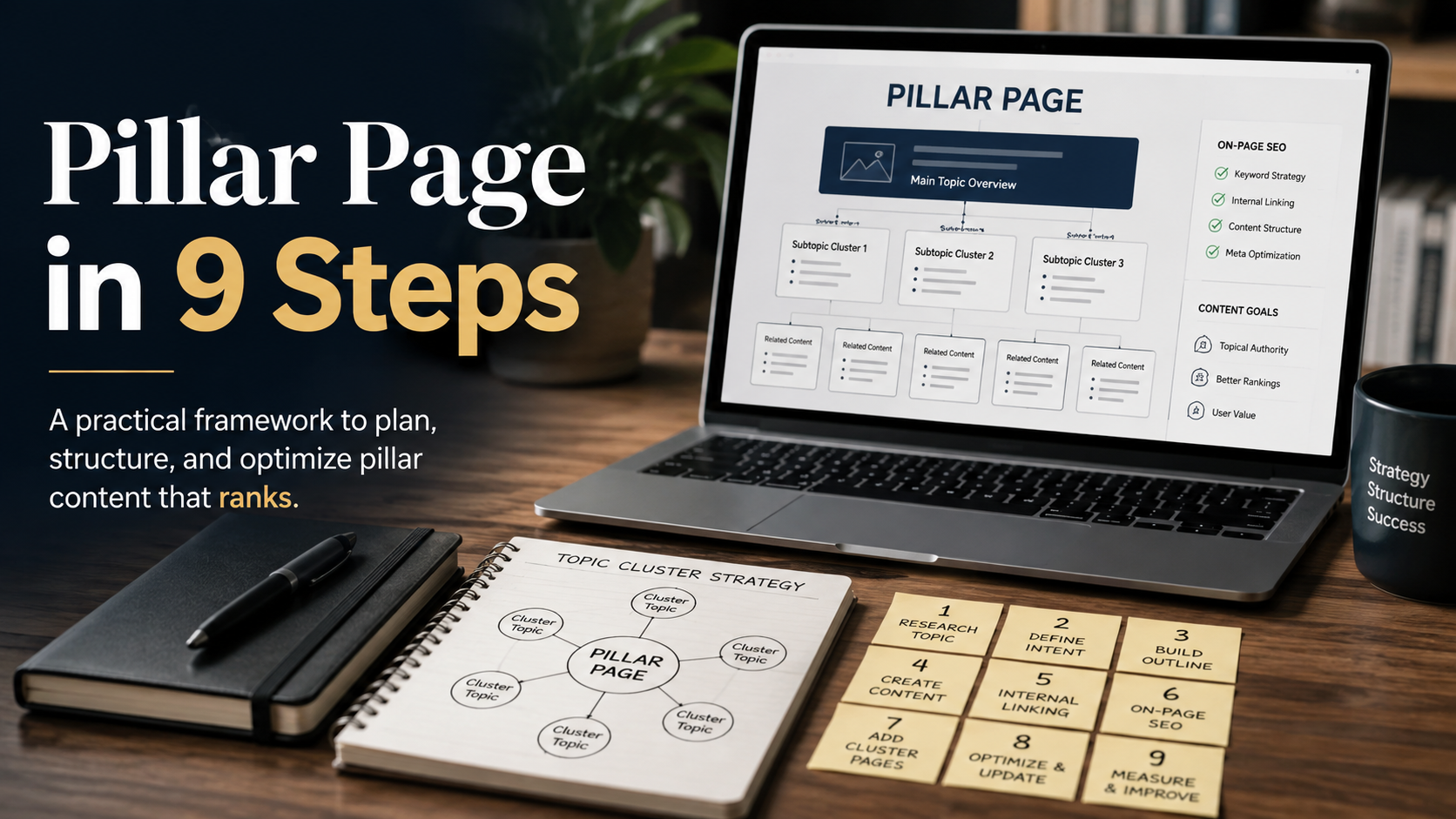
A pillar page is not a longer blog post. It is a structure, and structures are built in a sequence. Here is the order that turns a broad topic into a page other pages can lean on.
Most pillar pages fail before a single word is written, because they are treated as a writing task when they are really a construction task. A blog post can be drafted in an afternoon. A pillar page is the load bearing center of a whole topic, and it has to be planned, built, wired to its supporting pages, and maintained for years. The good news is that the work follows a clear order, and this guide walks through all nine steps in that order.
If you want the full theory behind why this structure works, why a center of gravity outperforms a scattered pile of posts, this companion piece on what a content pillar is and everything it quietly stands for covers the concept in depth. This page is the hands on build. Read them together and you have both the why and the how
BEFORE YOU START A pillar page only earns its cost when the topic is broad enough to hold a dozen supporting pages and stable enough to stay relevant for years. If your topic has no natural subtopics, it is a single article, not a pillar. Confirm that first, then begin the sequence below. |
Pick the head topic
BROAD, DURABLE, AND YOURS TO OWN

Everything downstream depends on choosing the right subject, so this is the step to slow down on. A head topic is the broad, orienting subject your pillar will own, the one that sits above a family of narrower questions. Retirement planning is a head topic. The 2025 contribution limit for a Roth account is not, it is a subtopic that belongs on a supporting page.
Run every candidate through three filters. First, audience demand: is there real, recurring interest in the subject, visible in search volume and in the questions your audience already asks? Second, business relevance: does the topic attract the kind of people who might become customers, so attention converts into value rather than idle traffic? Third, right to win: do you have genuine expertise or an angle that lets you beat what already ranks? A topic that clears all three is worth the investment. One that clears only one is a distraction dressed up as strategy.
The head topic is a promise. Everything you build afterward has to keep it.
Map the search intent
UNDERSTAND WHAT THE READER ACTUALLY WANTS

Before you decide what to write, decide what the reader is trying to accomplish when they search your head topic. A broad query like this is almost always informational, which means the visitor wants to understand a subject, not buy something immediately. Your pillar has to satisfy that intent completely, or the page will never hold its ranking no matter how well it is written.
Read the current top results for your head term. Notice what they cover, what they assume the reader already knows, and where they leave gaps. You are not trying to copy them. You are trying to see the shape of a complete answer so that yours can be more thorough, better organized, and easier to extract a clear answer from than anything already ranking.
Build the subtopic list
EVERY QUESTION THAT LIVES UNDER THE HEAD TOPIC

This is the step that quietly determines how strong your pillar becomes. List every meaningful question a knowledgeable reader might ask about the head topic, from the obvious ones down to the specific ones they only think of once they are deep in the subject. Keyword research tools help, but so does simply writing down every question you have ever been asked about the topic.
Each of these questions is a future supporting page, and the whole list becomes the skeleton of your topic cluster. Aim for a range of roughly five to twenty subtopics. Below five, the topic probably was not broad enough to justify a pillar. Far above twenty, you are likely looking at several pillars wearing one trenchcoat, and you should split them.
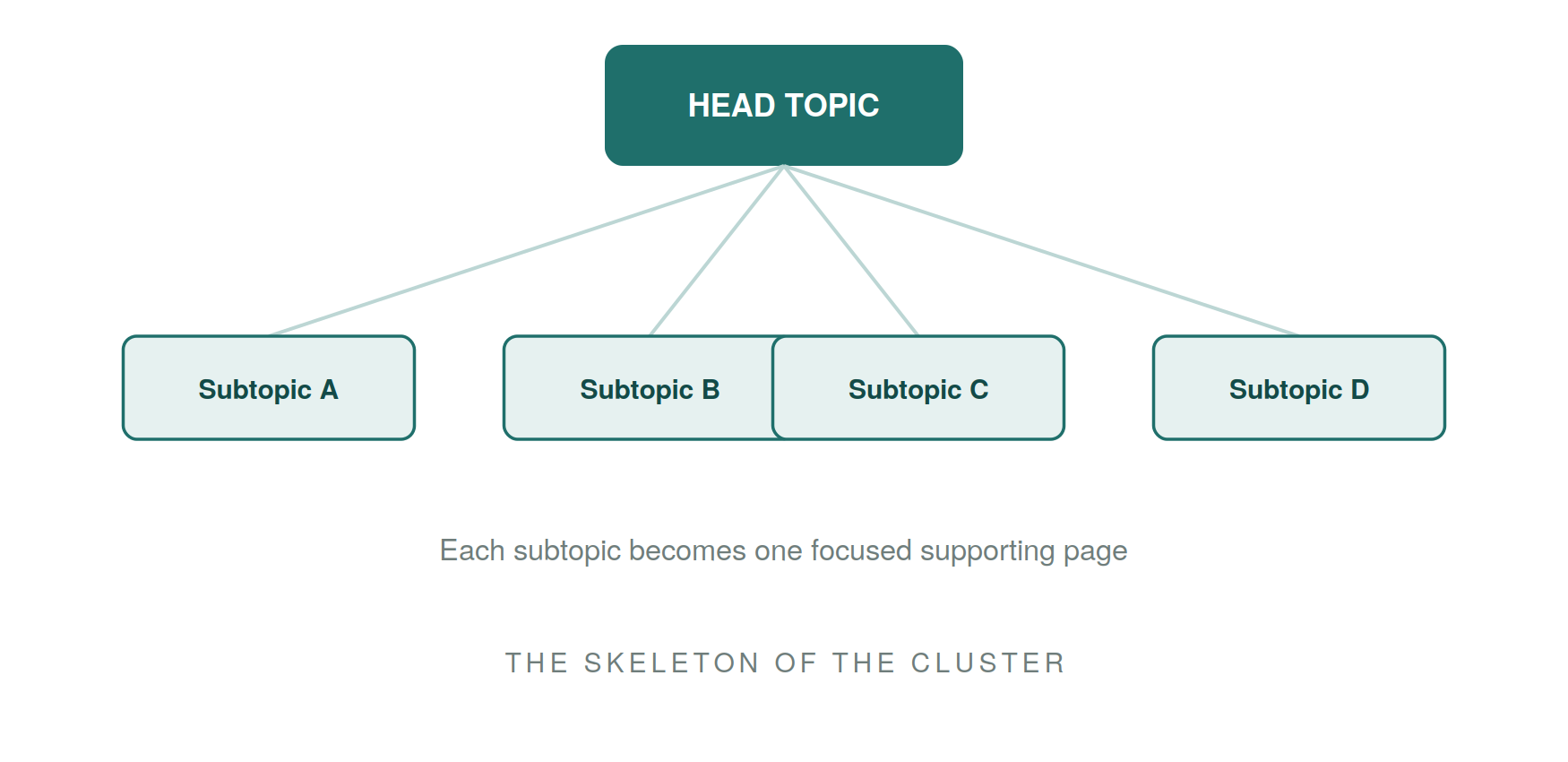
Figure 1. The subtopic list is the skeleton, one question per future supporting page.
Run a cannibalization audit
CHECK WHAT YOU HAVE ALREADY PUBLISHED

Before you build anything new, look at what already lives on your site. If you have older posts that target the head topic or its subtopics, they will compete with your new pillar and cluster for the same rankings, and that internal competition weakens all of them. This audit is the step most guides skip, and skipping it is why so many clusters underperform.
For each overlapping page you find, make a decision. Fold a thin post into the pillar or a supporting page. Redirect a page that no longer has a distinct job. Or refresh and repurpose a strong page as one of your supporting pieces. The goal is one clear owner for every query, so your own pages stop colliding at the same search.
Choose the format
GUIDE, HUB, OR DEFINITION
Pillar pages come in a few recognizable shapes, and choosing the right one before you outline saves real rework. A teachable guide walks the reader through a subject from the top and is the most common shape. A curated hub gathers and organizes resources around a theme. A definitional page settles what something is and what it involves. Pick the shape that matches your head topic and the intent you mapped in step two.
The format decides your outline, your tone, and how you will hand depth to the supporting pages. A guide summarizes each subtopic and links out to the detailed page. A hub points to resources with short framing. A definition draws clear lines around a concept. Name the format now so the draft has a spine.
| FORMAT | WHAT IT DOES | BEST WHEN |
|---|---|---|
| Teachable guide | Walks the whole subject from the top and delegates detail to clusters | The reader wants to learn a broad subject end to end |
| Curated hub | Gathers and organizes related resources around one theme | You have many strong pieces that need a clear home |
| Definitional page | Settles what a concept is and what it involves | The term is broad, confused, or means different things |
Table 1. Three common pillar formats and when each fits.
Outline the pillar
BREADTH AT THE TOP, DEPTH DELEGATED

Now turn the subtopic list into a structure. The pillar covers the whole territory at a readable altitude, and it deliberately hands the microscope work to the supporting pages. For each subtopic, the pillar carries a clear summary that a reader can understand on its own, then links to the dedicated page for anyone who wants the full treatment.
Order the sections the way a reader would want to travel through the subject, starting with why it matters and moving through the pieces in a logical sequence. Put a direct, extractable answer to the head question near the top of the page, because both readers and answer engines reward a source that states its point clearly and early rather than burying it.
Write the page
COMPREHENSIVE, CLEAR, AND GENUINELY USEFUL

Write to the outline, and hold onto one word above all others: comprehensive. A reader who lands on the pillar should feel they have found the definitive resource on the subject, not one more partial article. That sense of completeness is what makes people stay, link, and return, and those behaviors are exactly what search engines reward.
Length alone does not make a pillar, so resist padding. Every section should earn its place by covering its slice of the subject well and then handing the deep dive to its supporting page. Demonstrate real knowledge, cite evidence where it strengthens a claim, and write for the person first. Google's own guidance on creating helpful, reliable, people first content makes the point plainly: content that shows genuine expertise and a clear primary purpose is what earns durable visibility.
Wire the internal links
TURN SEPARATE PAGES INTO ONE STRUCTURE

This step is what turns a long article into an actual pillar. The pillar links out to every supporting page, and every supporting page links back to the pillar. That two way link fabric is the mechanism that lets ranking systems see your separate posts as one connected body of work, and it is how authority circulates through the cluster instead of leaking away.
Use descriptive anchor text on every link, so both readers and search systems understand what a linked page covers before anyone clicks. Google's documentation on making links crawlable recommends exactly this. Keep the pillar shallow from the home page so it is easy to reach, and add sideways links between closely related supporting pages where they genuinely help the reader.
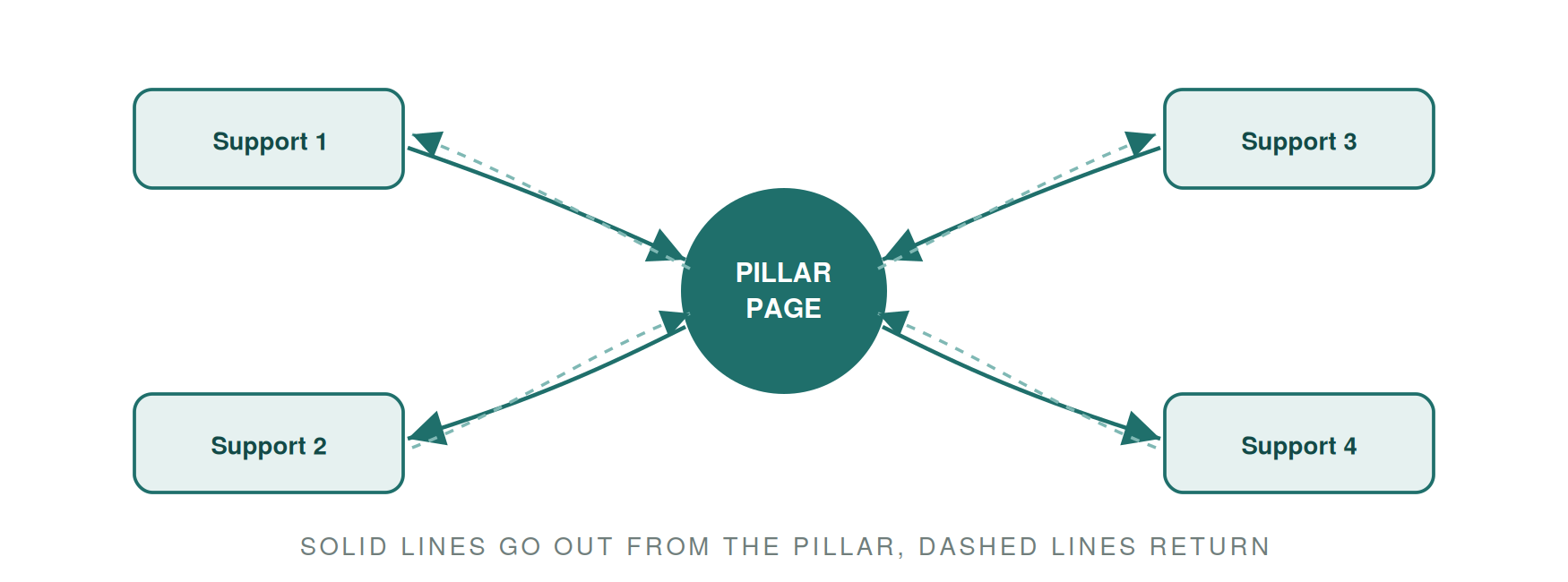
Figure 2. Two way linking is the wiring that turns a page and its clusters into a single structure.
Publish, measure, and maintain
A PILLAR IS A COMMITMENT, NOT A LAUNCH

Publishing is the middle of the work, not the end. Once the page is live, measure the whole cluster rather than the pillar alone, because a modest looking hub can quietly power significant results across everything linked to it. Watch rankings, links, and traffic across the pillar and all its supporting pages together, and treat a rising cluster as the real sign of success.
Then keep it alive. Content decay erodes even excellent pages as facts age, competitors improve, and intent shifts, so put the pillar on a refresh cycle and prune overlapping supporting pages before they sprawl. The payoff hides in exactly this durability, because a maintained pillar compounds its authority over the years rather than fading after launch.
| SIGNAL | WHAT A HEALTHY TREND LOOKS LIKE |
|---|---|
| Cluster traffic | Visits across the pillar and every supporting page rising together |
| Keyword coverage | The cluster ranking for a widening set of related queries |
| Earned links | Other sites citing the pillar as a reference on the subject |
| Freshness | Pages reviewed and updated on a regular schedule |
Table 2. What to watch after the pillar goes live.
THE NINE STEPS AT A GLANCE 1. Pick the head topic that is broad, durable, and yours to own. 2. Map the search intent behind the broad query. 3. Build the subtopic list of every question underneath it. 4. Run a cannibalization audit of what you already publish. 5. Choose the format, guide, hub, or definition. 6. Outline the pillar with breadth at the top and depth delegated. 7. Write the page to be comprehensive, clear, and useful. 8. Wire the internal links both ways with descriptive anchors. 9. Publish, measure, and maintain the whole cluster over time. |
The takeaway
BUILD THE STRUCTURE, NOT JUST THE PAGE

A pillar page rewards the team that treats it as construction rather than composition. Choose a topic you can own, map what the reader wants, list every subtopic, clear the ground of competing pages, pick a format, outline for breadth, write comprehensively, wire the links both ways, and then maintain the whole thing as a living structure.
Follow the nine steps in order and you do not just publish a long page. You build a center of gravity for a subject, one that gathers authority, organizes everything around it, and keeps earning its place for years.
Discussion 0
More posts
How to Find and Fix Keyword Cannibalization
Keyword cannibalization is what happens when two or more of your own pages chase the same search query. Instead of compe...
How to Find Orphan Pages and Fix Your Internal Linking
Every page on your site should be reachable through at least one link. When it is not, search engines struggle to find i...
Content Consolidation: When to Merge Competing Articles
When two or three of your own pages chase the same topic, they compete with each other instead of the rest of the web. H...
Please log in or create an account to join the discussion.