Content Consolidation: When to Merge Competing Articles


When two or three of your own pages chase the same topic, they compete with each other instead of the rest of the web. Here is how to spot that, decide when merging fixes it, do it without breaking anything, and prove it worked.
The short version
| Question | Answer |
|---|---|
| What it is | Merging several overlapping pages into one stronger page, then redirecting the rest. |
| The problem it solves | Self-competition, where your own URLs split traffic, links, and ranking signals. |
| Merge when | Pages chase the same intent and neither wins clearly on its own. |
| Keep separate when | Pages serve a different intent, audience, or funnel stage. |
What consolidation actually means
Content consolidation is the practice of merging two or more competing pages into a single definitive page, then pointing the old URLs at the survivor. The goal is one strong answer where you used to have several weak ones.
It is rarely a project on its own. Consolidation is usually one verdict that falls out of a broader content audit, the review where every page earns a decision: keep, refresh, consolidate, redirect, or retire.
Merging is not deletion. You keep the best material from each page, fold it into one home, and preserve the value the old URLs earned by redirecting them. Nothing worth keeping gets thrown away.

Consolidation is a confluence. Several streams of coverage join into one channel that runs stronger than any single tributary.
How it differs from refresh, redirect, and retire
Consolidation is easy to confuse with the verdicts sitting next to it in an audit. The difference comes down to how many pages are involved and whether anything survives.
A refresh keeps one page and improves it. A redirect retires one page and forwards its visitors. A retire removes a page with nothing worth saving. Consolidation is the only verdict that takes several pages and produces one.
The four verdicts side by side
| Verdict | What happens to the pages | Use it when |
|---|---|---|
| Refresh | One page stays and gets better. | The topic is right but the content has aged. |
| Consolidate | Several pages become one. | Multiple pages compete for the same intent. |
| Redirect | One page is removed, its value forwarded. | The page is obsolete but still earns links or visits. |
| Retire | One page is removed cleanly. | The page has no value, links, or reason to exist. |
A single consolidation quietly contains smaller versions of the others. You refresh the survivor, redirect the losers, and retire anything not worth folding in. That is why it is the most involved verdict to execute well.
Why competing articles quietly cost you
When several of your pages target the same query, a search engine has to choose between them. It rarely rewards the whole set. Instead the pages take turns ranking, and none of them builds lasting momentum.
This self-competition is often called keyword cannibalization. Your authority for a topic gets spread thin across near-identical URLs rather than concentrated in one page that could actually hold the position.
There is a technical layer too. When Google finds pages that look the same or very similar, it groups them and picks one to represent the set, a process explained in Google's documentation on canonicalization. If the version it picks is not the one you would have chosen, you lose control over what shows in results.
Split signals also weaken your links. Ten backlinks aimed at three competing pages help far less than the same ten aimed at one. Consolidation gathers that scattered authority into a single target.
How to tell you have a consolidation problem
Not every pair of related pages is a conflict. You are looking for real overlap in what the reader wants, not just a shared word in the title.
The clearest signal is positions that swap. Filter your search data by query and watch which URL ranks from week to week. If two of your pages keep trading places for the same term, they are competing.
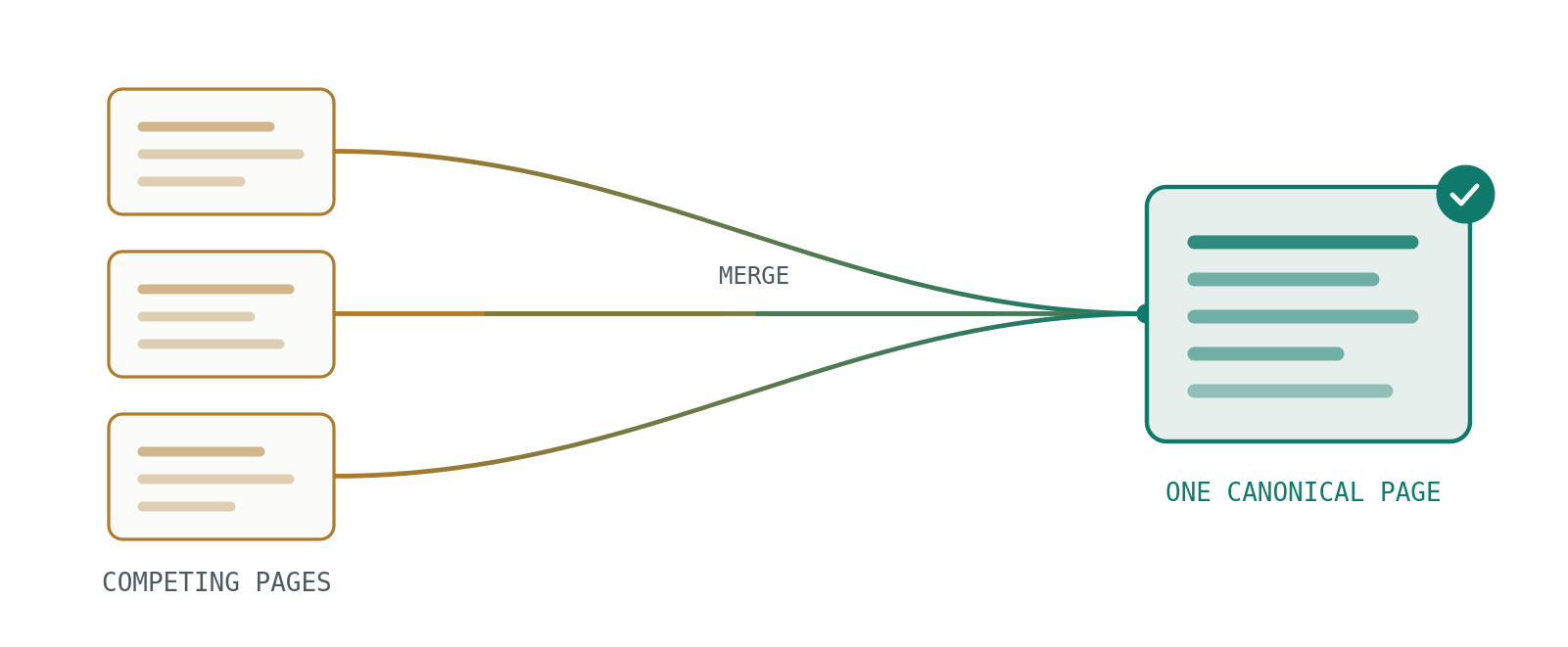
Several weak pages become one page strong enough to win the position.
A few other patterns point the same way:
- Several thin posts circling one subject, none of them the obvious best answer.
- A new article that never gains traction because an older one already covers the ground.
- A cluster of pages with almost identical titles and headings.
- Impressions spread across many URLs for one query, with clicks landing on none of them.
When to merge
Merge when the pages are really answering the same question for the same kind of reader. If a searcher would be satisfied by either one, you have a single job disguised as several.
A few conditions make consolidation the right call:
- The pages target the same search intent, not just the same keyword.
- Neither ranks well alone, or one clearly outperforms and the others only dilute it.
- The topics overlap so much that a reader would never need both.
- Combined, the pages would make a more complete resource than any one of them.
- When most of these hold, one authoritative page will almost always beat the fragments.
The rule of thumb Consolidate pages that compete, and protect pages that merely coexist. Sharing a keyword is not the same as fighting over one. |
When to keep them separate
Merging is not always the answer, and forcing unrelated pages together does real damage. Two pages can share a keyword and still deserve to live apart.
Keep them separate when the intent differs. A tutorial and a product comparison might both mention the same tool, yet they serve readers at different moments and each deserves to stand on its own.
Keep them separate when they map to different funnel stages, speak to different audiences, or already rank well for different queries. If both pages are winning, leave them alone. Consolidation is a fix for competition, not a tidiness exercise.
Merge or keep separate
| Situation | Better call |
|---|---|
| Two posts rank for the same query and keep swapping | Merge |
| Both cover one topic, but one is thin and stale | Merge |
| A beginner guide and an advanced deep dive on one topic | Keep separate |
| Pages target different intent, such as how to versus best of | Keep separate |
| Both rank well for different, distinct queries | Keep separate |
A short checklist before you merge
A merge is hard to reverse once redirects are live, so it pays to confirm a few things first. Run through this list before you touch anything.
- You have confirmed the pages target the same intent, not just the same keyword.
- You have picked the single URL that will survive, and you can defend the choice.
- You have exported the current rankings, clicks, and backlinks for every page involved.
- You have saved a copy of each page, so nothing is lost if you need to revisit it.
- You have listed every internal link that points at the pages you plan to retire.
- You know where each old URL will redirect, and it is a closely related page.
- If any line is still open, the merge is not ready. The few minutes this takes are far cheaper than untangling a rushed consolidation weeks later.

Merging is editorial work. You rebuild one better page from the strongest parts of several, rather than pointing redirects at a winner and hoping.
How to merge, step by step
Once you have decided to consolidate, the order of operations matters. Rushing the redirect before the content is ready is how sites lose rankings.
01 · Pick the page that survives
Choose the URL with the strongest signals: the best rankings, the most relevant backlinks, and the cleanest address. This becomes the canonical home for the topic, and everything else will point here.
02 · Combine the best of each page
Pull the strongest sections, examples, and data from the losing pages into the survivor. The merged page should read better than any of its parts, not like the winner with a few paragraphs bolted on.
03 · Redirect the old URLs
Send each retired URL to the survivor with a permanent 301 redirect, which passes the old page's ranking signals to their new home. Google's short reference on 301 redirects is worth reading before you ship a batch. Point each one at the closest relevant page, never at the homepage.
04 · Use a canonical tag when a page must stay live
Sometimes an old page needs to stay reachable for a campaign or an internal reason. In that case, mark the survivor as canonical instead of redirecting, using the methods in Google's guide to consolidating duplicate URLs. This tells search engines which version deserves the credit.
05 · Fix the internal links
Update every internal link that pointed at a retired URL so it targets the survivor directly. Leaning on the redirect alone leaves chains that slow crawling and leak a little value at each hop.
06 · Make the merged page genuinely better
A merge is a chance to raise quality, not just cut the page count. Lead with a clear answer near the top, keep the facts consistent, and show real experience, which is what Google's helpful content guidance has rewarded all along.
Why consolidation matters more in AI search
Search results now include AI generated answers that summarize a topic and cite a handful of sources. When your coverage of a subject is split across competing pages, none of them is the obvious, complete source that a summary would draw from.
One authoritative page is easier for both people and machines to read, quote, and trust. It states a clear answer, keeps its facts consistent, and does not contradict a second version of itself elsewhere on your site.
Google makes the same point plainly. Its guide to optimizing for generative AI features notes that a high quantity of pages does not make a site higher quality, and steers you toward content people find genuinely useful and distinct. Consolidation is one of the fastest ways to move in that direction.
Contradictions are the quiet risk. If two of your pages state different numbers or different advice, any summary of your brand inherits that conflict. Merging removes the contradiction along with the competition.
Mistakes that undo a good merge
Even a well-judged consolidation can backfire in execution. A handful of errors account for most of the damage.
- Merging pages that serve different intent, which strands the readers each one used to satisfy.
- Redirecting removed pages to the homepage, which search engines often treat as a soft error that passes little value.
- Forgetting the internal links, so authority keeps flowing into a dead end.
- Faking freshness by changing the date without changing the substance.
- Shipping every redirect at once, which leaves no clean way to trace what caused a change.
Handle with care Roll out in batches, starting with the lowest-risk merges, and keep a rollback plan you have actually tested. A cleanup should never turn into an incident. |

Record the combined numbers before the merge, then measure the single survivor against that baseline over the weeks that follow.
How to know the merge worked
A consolidation is a bet that one strong page will beat several weak ones. Like any bet, you should record the odds before and check the result after.
Before you merge, note the combined clicks, impressions, average position, and conversions of every page involved. That combined number is your baseline. The merged page has to beat the sum, not just one of the parts.
Then give it time. Rankings often dip for a week or two while redirects settle, before they recover and climb, so do not judge the result on day three.
What to check, and when
| Window | What to check | What good looks like |
|---|---|---|
| First 2 weeks | Redirects resolve and no crawl errors appear. | Old URLs forward cleanly to the survivor. |
| 30 days | Rankings settle for the target query. | Positions steady or improving, with no lost coverage. |
| 90 days | Clicks and conversions against the baseline. | The merged page beats the old combined total. |
Judge only the pages you touched. Site wide traffic moves for many reasons, so tie the result to the merged set and the queries it targets. Annotate the change date in your analytics, so a later reviewer can see cause and effect instead of guessing.
What consolidation looks like in practice
Frameworks land faster with real rows in front of you. Here are a few typical cases and the decision each one deserves.
Four realistic cases
| Pages | What is happening | Decision |
|---|---|---|
| Three posts on email subject lines | All rank poorly for the same term and split the clicks. | Merge into one guide, redirect the rest |
| A pricing page and a pricing FAQ | Each answers a different question well. | Keep separate |
| Two near-identical how-to articles | One is newer, the other holds the backlinks. | Merge, keep the newer copy, redirect the old URL |
| A 2022 trends post and a 2025 trends post | Both earn traffic for their own year. | Keep separate |
Keeping competing pages from coming back
Consolidation fixes the pages you have. It does nothing to stop new duplicates from appearing next quarter, which is how most sites end up needing the same cleanup twice.
The habit that prevents it is simple. Before commissioning a new article, check whether an existing page already owns that intent. If one does, the stronger move is often to deepen it rather than publish a rival beside it.
Give every important topic a clear home and a single owner. When a subject has an obvious canonical page, writers add to it instead of starting parallel versions, and the competition never forms in the first place.

The goal is one clear route to the destination, not several faint tracks that each peter out along the way.
The bottom line
Consolidation is one of the highest return moves in all of content maintenance, and the reason is plain economics. You already paid to research, write, and publish those competing pages. Merging turns that spent effort into a single asset strong enough to finally win, without commissioning anything new.
The whole discipline lives in one distinction: pages that compete versus pages that merely coexist. Competing pages chase the same reader with the same intent and split the reward between them. Coexisting pages share a keyword but answer different questions, and they belong apart. Merge the first kind, and protect the second.
It helps to remember what consolidation is not. It is not a tidiness project, and a smaller page count is not the prize. Removing a page that quietly serves a real purpose is a loss, not a win. The aim is concentration: gathering scattered authority into the pages strong enough to carry it.
When you get it right, the payoff compounds. One clear page attracts links instead of dividing them, holds its ranking instead of trading places with a rival, and gives both readers and AI answers a single source they can trust. The hours you stop spending on decayed duplicates get reinvested in topics with proven demand.
So audit honestly, decide deliberately, and act with care. Merge the pages that compete, keep the ones that coexist, and let one strong page do the job that several weak ones never could.
Discussion 0
More posts

How to Find and Fix Keyword Cannibalization
Keyword cannibalization is what happens when two or more of your own pages chase the same search query. Instead of compe...

How to Find Orphan Pages and Fix Your Internal Linking
Every page on your site should be reachable through at least one link. When it is not, search engines struggle to find i...

How to Refresh Old Blog Posts Without Losing Rankings
Older articles quietly lose traffic as facts age and search habits change. Here is how to update them so they climb back...
Please log in or create an account to join the discussion.