Guide, Hub, or Definition: Choosing the Right Pillar Page Format

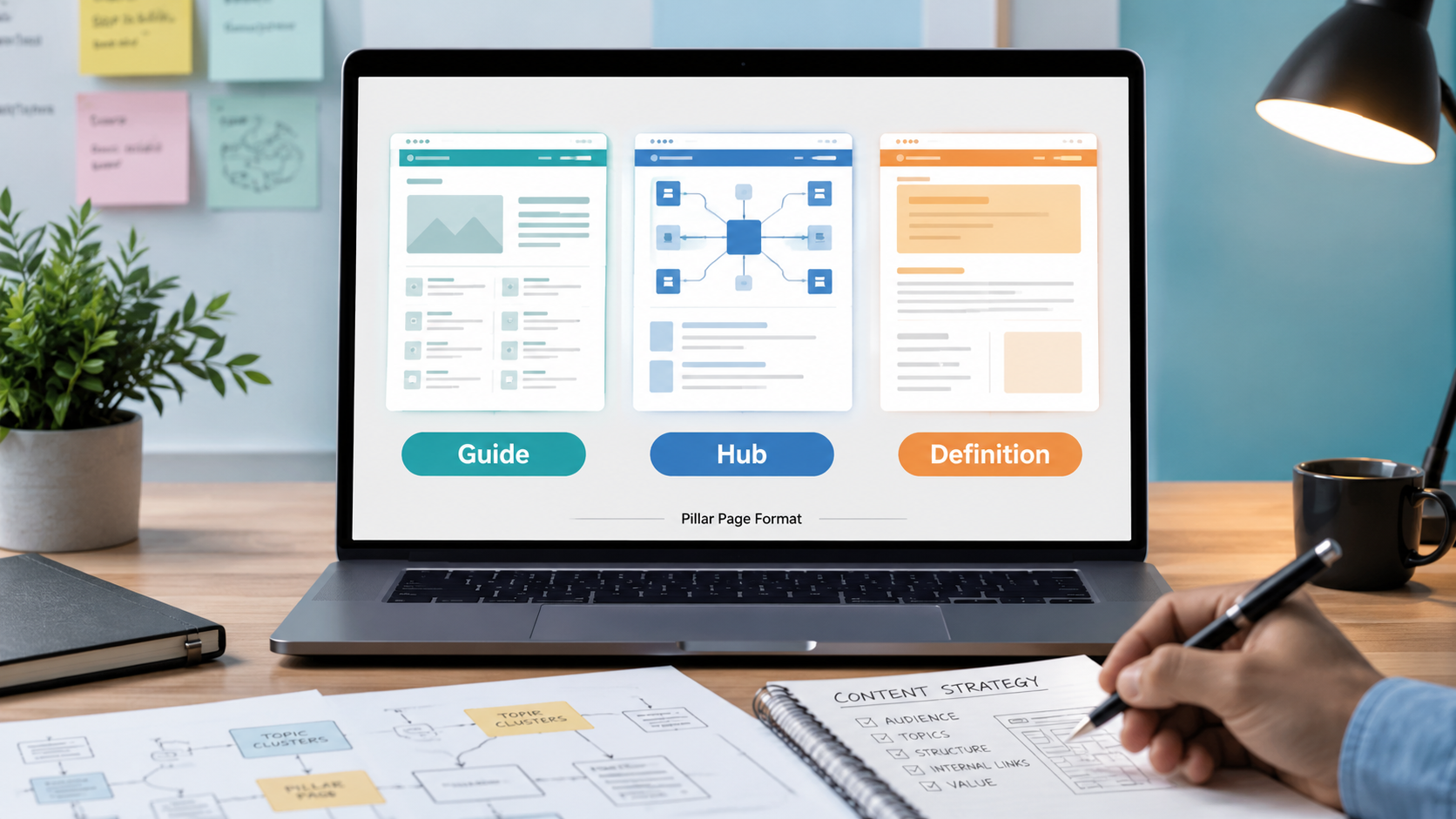
Three formats dominate the pillar page world, and most teams pick one by habit rather than by fit. This breakdown compares all three in depth so you can match the format to the search intent, not the other way around.
Every pillar page conversation eventually hits the same fork in the road. You have picked the topic, you have mapped the cluster, and then someone asks the question that stalls the whole project: what should the page actually look like?
It sounds like a design question. It is not. The format of a pillar page decides which keywords it can realistically rank for, how long it needs to be, how it links to the rest of your site, and how much maintenance it will demand a year from now. Choose the wrong format and you can write ten thousand excellent words that never quite match what searchers wanted.
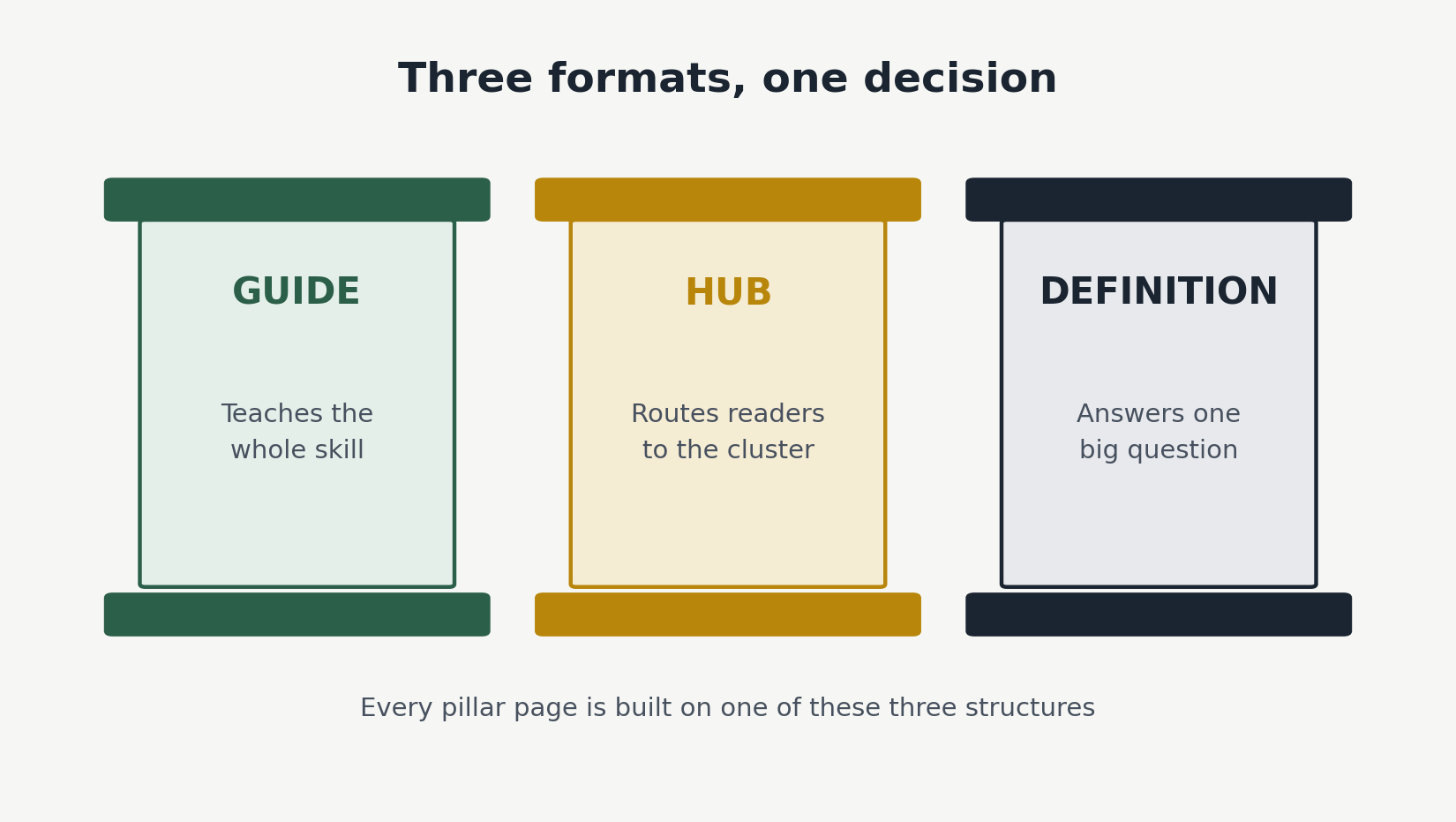
The three pillar page formats and the single job each one performs
Before comparing the three formats, it helps to be precise about the foundation underneath them. A pillar page is the public face of a content pillar, and if that underlying concept is fuzzy for you or your team, this explanation of what a content pillar is and everything it quietly stands for is worth reading first, because every format decision below assumes that groundwork is in place.
With that settled, let us meet the three contenders properly.
Format One: The Guide Pillar Page
FORMAT PROFILE
The guide is the marathon runner of pillar pages. It takes a reader who knows little about a topic and walks them through it in a deliberate sequence: chapter one builds into chapter two, chapter two sets up chapter three, and by the end the reader can actually do the thing. Think "The Complete Guide to Email Deliverability" or "SEO for SaaS Startups: The Full Playbook."
| Typical length | 4,000 to 10,000 words on a single URL, usually with a sticky table of contents. |
| Search intent served | Learning intent. Queries like "how to," "guide to," "tutorial," and "step by step." |
| Reader relationship | The reader stays on the page for a long session. Depth of engagement matters more than clicks outward. |
| Linking behavior | Internal links are supplementary. The page could stand alone even if every link were removed. |
| Best suited for | Skill based topics with a natural beginning, middle, and end, where sequence genuinely matters. |
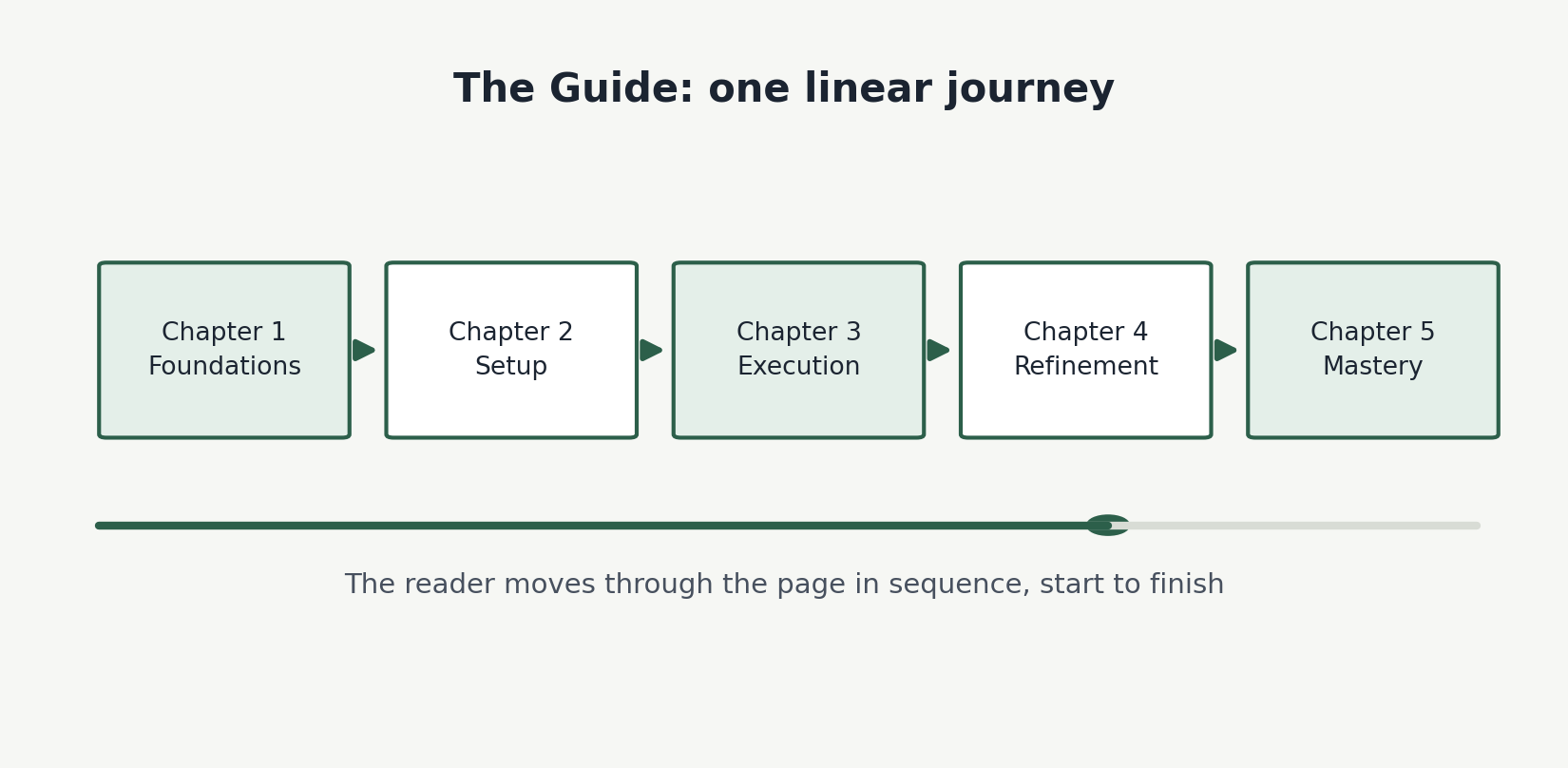
A guide moves the reader through one continuous sequence on a single page
Why guides win
Guides earn backlinks better than any other pillar format. A genuinely complete guide becomes the resource other writers cite when they do not want to explain something themselves. That citation gravity compounds over time and lifts the entire domain.
Guides also dominate long, specific queries. Because a single guide covers dozens of subtopics in real depth, it can rank for hundreds of long tail variations without any one of them being the explicit target.
Where guides struggle
The weakness is weight. A 9,000 word guide is expensive to produce, slow to update, and intimidating on mobile, where most reading now happens. Research from the Nielsen Norman Group on how people read online has shown for years that readers scan rather than read, which means a guide lives or dies on its formatting: descriptive subheadings, generous white space, and a navigation system that lets a scanner drop into exactly the section they need.
Guides also blur the line with their own cluster content. If the guide explains a subtopic fully, the dedicated cluster article on that subtopic has nothing left to say, and the two pages start competing with each other in search results.
Format Two: The Hub Pillar Page
FORMAT PROFILE
The hub flips the guide's logic. Instead of teaching everything itself, it introduces each subtopic in a short, useful summary and then routes the reader to a dedicated article for the full treatment. The hub is a table of contents with a soul: it frames the topic, shows how the pieces relate, and sends authority flowing outward through its links. Learning platforms and documentation sites lean on this format heavily.
| Typical length | 1,500 to 3,000 words, with each section deliberately kept brief. |
| Search intent served | Navigational and exploratory intent. Queries like "resources," "topics," and broad category head terms. |
| Reader relationship | The reader arrives, orients, and clicks deeper. A short session on the hub is a success, not a failure. |
| Linking behavior | Internal links are the entire point. The page exists to distribute readers and authority to the cluster. |
| Best suited for | Wide topics with many parallel subtopics where no single reading order is correct. |
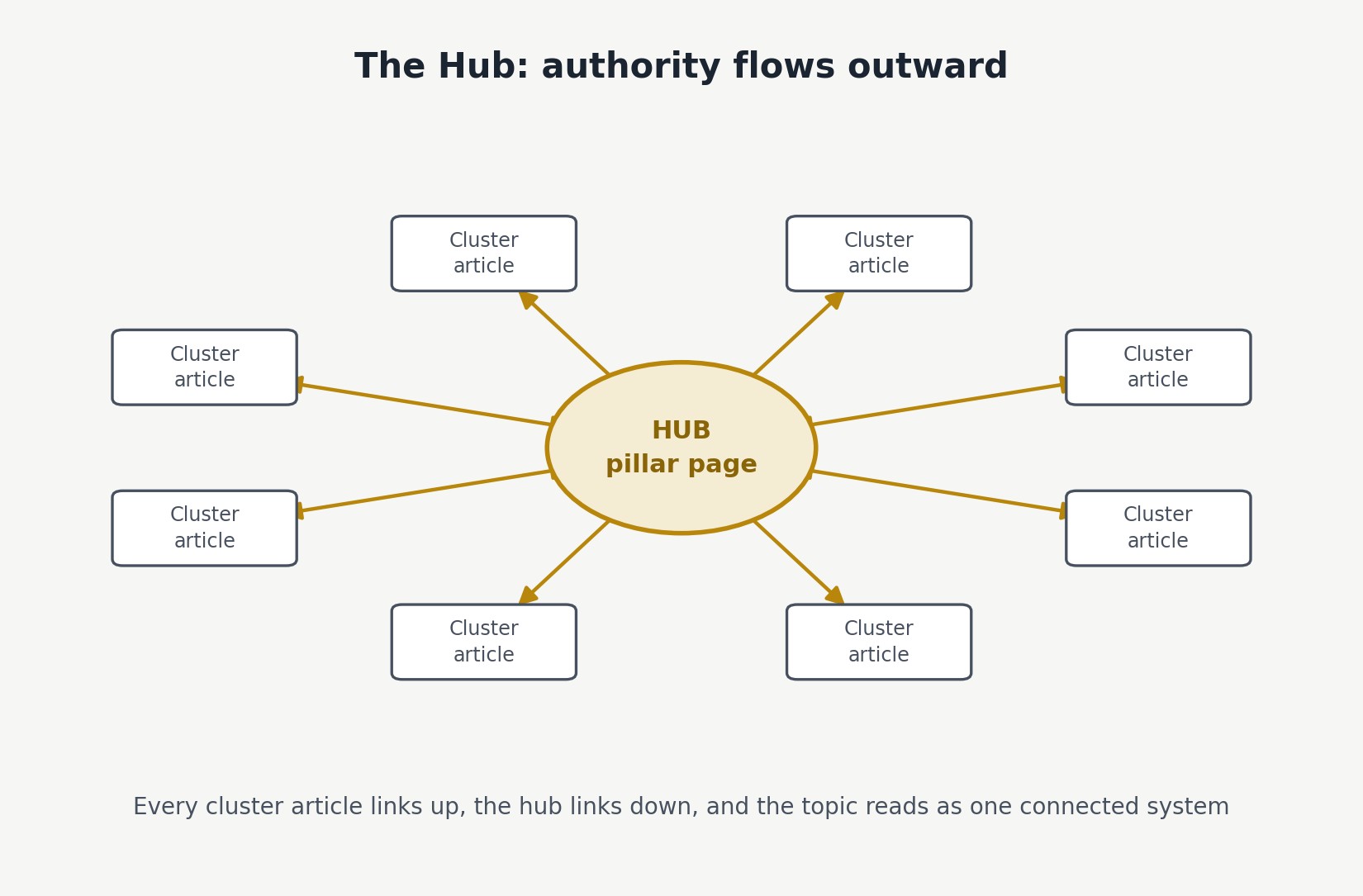
The hub sits at the center of its cluster and passes authority in both directions
Why hubs win
Hubs are the cleanest expression of the pillar and cluster model. Every cluster article links up to the hub, the hub links down to every article, and search engines get an unmistakable signal that this section of the site owns the topic. When you publish a new cluster piece, you add a section to the hub and the architecture absorbs it instantly.
Hubs are also the easiest format to maintain. Because each section is a summary rather than a full lesson, updates usually happen in the cluster articles while the hub stays stable for years.
Where hubs struggle
A hub is only as strong as its cluster. Launch a hub with four thin supporting articles and you have built a beautiful lobby for an empty building. Hubs also rarely attract backlinks on their own, since nobody cites a directory. And if the summaries are lazy, the page reads like a link list, which is precisely the kind of low value aggregation that Google's guidance on creating helpful content warns against. Every hub section has to deliver a real insight before it asks for the click.
Format Three: The Definition Pillar Page
FORMAT PROFILE
The definition page, sometimes called a "what is" page, targets one enormous conceptual query and answers it better than anyone else. "What is zero trust security?" "What is revenue operations?" The page opens with a crisp, quotable definition, then expands outward: why the concept matters, how it works, how it compares to neighboring concepts, and where to go next.
| Typical length | 1,500 to 3,500 words, front loaded so the core answer appears immediately. |
| Search intent served | Informational intent at its purest. Queries like "what is," "meaning," "definition," and "explained." |
| Reader relationship | Many readers get their answer in ninety seconds. The page converts a fraction of them into deeper exploration. |
| Linking behavior | Moderate. Links appear where a reader would naturally want more, especially in comparison and next step sections. |
| Best suited for | Emerging or jargon heavy fields where a single term carries huge search volume. |
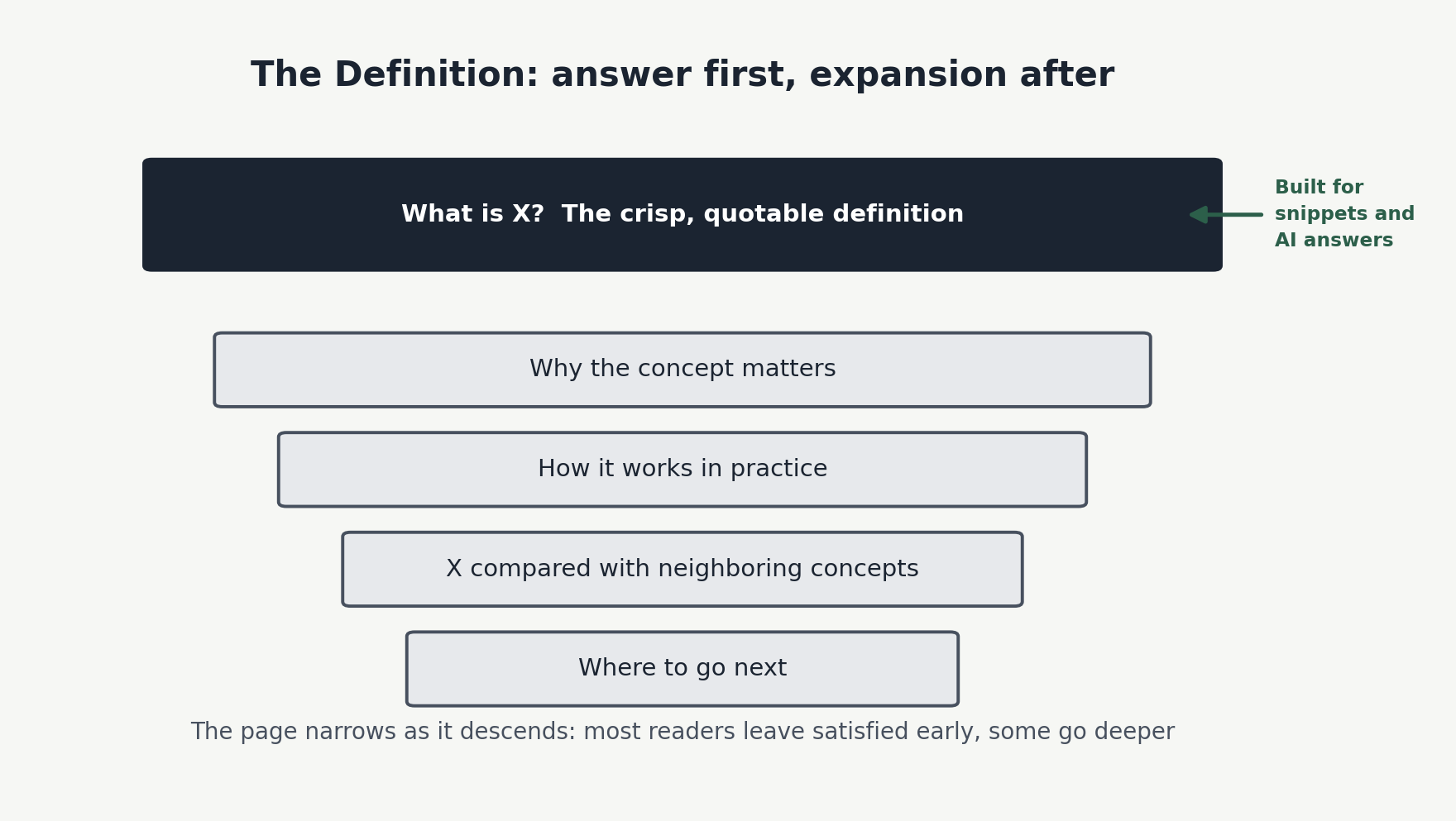
A definition page leads with the answer and narrows as the reader descends
Why definition pages win
Definition pages are the sniper rifles of the three formats. They target one keyword with massive volume, and when they hit, they capture featured snippets, AI answer citations, and voice results, because their structure mirrors exactly how answer engines want information packaged: a tight definition first, expansion after.
They are also the fastest format to ship. A strong definition page can go from brief to published in a week, which makes it the ideal first move into a new topic area while the larger cluster is still in production.
Where definition pages struggle
Volume concentration is also the risk. A definition page tied to one term rises and falls with that term's popularity, so it pays to check the trajectory in Google Trends before committing, because a fading term drags the page down with it. Definition pages also face brutal competition, since dictionaries, encyclopedias, and every major publisher in your space will contest the same query. Winning usually requires something extra: original examples, proprietary data, or a perspective the generic answers lack.
The Full Comparison, Side by Side
Here is how the three formats stack up across the dimensions that actually drive the decision. Read down the column that matches your situation rather than across every row.
| DIMENSION | GUIDE | HUB | DEFINITION |
|---|---|---|---|
| Core job | Teach a complete skill in one continuous resource | Organize a topic and route readers to deeper pages | Answer one major conceptual question decisively |
| Primary intent | How to learn or do something | Explore everything a topic contains | Understand what something means |
| Typical length | 4,000 to 10,000 words | 1,500 to 3,000 words | 1,500 to 3,500 words |
| Time to publish | Slowest, often four to eight weeks | Fast for the page itself, but the cluster must exist first | Fastest, often one to two weeks |
| Backlink potential | Highest, since complete guides become citation magnets | Lowest, since directories are rarely cited | Moderate, strongest when the definition becomes the canonical one |
| Featured snippet fit | Moderate, wins scattered snippets across many subtopics | Low, structure does not match answer formats | Highest, built precisely for snippet and AI answer capture |
| Cluster dependence | Low, the page stands alone | Total, the page is meaningless without the cluster | Moderate, benefits from a cluster but survives without one |
| Maintenance load | Heavy, long pages age in many places at once | Light, updates live mostly in cluster articles | Moderate, definitions and examples need periodic refreshing |
| Ideal topic shape | Sequential topics where order matters | Broad topics with many parallel branches | Concept topics anchored to one dominant term |
| Biggest failure mode | Cannibalizing its own cluster articles | Launching before the cluster is ready | Losing to encyclopedias on a contested query |
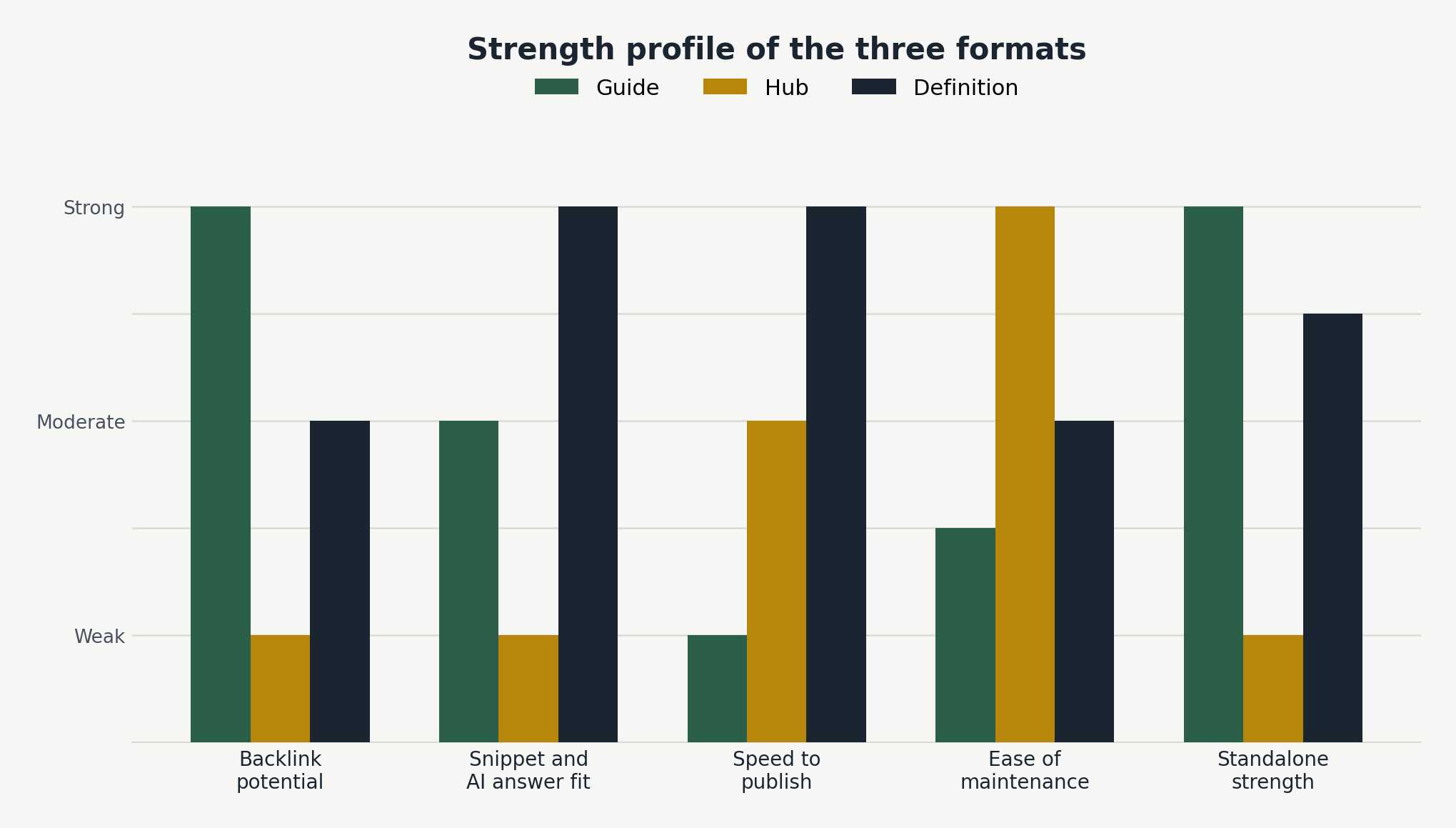
Each format is strong exactly where the other two are weak
The format is not a stylistic preference. It is a promise to the searcher about what kind of page they are about to open, and rankings reward the pages that keep that promise.
A Three Question Decision Path
Strip away the theory and the choice comes down to three questions, asked in order. Answer them honestly and the format usually picks itself.
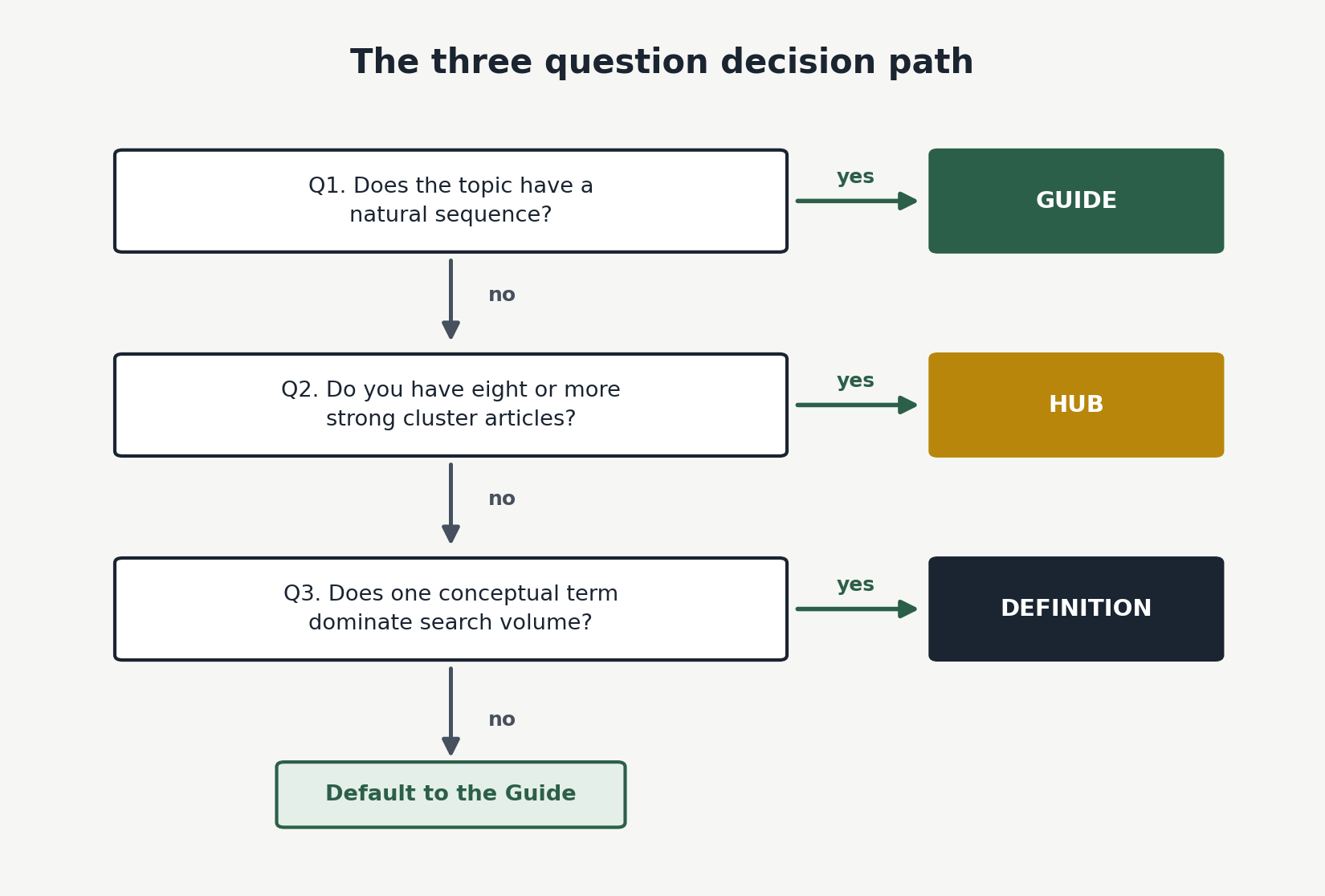
Run the three questions in order and stop at the first yes
Question one: does the topic have a natural sequence?
If a beginner must learn step one before step two makes sense, the topic wants to be a guide. Sequence is the guide's home turf and neither of the other formats can replicate it. If the subtopics are parallel rather than sequential, move to question two.
Question two: do you already have, or will you soon have, eight or more strong cluster articles?
A yes points firmly at the hub, because the hub converts an existing library into a coherent, crawlable topic architecture. A no removes the hub from contention for now, since a hub without a cluster is an empty shell. Move to question three.
Question three: is there one conceptual term with dominant search volume at the center of the topic?
If a single "what is" query towers over everything else, build the definition page and let it plant your flag while the rest of the cluster grows. If no single term dominates, circle back to the guide, which remains the strongest default when the signals are mixed.
The Quiet Fourth Option: Evolving Between Formats
Here is the part most format debates miss: the choice is not permanent. The smartest content teams treat the three formats as stages rather than silos.
A common evolution starts with a definition page, shipped early to claim the core term. As cluster articles accumulate around it, the page gains summary sections with outbound links and gradually behaves more like a hub. Later, if the topic proves durable, the team publishes a standalone guide targeting the "how to" side of the same subject, linked from the hub like any other cluster piece.
The reverse path exists too. A sprawling guide that has grown unwieldy can be broken apart: each chapter becomes its own cluster article, and the original URL is rebuilt as a hub that preserves the accumulated backlink equity while fixing the mobile experience. This restructuring is one of the highest leverage refreshes available to a mature content library, precisely because the authority already exists and only the architecture changes.
So when someone on your team frames the decision as guide versus hub versus definition, the more useful framing is usually this: which format is right for this topic, at this stage, with the cluster we have today?
Format Mistakes That Keep Pillar Pages From Ranking
Building a hub and calling it a guide
A page titled "The Complete Guide to X" that consists of twelve short blurbs and twelve links breaks its promise in the first scroll. Searchers bounce, engagement signals sink, and the mismatch between title and format quietly caps the page's ceiling.
Writing a guide when the query wants a definition
If the search results for your target term show short, definition led pages, an 8,000 word tutorial is answering a question nobody asked. Study the current results before drafting a single outline, because the ranking pages are the clearest available record of what the intent actually is.
Letting the pillar and the cluster say the same things
This is the guide format's chronic illness. The fix is a coverage contract: the pillar explains each subtopic to roughly twenty percent depth and the cluster article owns the remaining eighty. Write that boundary into the brief for both pages and cannibalization largely disappears.
Choosing a format because a competitor did
Your competitor's hub may exist because they have sixty cluster articles and you have six. Formats do not transfer between sites with different libraries, different authority, and different audiences. Borrow the topic if you like, but run the three question path yourself.
The Verdict
There is no universally best pillar page format, but there is always a best format for a specific topic at a specific moment. Guides win on sequential, skill based topics and pull the most backlinks. Hubs win on broad topics backed by a deep cluster and create the cleanest site architecture. Definition pages win on concept heavy queries and plant a flag faster than anything else.
Pick the format that matches the intent, honor the promise the format makes, and revisit the choice as your cluster matures. The teams that treat format as a strategic decision rather than a template default are the ones whose pillar pages still rank three years after publication.
Discussion 0
More posts
How to Find and Fix Keyword Cannibalization
Keyword cannibalization is what happens when two or more of your own pages chase the same search query. Instead of compe...
How to Find Orphan Pages and Fix Your Internal Linking
Every page on your site should be reachable through at least one link. When it is not, search engines struggle to find i...
Content Consolidation: When to Merge Competing Articles
When two or three of your own pages chase the same topic, they compete with each other instead of the rest of the web. H...
Please log in or create an account to join the discussion.