Content Pillars vs Content Formats: Don't Confuse the Topic With the Medium


Half of all broken content strategies trace back to one category error: treating "video" like a topic and "our topic" like an afterthought. This is the untangling.
AXIS ONE: THE TOPIC Content Pillar A subject territory you commit to owning: the question space your audience keeps returning to. Answers WHAT you talk about. Lives for years. Example: home coffee brewing. | AXIS TWO: THE MEDIUM Content Format A container the topic travels in: article, video, podcast, carousel, email, webinar. Answers HOW it reaches people. Swappable per channel. Example: a 40-second vertical video. |
Ask a struggling content team to name their pillars and listen carefully to the answer. If it comes back as "blog, video, and the newsletter," you have just heard the whole problem in six words. Those are not pillars. Those are containers. The team has organized its entire strategy around the shapes content arrives in, and left the actual subject matter, the only thing audiences form loyalty to, undefined and drifting. It is the equivalent of a restaurant whose menu categories are "plates, bowls, and cups."
This confusion is not a beginner mistake; it is embedded in how the industry talks. Job titles are format titles: video producer, podcast host, newsletter writer. Tools sort by format. Calendars sort by format. Platforms are formats with login screens. Everything in a content team's daily environment is organized along the medium axis, so it takes a deliberate act of strategy to keep the topic axis primary. This article is that act, done thoroughly: precise definitions of both axes, the environmental reasons they blur, a gallery of the confusions as actually spoken, a full anatomy comparison, the matrix showing how the two axes multiply rather than compete, the correct order of operations, and the failure profiles of getting the order wrong.
The pillar axis carries more meaning than a single definition can hold, and it is worth absorbing in full before the comparison starts: a pillar is a standing commitment with a hub, supporting pieces, deliberate wiring, and a years-long clock, a framing unpacked properly in this piece on what a content pillar is and everything it quietly stands for. Every argument below assumes that fuller definition, because a pillar reduced to "a theme we like" blurs into formats far too easily.
Why Smart Teams Make This Category Error
The confusion is environmental, not intellectual, which is why intelligence alone never fixes it.
Nobody confuses topics with media in ordinary life. No one thinks "phone call" is a subject or believes "paperback" is what a novel is about. The confusion appears specifically in content marketing, and it appears because three forces in the working environment all push the format axis into the foreground at once, every single day, while nothing in the environment pushes back.
The first force is organizational. Teams are hired, titled, and budgeted by format: a video person, a social person, a blog person. When headcount is format-shaped, planning becomes format-shaped, because each person's natural question is "what should I make in my medium this week," not "what does our topic need next." The second force is instrumental. Every tool in the stack, from the CMS to the scheduler to the analytics suite, presents format as the primary dimension: posts here, videos there, emails in a third silo. You manage what your tools display, and the tools display containers. The third force is cultural, and it is the deep one: the industry inherited a century of media thinking in which the medium genuinely was the strategic decision. Marshall McLuhan's famous claim that the medium is the message is a real insight about how forms shape perception, but content teams quietly upgraded it from "the medium shapes the message" to "the medium can replace the topic," which is not what anyone argued and not how audiences behave.

Audiences, meanwhile, live entirely on the topic axis. Nobody subscribes to "video" in general; they subscribe to a creator because of what the videos are reliably about. Podcast listening keeps growing as a behavior, as the Pew Research Center's audio and podcasting fact sheet tracks year over year, but no listener follows the format itself; every subscription is a bet that a specific show will keep covering a specific territory. The strategic consequence is stark: your team's environment is organized along the axis your audience is indifferent to, and indifferent to the axis your audience actually uses to decide whether you matter. Left uncorrected, drift toward format-first thinking is not a risk; it is the default.
The Confusion, As Actually Spoken
Four sentences from real planning meetings, each hiding the category error in plain sight, each corrected in full.
Category errors are easiest to catch in the wild, in the exact phrasings teams use, because the phrasings feel completely reasonable in the room. Each entry below pairs an overheard line with its correction, and the corrections do more than swap words: each explains what the speaker actually needs, which is always a real question the format-first framing was hiding.

OVERHEARD
"Our three content pillars are the blog, YouTube, and the newsletter."
THE UNTANGLING
This sentence names zero topics. It lists three shipping containers and calls them cargo. A reader hearing this cannot tell what the company knows about, cares about, or wants to be found for, and neither, usually, can the team.
The hidden real question is: what subjects will all three of those channels reliably cover? Answer that, and the blog, YouTube, and the newsletter become what they actually are: three delivery routes for the same two or three topic commitments, each route carrying the topics in the shape that suits it.
OVERHEARD
"We need a TikTok strategy."
THE UNTANGLING
What is actually needed is a decision about whether your existing topics have an audience on that platform, and if so, what shape they must take to survive there. A "TikTok strategy" with no topic underneath it is a plan to make short vertical videos about nothing in particular, which is how brand accounts end up chasing trends that have no connection to what the company sells or knows.
The corrected sentence is: "We need to decide which of our pillars translates to short vertical video, and what our angle looks like at 40 seconds." Same platform, same team, completely different output, because now every video inherits a subject.
OVERHEARD
"Long-form is one of our pillars this year."
THE UNTANGLING
Long-form is a length, and length is a property of a format, two levels removed from being a topic. Committing to "long-form" commits the team to a word count in search of a reason. The predictable result is padded articles, because the commitment is to the shape, and shape can always be filled.
The real instinct underneath is usually sound: the team senses its topics deserve deeper treatment than they are getting. The corrected commitment is depth on a named territory: "This year we make our coverage of X the most thorough available." Depth then earns its length instead of length impersonating depth.
OVERHEARD
"The podcast isn't performing, so we're cutting that pillar."
THE UNTANGLING
This sentence is about to make two mistakes at once. If the podcast is a format carrying real topics, cutting "the pillar" abandons the topics along with the medium, when the diagnosis may only implicate the medium: wrong format for this audience, wrong production quality, wrong distribution. The topics might thrive as articles or video.
The corrected diagnosis separates the axes before deciding: is the subject failing to attract anyone in any format, or is this container failing to deliver a subject that performs elsewhere? The first finding retires a pillar. The second one retires a format and re-homes its topics. Confusing them means firing the message for the crimes of the medium.
The Full Anatomy: Two Different Kinds of Thing
Pillars and formats differ on every strategic dimension that matters, which is exactly why they cannot substitute for each other.
The deepest way to see that pillars and formats are different kinds of thing, not just different words, is to run them through the same set of strategic questions and watch the answers diverge on every single row. Read the table one dimension at a time. The lifespan row explains why retiring them feels so different. The loyalty row explains why audiences follow you across formats but abandon you across topics. The failure row is the one to bring to your next planning meeting, because the two failure modes require opposite responses, and teams that cannot tell the axes apart routinely apply the wrong one.
Pillar vs Format Across Ten Dimensions
| DIMENSION | CONTENT PILLAR (THE TOPIC) | CONTENT FORMAT (THE MEDIUM) |
|---|---|---|
| Question it answers | What do we talk about, and what do we want to be known for? | How does this idea reach people on a given channel? |
| Chosen based on | Audience demand, right to win, and distance to revenue | Channel norms, audience consumption habits, and production capacity |
| Natural lifespan | Years; retired only when demand or the business changes | Trend-cyclical; formats rise, mutate, and fade with platforms |
| Unit of planning | A subtopic map and a query map owned for the long term | A production template: length, structure, cadence, specs |
| What loyalty attaches to | This axis; audiences follow subjects and the people reliable on them | Almost nothing; nobody is loyal to "carousel" as a shape |
| Compounding behavior | Compounds: pieces interlink, authority accrues, the territory deepens | Does not compound on its own; a format is only as good as its last piece |
| Success metric lives at | Cluster level: share of the topic, cluster traffic, influenced pipeline | Piece and channel level: completion rate, CTR, engagement per post |
| Who should own it | A strategist or editor accountable for the territory | A producer or channel specialist accountable for the craft |
| What failure means | The bet was wrong: no demand, no right to win, or no revenue path | The container was wrong: poor channel fit, craft, or distribution |
| Correct response to failure | Retire or rebuild the territory; re-home nothing, the subject itself failed | Swap the container and keep the topics; the subject was never on trial |
Two rows deserve a second pass because they carry the money. Compounding is the entire economic argument for pillar strategy: topic territories appreciate, because every new piece makes the old ones more findable and more authoritative. Formats cannot do this alone; fifty disconnected videos about fifty subjects are fifty lottery tickets. And the ownership row quietly explains most org-chart dysfunction in content teams: when only format owners exist, the topic axis is owned by no one, and an unowned axis is an undefended one.
The Matrix: Where the Two Axes Multiply
Pillars and formats are not rivals for the same slot in your strategy. They are perpendicular, and the intersection is where all actual content lives.
Everything published sits at the crossing of one pillar and one format: a topic wearing a container. Seeing strategy as this grid, pillars down one side, formats across the top, dissolves the whole confusion, because it becomes obvious that the two axes do different jobs and neither can fill the other's slot. It also unlocks the most underused efficiency in content: one well-researched topic asset can populate an entire row of the grid, each cell reshaped for its medium rather than created from scratch. Media theory calls the ambitious version of this transmedia storytelling, where each medium contributes its distinct strengths to one larger subject, and the everyday marketing version is the same idea at smaller scale: the topic stays constant, the shape adapts, and the research cost is paid once.

Here is one full row of the grid made concrete. The pillar is home coffee brewing, held by a company selling grinders. The subject never changes across the row; everything else does, and the columns show exactly what changes: the job each format performs in the audience journey, what production genuinely costs, how long the asset keeps working, and which metric can honestly judge it. Read down the metric column and notice that no single number could evaluate the whole row, which is precisely why format metrics can never substitute for pillar metrics.
One Pillar, Six Formats: The Coffee Brewing Row
| FORMAT | SHAPE THE TOPIC TAKES | JOB IN THE JOURNEY | WORKING LIFESPAN | HONEST SUCCESS METRIC |
|---|---|---|---|---|
| Pillar article | The complete guide to grind size, ratios, and water, the hub of the cluster | Capture search demand; anchor the territory | Years, with updates | Non-brand organic clicks and rankings for the head queries |
| YouTube video | A 9-minute visual walkthrough of one brewing method from the guide | Demonstrate what text cannot; reach browse audiences | 1 to 3 years | Watch time and subscribers gained from the video |
| Short vertical video | One 40-second myth-bust pulled from the guide's most surprising finding | Introduce the brand to cold audiences | Days | Reach, follows, and profile visits per clip |
| Podcast episode | A 30-minute conversation with a roaster extending the guide's ideas | Deepen trust with the committed audience | Months, long tail | Completion rate and returning listeners |
| Email course | The guide split into five daily lessons with one action each | Convert interest into a durable owned relationship | Evergreen automation | Signups, completion, and replies |
| Live webinar | A brew-along session answering questions the cluster surfaced | Move warm audience toward purchase | One event plus replay | Attendance and product conversions within 30 days |
Notice what the row proves in both directions. Remove the pillar and every cell collapses: six teams making six disconnected things with nothing accumulating. Remove the formats and the pillar is a research document nobody encounters. The axes need each other exactly because they are different kinds of thing, which is the final argument against confusing them: confusion does not merge their strengths, it forfeits both.
The Order of Operations
The axes are equal in importance but not in sequence. Topic decisions must come first, and the procedure below is the sequence in full.
Everything in this article converts into one working rule: decide along the pillar axis before deciding along the format axis, every time, at every scale, from annual planning down to a single post. The reason is dependency, not hierarchy. Format decisions are unanswerable without a topic: you cannot judge whether video "works for you" in the abstract, only whether video suits a particular subject for a particular audience on a particular channel. Run the sequence backwards and every downstream choice is a guess wearing a plan's clothing. The procedure below walks the sequence at the level of an annual or quarterly strategy; steps one through three live on the indigo topic axis, four through six on the orange format axis, and the colored numbering marks the moment strategy hands off to production.

TOPIC FIRST, MEDIUM SECOND: THE SIX-STEP SEQUENCE
RUN AT ANNUAL PLANNING, SANITY-CHECK QUARTERLY
STEP 1 - Fix the pillars before any format is mentioned
Select two to four topic territories using evidence: demonstrated demand, a defensible right to win, and a short path to revenue. Write them as subjects ("payroll compliance for restaurants"), never as containers, and ban format words from this meeting entirely; their presence this early is how the confusion begins.
STEP 2 - Map each pillar's subtopics and queries
Produce the subtopic map and query map that define what the territory contains and what winning it means. This artifact is format-agnostic on purpose: it describes knowledge to be delivered, not assets to be produced, and every format will draw from it later.
STEP 3 - Locate the audience's formats per pillar
Only now does the medium enter, and it enters as research: where does this pillar's audience actually consume, and in what shapes? A developer-tools pillar may live in long text and code walkthroughs; a fitness pillar in short video. The answer belongs to the audience, not to the team's preferences or existing headcount.
STEP 4 - Choose a primary format and one or two satellites per pillar
The primary format is where the pillar's depth lives, usually the format that best captures the pillar's demand. Satellites redistribute that depth into other shapes. Choosing fewer formats done well beats populating every cell of the matrix thinly; empty cells are a plan, not a failure.
STEP 5 - Build the derivation pipeline
Define, in writing, how a primary asset becomes its satellites: the guide yields the video script, the video yields three clips, the research yields the email course. Derivation is where the matrix pays: the expensive thinking is bought once and shipped in every shape the audience uses.
STEP 6 - Assign metrics to the correct axis
Pillar health is judged on cluster-level measures: territory share, cluster traffic, influenced pipeline. Format health is judged on craft measures: completion, engagement, channel growth. Reporting that mixes the axes recreates the confusion this whole sequence exists to prevent, so keep the two reports physically separate.
What Each Wrong Turn Costs
The confusion fails in two directions, and each direction has a recognizable profile, a characteristic victim, and a distinct repair.
There are two ways to get the axes wrong, and they produce opposite-looking teams with the same underlying disease. Format-first teams are the loud failure: busy, visible, everywhere, and forgettable, because constant production with no topic spine means nothing accumulates and no audience knows what they are for. Topic-only teams are the quiet failure: rigorous strategy documents, beautiful subtopic maps, and a publishing reality of one format, usually long articles, regardless of where the audience actually is, because the medium was treated as an afterthought unworthy of strategy. The comparison below puts both profiles side by side so you can locate your own team honestly; most teams are not purely one or the other, but almost every team leans, and the lean predicts the failure.
Format-First vs Topic-Only: The Two Failure Profiles
| TRAIT | FORMAT-FIRST TEAM (LOUD FAILURE) | TOPIC-ONLY TEAM (QUIET FAILURE) |
|---|---|---|
| How planning sounds | "What are we posting this week?" per channel, with topics improvised to fill slots | "What does the territory need?" with the delivery medium assumed, never chosen |
| Output pattern | High volume across many channels, low coherence, nothing references anything | Deep, well-linked material in one format, invisible to everyone outside that format's audience |
| What the audience experiences | A brand that is everywhere and about nothing in particular | A brand that is an authority for the small slice who read, and absent for everyone else |
| Telltale metric signature | Decent per-post engagement, near-zero compounding: traffic resets with every piece | Strong cluster metrics in one channel, negligible reach on every other |
| Root cause | The medium axis colonized planning; no one owns any topic territory | The topic axis colonized planning; format was never treated as a real decision |
| Characteristic quote | "We need to be on that platform" | "Our audience will find the guide" |
| The repair | Run Steps 1 and 2: install pillars above the channels and make every slot inherit a subject | Run Steps 3 through 5: research the audience's formats and build the derivation pipeline |
| Repair difficulty | Harder: requires new strategy and often new ownership, against momentum | Easier: the hard thinking exists; it only needs reshaping into more containers |
The asymmetry in the last row is worth holding onto. A topic-only team is sitting on unshipped value: the research is done, the territory is mapped, and repair is mostly a production exercise. A format-first team has the opposite inventory: enormous shipped volume with no strategic spine to retrofit under it, which is why its repair starts with the uncomfortable planning work it skipped. If you must err while building, err toward the topic axis; it is the recoverable direction.
THE 60-SECOND SELF-DIAGNOSIS
1. Written without container words, what are your pillars?
If the honest answer requires words like blog, video, or newsletter, the format axis is doing the topic axis's job.
2. Who in the org is accountable for a topic, not a channel?
If every content owner in the org chart owns a medium, the topic axis is unowned, and unowned means undefended.
3. Could you kill a format tomorrow without losing a topic?
If retiring the podcast would silently delete a subject from your strategy, topics and containers are fused that should be separate.
4. Does one research effort ship in more than one shape?
If every asset is researched from scratch for its channel, the matrix's main efficiency is being left unclaimed.
5. Do your reports separate territory health from craft health?
If one dashboard mixes cluster metrics with completion rates, the confusion has reached the measurement layer, where it does the most damage.
Two Axes, One Rule
The whole distinction compresses into a sentence you can carry into any planning meeting: pillars are what you refuse to stop talking about, formats are whatever shape that refusal takes this year. Formats will keep churning; platforms rise, lengths shrink, containers mutate every eighteen months, and a healthy team re-decides its formats as often as the audience moves. The topics are the part that must not churn, because they are the only thing the audience is actually attached to and the only asset that compounds. Get the nouns right in your next planning document, topics as pillars, media as formats, decided in that order, and a surprising amount of downstream strategy fixes itself, because half of strategy is refusing to confuse the message with the envelope it arrives in.
Discussion 0
More posts
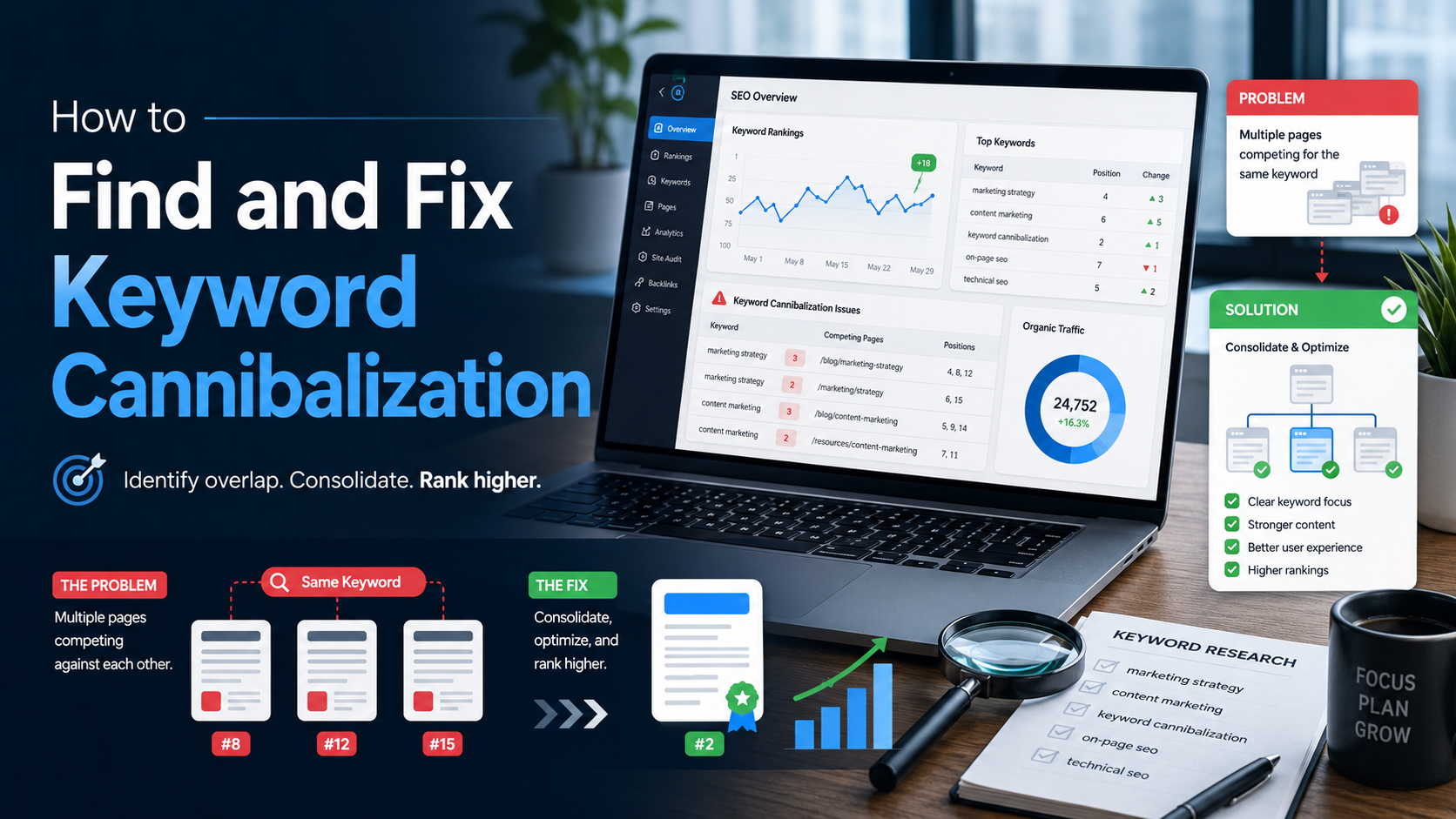
How to Find and Fix Keyword Cannibalization
Keyword cannibalization is what happens when two or more of your own pages chase the same search query. Instead of compe...
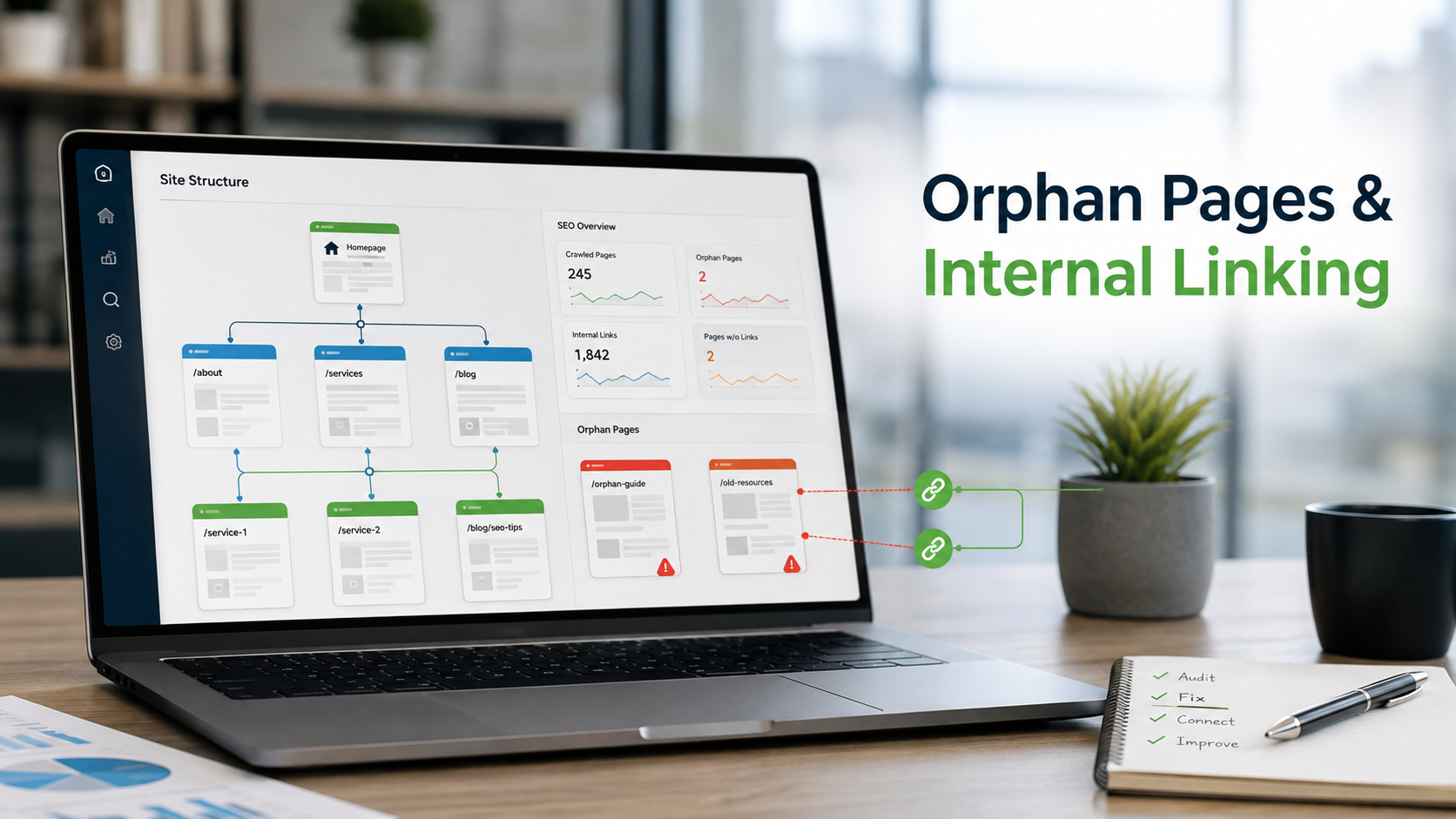
How to Find Orphan Pages and Fix Your Internal Linking
Every page on your site should be reachable through at least one link. When it is not, search engines struggle to find i...
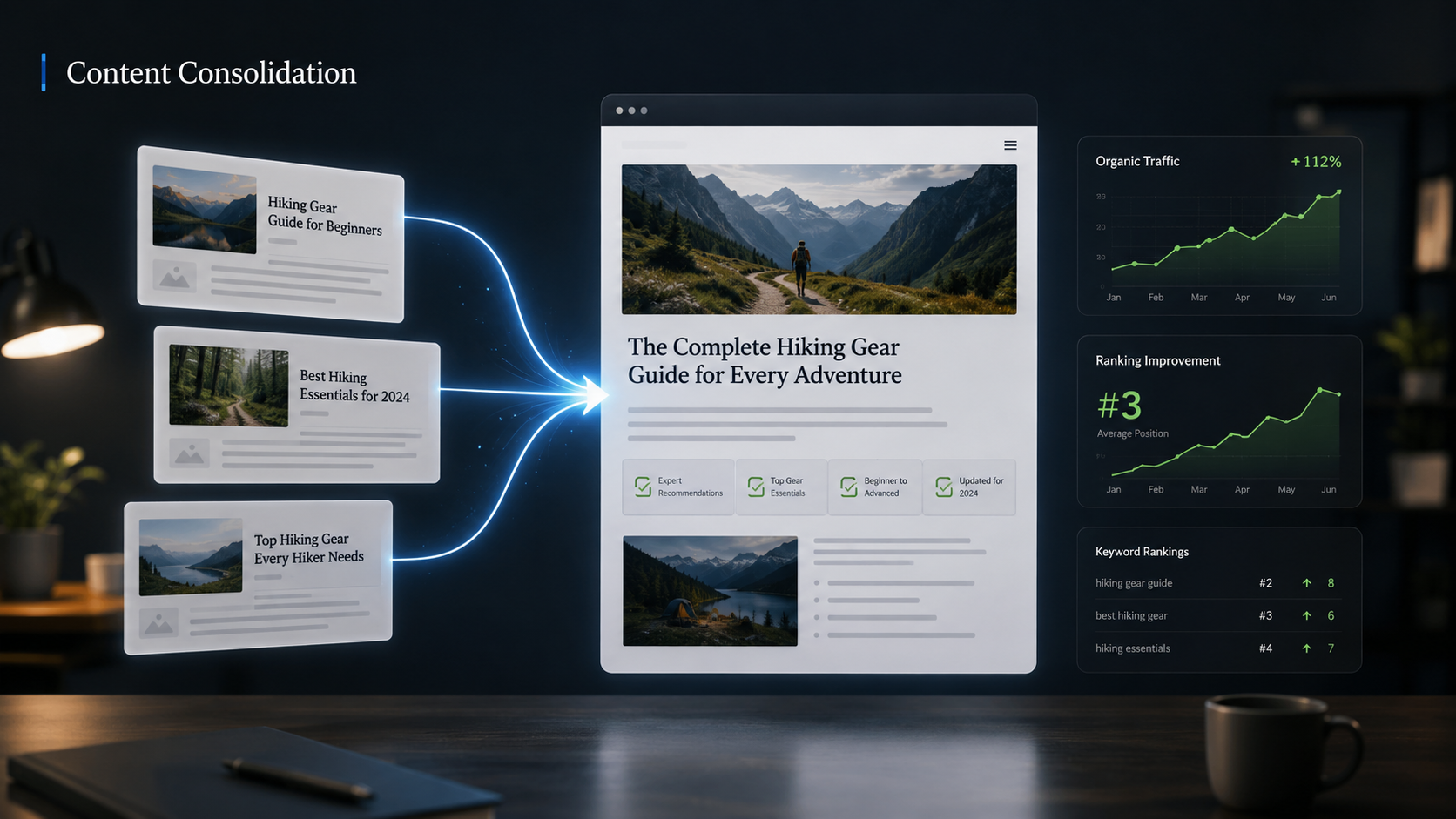
Content Consolidation: When to Merge Competing Articles
When two or three of your own pages chase the same topic, they compete with each other instead of the rest of the web. H...
Please log in or create an account to join the discussion.