Content Pillar Mistakes: 10 Reasons Topic Clusters Fail


Most dead clusters were killed early, quietly, and by their own teams. This is the post-mortem: ten recurring mistakes, the symptoms they produce, and the repairs that actually work.
Topic clusters rarely die of one big wound. They die of ten small, common, well-documented mistakes, and the frustrating part is that teams usually notice the symptoms a year before they diagnose the disease. Traffic flatlines, so more articles get commissioned. The new articles flatline too, so the topic gets blamed, the pillar gets abandoned, and the actual mistake, made back in a planning meeting nobody remembers, is never found.
This article is organized as a failure analysis rather than a tip list. The ten mistakes are grouped by the phase where they are committed: planning, execution, and maintenance. Each one is written up as a file with four parts: the symptom you will observe, the root cause underneath it, how the failure actually unfolds over time, and the fix. After the files come the diagnostic tools: a misdiagnosis table, a master matrix of all ten, a repair-or-rebuild comparison, and a 90-minute triage procedure for a cluster that is already underwater.
Every file also carries a severity stamp, and the three grades mean specific things. Critical means the mistake can kill the cluster on its own, even if everything else is done perfectly; there are four of these, and they demand fixing first. Major means the mistake caps the cluster's ceiling: it will underperform indefinitely but limp along, which makes these failures survivable and therefore long-lived. Sneaky means the mistake produces no alarming signal at all; the numbers look plausible, the work looks fine, and the damage only becomes visible when you go looking with the specific test for it. Severity describes loudness of damage, not cost of repair, and the two are separated deliberately, because as the master matrix will show, the quietest failures are often the cheapest to fix.
One definition before the autopsy begins. Throughout this piece, a pillar is treated as a standing commitment to a topic, with a hub page, supporting pieces, and deliberate internal wiring, not merely a category tag. That framing matters, because half the failures below are only visible once you take the commitment seriously; the full case for that framing is made well in this piece on what a content pillar is and everything it quietly stands for, and everything here builds on it.
FAILURE PHASE ONE | Planning Mistakes: Dead Before the First Draft
Planning failures are the most expensive category because everything built on top of them inherits the flaw. A cluster with a planning defect can be executed flawlessly for a year and still produce nothing, which is exactly why these mistakes survive: the effort looks responsible, so nobody suspects the blueprint. Writers hit deadlines, editors polish drafts, designers ship pages, and every individual contribution is genuinely good, which makes the collective zero feel impossible and sends the blame hunting in the wrong places.
The four files in this phase share a diagnostic signature worth memorizing: the harder the team works, the clearer the failure becomes, because output is the one variable that is demonstrably not the problem. If your cluster has consistent production, reasonable quality, and no results, start your investigation here, not in the execution layer. The other thing these four share is timing: all of them are committed before the first draft exists, in meetings that feel low-stakes precisely because no work has started yet. That is backwards. The pillar selection meeting is the highest-stakes hour of the entire program, and the four files below are the four ways to lose it.

Planning failures hide in plain sight: the wall looks strategic whether or not the evidence exists. Photo: Unsplash
01 - Choosing pillars by brainstorm instead of evidence
SEVERITY: CRITICAL
SYMPTOM Pieces are published on schedule, quality is fine, and traffic never arrives. Idea generation gets harder every month because the topic has no natural pull, and the flatline eventually gets blamed on quality or algorithms rather than on the topic itself.
ROOT CAUSE The pillar list was produced in a meeting, from the inside out: what the team finds interesting, what leadership wants to be known for. A brainstorm can only surface what the team already believes, and the team is not the audience. Nobody checked whether a defined audience keeps asking about the topic anywhere.
HOW IT UNFOLDS This is the founding mistake, and it survives because brainstorms feel like strategy. Content gets produced for questions nobody is asking, so there is no search demand to capture, no community conversation to join, and no reason for anyone to arrive. The team keeps publishing because effort feels like progress, and by the time the pattern is undeniable, a year of production has been spent proving that silence scales.
THE FIX Re-run selection with evidence gates, inverting the direction of proof: instead of asking "what should we say," ask "what are they already asking." Demand must show up in at least two independent sources: search data, community threads, sales calls, support tickets. A free sanity check takes minutes: put the candidate topic into Google Trends and see whether interest exists at all and which direction it is moving. Five minutes of checking can kill a doomed candidate before it costs a year.
02 - Copying a competitor's cluster wholesale
SEVERITY: MAJOR
SYMPTOM Your cluster mirrors the market leader's sitemap, ranks behind them on every query, and has no piece anyone links to, because a better version of everything you publish already exists. The program is permanently in second place on every query it targets.
ROOT CAUSE Teams copy because it looks like de-risking: the leader's cluster clearly works, so replicating its structure should work too. The flaw is survivorship bias applied to content: what you can see and copy is the outline, and what you cannot copy is everything that actually makes it rank.
HOW IT UNFOLDS The invisible assets stay with the original: years of accumulated backlinks, domain authority, brand searches, and dozens of iterations you never witnessed. You end up publishing a slightly worse version of content that already exists, which gives search engines zero reason to rank you and gives readers zero reason to cite you. Nothing you do harder fixes this, because effort was never the missing variable.
THE FIX Change what competitors are used for: not as a template, but as a saturation map showing where not to compete head-on. Build only where you hold an unfair input they structurally cannot copy: proprietary data, practitioner experience, a community, or a defensible contrarian position. If no such input exists for the topic, the topic is theirs; the honest move is choosing different ground.
03 - Scoping the pillar at the wrong altitude
SEVERITY: MAJOR
SYMPTOM Too broad: the pillar is "marketing" or "technology," a category rather than a topic, and the cluster becomes an aimless everything-blog with no center of gravity. Too narrow: the pillar is really one article wearing a strategy costume, and by month three the team is writing filler variations of the same piece, which readers notice before the team does.
ROOT CAUSE Scope was set by naming, not by mapping. Nobody listed the subtopics before committing, so nobody noticed the topic contained either four hundred pieces or four. A name feels like a scope decision, but only a map is one.
HOW IT UNFOLDS The two forms fail differently. The broad version produces pieces that share a label but not an audience: internal links feel arbitrary, and the hub page cannot honestly summarize its own children, so the cluster never coheres into a unit search engines or readers recognize. The narrow version simply runs out: the map was four pieces deep, and every piece after that is repetition wearing a new headline.
THE FIX Apply the 15-to-50 rule before approval: map every subtopic you can defend as a standalone piece, and count. Fewer than 15 means the candidate is a supporting piece inside a bigger pillar; fold it in. More than 50 means it is a category containing several pillars; split it and commit to one. The exact numbers matter less than the discipline of counting before committing.
04 - Building a pillar with no commercial anchor
SEVERITY: CRITICAL
SYMPTOM The cluster wins traffic, sometimes impressive traffic, and produces nothing: no signups, no demos, no deals touched. Every piece ends with a call to action that reads like it wandered in from another website, and when budgets tighten, nobody can defend the line item.
ROOT CAUSE The topic sits three or more logical steps from what the business sells, so the commercial connection must be forced in every single piece. The mistake persists because it is emotionally attractive: distant topics are often the fun ones, and "brand awareness" absorbs any objection raised against them.
HOW IT UNFOLDS The mechanism is attention arithmetic. A reader finishing an article has a few seconds of attention left. A one-step connection, you have this problem and we solve it, fits inside that window. A three-step chain of reasoning does not, so readers feel the pivot as a non sequitur and leave. This is the failure that produces "successful" content programs that get defunded: the traffic is real, and so is the zero underneath it.
THE FIX Count the steps from topic to offer before launch, out loud, with sales in the room, so the distance is undeniable while it is still cheap to act on. One step is ideal, two is workable, three is a veto. For an existing orphan cluster, either build bridging subtopics that pull the territory closer to the offer, or reclassify it honestly as a brand project with brand-project expectations and brand-project budget.
FAILURE PHASE TWO | Execution Mistakes: Right Plan, Broken Build
Execution failures happen to well-chosen pillars, which makes them more tragic and, fortunately, more repairable. The pattern across all three is the same: the cluster exists as a list of articles but was never built as a structure, so the compounding that justifies pillar strategy never switches on. The difference between a stack and a structure is everything here. A stack is pieces that happen to share a topic. A structure is a hub that owns the head query, supporting pieces that each own exactly one question, and deliberate wiring that lets authority and readers flow between them. Pillar strategy's entire economic argument rests on structural effects, so a cluster missing its structure is paying pillar costs for article returns.
The good news is that structural problems have structural fixes, and structure is cheap to change compared to content. Rebuilding one hub page, drawing one query map, and running one linking sprint touch a fraction of the words in the cluster while changing how every word performs. This is why the diagnostic order in the triage later checks planning before execution: if the planning layer is sound, the three files below are the difference between the cluster you have and the cluster you were promised, and all three can usually be cleared inside a single quarter.

05 - Publishing a pillar page that is a table of contents SEVERITY: MAJOR
SYMPTOM The hub page has the worst engagement in the cluster. Visitors bounce off it, it ranks for nothing, and supporting pieces outrank it on the head term it was supposed to own. The flagship of the whole strategy is quietly its weakest page.
ROOT CAUSE The hub was built last, as navigation: a paragraph, a list of links to the supporting pieces, done. The page was supposed to be the flagship, and this approach turns it into a lobby, a room whose only feature is its doors.
HOW IT UNFOLDS Thinness fails in both directions at once. Readers arriving from search find no answers, only doors, so they bounce, and engagement data marks the page as unsatisfying. Search engines see a page with little substantive content attempting to rank for the most competitive query in the entire cluster, and rank a supporting piece or a competitor instead. The whole cluster then inherits the weakness, because every internal link is pushing authority toward a page that cannot use it.
THE FIX Rebuild the hub as the best standalone answer to the head query: a genuine guide that could survive without its cluster, with links to supporting pieces woven in as depth extensions rather than as the content itself. A working test: would anyone bookmark this page if every link were removed? This is the highest-leverage repair on the list, one page whose improvement lifts everything wired to it.
06 - Letting cluster pieces cannibalize each other
SEVERITY: SNEAKY
SYMPTOM Rankings for key queries oscillate as Google swaps which of your pages it shows, and none of the contenders ever climbs. Nothing looks wrong on the surface: every piece is good, every piece is on-topic, and the numbers just mysteriously refuse to move.
ROOT CAUSE Pieces were commissioned by title rather than by target query, so three articles quietly answer the same question from slightly different angles. Nobody owns the map of which piece owns which query, so nobody can even see the collision.
HOW IT UNFOLDS You are splitting your own vote. Google has to choose which of your pages to show for the query and keeps changing its mind, which is exactly the oscillation you see between your own URLs. The authority, links, and engagement that should consolidate onto one strong page are divided across three mediocre contenders, and none of the three can beat a competitor's single focused page. The cluster loses to opponents it could beat unified.
THE FIX Build a one-page query map: every target query assigned to exactly one URL, giving each page exclusive ownership of its question. Where overlaps exist, consolidate the weaker pages into the strongest with redirects, so their equity transfers instead of evaporating. Then add the map check to the brief template, so no future piece can recreate the collision.
07 - Leaving internal links to chance
SEVERITY: CRITICAL
SYMPTOM Crawls show orphan pieces nothing points to, a hub page most of its own cluster never mentions, and readers who land on one article and leave, because there is no path to a second. Three predictable defects, all invisible until someone actually crawls.
ROOT CAUSE Linking was treated as a stylistic garnish, something writers add if a phrase happens to remind them of another article. But in a cluster, links are the load-bearing structure: how authority flows to the hub, how search engines understand the pages as a unit about one topic, and how a reader who liked one piece finds a second. Google's own SEO starter guide is blunt that crawlable internal links are how pages are found and understood in context.
HOW IT UNFOLDS Orphans are effectively invisible: crawlers barely find them and readers never do. A weakly referenced hub starves, because the flagship page receives none of the equity its cluster generates. Reader sessions dead-end after one piece. The cluster performs like a pile of unrelated articles, because structurally that is what it is, and no amount of additional publishing fixes wiring.
THE FIX Convert linking from taste into a rule, then audit it. Minimum wiring: every piece links up to the hub and across to at least two siblings with descriptive anchors, and the hub links down to every piece. Run a one-time retro-linking sprint on the existing cluster before publishing anything new; crawlers re-read repaired structure quickly, which is why this critical failure is also the cheapest and fastest to fix.
FAILURE PHASE THREE | Maintenance Mistakes: The Slow Deaths
Maintenance failures kill clusters that were chosen well and built well, which is why they are the least forgivable and the least noticed. Nothing dramatic happens; the asset simply stops being tended, and compounding runs in reverse just as quietly as it ran forward. This is the phase where the enemy is not a bad decision but the absence of decisions: no one chose to abandon the cluster, no one chose to measure the wrong unit, no one chose to let sixty pieces rot. The calendar just filled with newer things, and the pillar slid off it.
What makes these three files structurally different from the first seven is that they cannot be fixed once. Files 01 through 07 are defects you repair and they stay repaired; files 08 through 10 are entropies you hold back with recurring habits, and the moment the habit lapses, the failure resumes. That is why every fix in this phase installs a clock rather than a patch: a protected monthly cadence, a quarterly cluster review, an annual gardening pass. If your organization is good at projects and bad at rituals, this phase is where your clusters will die, and knowing that in advance is half the defense.

08 - Abandoning the cluster after launch quarter
SEVERITY: CRITICAL
SYMPTOM A burst of eight pieces at launch, then silence. Impressions that were climbing flatten around month five, and the cluster fossilizes at 30 percent of its mapped subtopics, permanently sub-scale.
ROOT CAUSE This failure is organizational, not editorial. The pillar was resourced as a campaign, with a start, a burst of energy, an announcement, and an end, instead of as a commitment. When the launch energy ran out, the publishing queue moved on to the next shiny initiative.
HOW IT UNFOLDS Pillar economics only work through compounding, and compounding needs continuous feeding. Search engines stop seeing a growing, tended territory and start seeing a finished, aging one. Competitors who keep publishing pass you not because they are better but because they are still moving. The cruelest part is timing: abandonment usually lands exactly when the leading indicators were about to convert into results, so the team walks away from the payoff it already paid for.
THE FIX Change the resourcing category: pillars become standing lines, like retainers, with a protected minimum cadence of one piece or one substantial update per month per pillar that survives every planning cycle. If the team cannot sustain that minimum across all its pillars, the honest answer is fewer pillars, never thinner coverage, because two fed pillars beat six starved ones.
09 - Measuring pieces instead of the cluster
SEVERITY: SNEAKY
SYMPTOM Reports celebrate individual posts and mourn others, budget follows last month's viral one-off, and nobody can answer the only strategic question: is the pillar as a whole gaining ground? The dashboard is full of numbers; it just measures the wrong object.
ROOT CAUSE Analytics tools default to pages, so teams default to piece-level thinking. Nobody ever built the cluster-level view: a frozen URL list, a saved filter covering the full set, a baseline from launch, and trends read quarterly rather than weekly.
HOW IT UNFOLDS Two failure modes run in parallel. Good pillars get killed early, judged on individual pieces during the quiet compounding phase when piece-level numbers all look weak. And bad pillars survive forever, because one viral one-off per quarter provides cover for a territory going nowhere. Either way, resource decisions are being made on the wrong unit of analysis, and the errors point in both directions at once.
THE FIX Register the cluster as a measurement unit once, in one afternoon: freeze the URL list and query list, save the filtered views in Search Console and analytics, record a baseline row, and review at cluster level on a quarterly clock. Piece-level data keeps its proper job, informing editing decisions, and loses the job it was never qualified for, delivering verdicts.
10 - Never pruning, updating, or consolidating
SEVERITY: MAJOR
SYMPTOM The cluster grows only in one direction. Sixty pieces after a few years, a third of them outdated, several overlapping, a few actively embarrassing, all still live and all diluting the hub, while rankings drift to fresher competitors one position at a time, too slowly to trigger alarm.
ROOT CAUSE Content operations almost universally treat publishing as progress and deletion as admitting failure, so nothing is ever merged, refreshed, or retired. The cluster ends up optimizing for its own size instead of its own authority.
HOW IT UNFOLDS Decay works on two fronts. Externally, individual pieces age out against fresher competitor coverage and slide down the rankings gradually enough that no single week looks like a problem. Internally, the bloat compounds: outdated pieces send stale signals, overlapping pieces reintroduce cannibalization from File 06, and the hub presides over an increasingly incoherent territory it can no longer honestly summarize.
THE FIX Institutionalize subtraction with an annual gardening pass and three verdicts per piece. Update it if the topic is alive and the piece is merely stale. Merge it into a stronger sibling with a redirect if it overlaps, so equity consolidates instead of dividing. Retire it if the subtopic no longer earns its place. Mature clusters routinely get stronger while getting smaller, the exact opposite of what publish-only instincts predict.
DIAGNOSTICS | Finding Your Mistake: Symptom vs Disease
Teams almost never misperceive symptoms; they misattribute them. The same observable problem, no traffic, can trace back to four different files above, and each one has a different repair. Misattribution is expensive in a specific way: it produces confident spending on the wrong cure. A team that blames "competitiveness" commissions more content when the real problem is wiring. A team that blames "writing quality" hires better freelancers when the real problem is a thin hub. The cure fails, which seems to confirm that the situation is hopeless, and the pillar gets abandoned one misdiagnosis later.
The table below is a translation layer between the complaints teams actually voice and the files that usually sit underneath them. Use it in three moves: find the sentence in the left column that sounds most like your team's own explanation, read the middle column as a hypothesis rather than a verdict, and run the 15-minute test in the right column before spending anything. Every test is designed to be cheap, binary, and runnable today with tools you already have, because a diagnosis you can confirm this afternoon beats a theory you debate for a quarter.
TABLE A THE MISDIAGNOSIS MAP
| WHAT GETS BLAMED | WHAT IS USUALLY WRONG | THE 15-MINUTE TEST TO CONFIRM |
|---|---|---|
| "The topic is too competitive" | File 02, imitation with no unfair input, or File 07, authority never reaching the hub through internal links | Name your unfair input in one sentence, then crawl the cluster: if orphans exist or the hub has few inbound internal links, wiring is the disease, not the market |
| "People just don't search for this" | File 01 if demand was never validated, but often File 06: demand exists and your own pages are splitting it | Check Search Console by query: multiple cluster URLs receiving impressions for the same query means cannibalization, not absent demand |
| "Our writing isn't good enough" | File 05, a thin hub dragging the cluster, or File 10, aging pieces losing to fresher coverage | Compare engagement rate of the hub against cluster average, and publish dates against the current top results for three core queries |
| "Content doesn't drive revenue" | File 04, a topic too many steps from the offer, or File 09, revenue influence simply never measured at cluster level | Count topic-to-offer steps aloud, then ask whether any CRM report has ever been filtered by cluster URLs; if not, absence of evidence is the finding |
| "We need more content" | File 08 only if the map has real gaps; more often Files 06 and 10, where the cluster needs consolidation, not volume | Count mapped subtopics still uncovered vs published pieces with overlapping targets; if overlaps outnumber gaps, stop commissioning |
| "SEO is dead for our niche" | Any planning file, most often 01 and 03, since a mis-scoped or evidence-free pillar fails identically in any algorithm era | Check whether any competitor grew organic visibility on the topic in the last year; if yes, the channel works and the cluster is the variable |
With the diagnosis narrowed, the master matrix puts all ten files side by side: where each is committed, how loud it is, the earliest signal it emits, and what recovery typically costs. Severity and recovery cost are deliberately separate columns, because the quietest mistakes are often the cheapest to fix and the loudest ones the most expensive. The column to spend the most time on is the earliest warning sign: every one of these signals is observable before the damage compounds, which means every failure on this list was, at some point, a five-minute check someone could have run.
TABLE B THE MASTER MATRIX, ALL TEN FAILURES
| FAILURE FILE | PHASE | SEVERITY | EARLIEST WARNING SIGN | TYPICAL RECOVERY COST |
|---|---|---|---|---|
| 01 Brainstormed pillars | Planning | Critical | Nobody can produce five real audience questions on the topic from the last quarter | Full reselection; existing content salvaged where it fits new pillars |
| 02 Competitor copying | Planning | Major | Your outline could be swapped with the market leader's sitemap unnoticed | Repositioning around an unfair input; partial rewrite of core pieces |
| 03 Wrong scope altitude | Planning | Major | Subtopic map lands under 15 or over 50 defensible pieces | Cheap if caught early: merge upward or split before building |
| 04 No commercial anchor | Planning | Critical | Drafting any call to action feels like changing the subject | Bridging subtopics if two steps away; retirement if three or more |
| 05 Table-of-contents hub | Execution | Major | Hub engagement sits at the bottom of the cluster from week one | One substantial rebuild of a single page; high leverage |
| 06 Cannibalization | Execution | Sneaky | Google rotates which of your URLs it shows for the same query | Query map plus consolidations and redirects; days, not months |
| 07 Accidental linking | Execution | Critical | First crawl shows orphans and a weakly referenced hub | A retro-linking sprint across the cluster; cheap and fast |
| 08 Post-launch abandonment | Maintenance | Critical | Next quarter's plan contains zero entries for the pillar | Restored cadence plus months of lost compounding you cannot buy back |
| 09 Piece-level measurement | Maintenance | Sneaky | Reports name individual posts but never the pillar as a line item | An afternoon of setup: URL list, saved filters, baseline |
| 10 Never pruning | Maintenance | Major | Piece count only ever increases while average rankings drift down | An annual gardening pass; effort scales with years of neglect |
Read the matrix for its patterns, not just its rows. Three stand out. First, phase predicts cost: every planning failure requires rethinking, while every execution failure is a bounded technical job, which is the whole argument for gating harder at selection time. Second, the two sneaky files, cannibalization and piece-level measurement, are also the two cheapest recoveries on the list, days and an afternoon respectively, so hunting for quiet failures pays absurdly well. Third, one cost on this table can never be bought back: the compounding months lost to abandonment in File 08. Every other failure refunds most of its damage once fixed; that one only stops the bleeding.
THE RECOVERY DECISION | Repair or Rebuild: Choosing the Right Recovery
Once the mistakes are identified, one decision governs everything downstream: repair the cluster in place, or rebuild the pillar from a corrected foundation. The wrong choice wastes a quarter in either direction: repairing a planning failure polishes a doomed structure, and rebuilding over an execution failure throws away salvageable authority. The decision rule is asymmetric on purpose: any confirmed planning failure forces a rebuild no matter how clean the execution looks, because execution quality cannot rescue a wrong bet, while even multiple execution and maintenance failures still point to repair, because a right bet can absorb a lot of bad building.
The mixed case deserves a sentence, since real audits rarely return a single tidy finding. When triage confirms failures in more than one phase, the planning verdict dominates: a cluster with File 04 and File 07 gets rebuilt, not rewired, and the wiring findings simply become part of the salvage audit for the new build. The comparison below lays out both paths in full so the choice can be made on dimensions rather than moods, and the two risk rows deserve special attention, because each path fails in the direction its advocates are blind to: repairers fall to sunk cost, rebuilders to overcorrection.
TABLE C REPAIR VS REBUILD, THE FULL COMPARISON
| DIMENSION | REPAIR IN PLACE | REBUILD FROM FOUNDATION |
|---|---|---|
| Choose when | Failures are in execution or maintenance only: files 05 through 10, with the planning layer sound | Any planning failure is present: files 01 through 04, regardless of how clean the execution looks |
| Core logic | The bet was right and the build was wrong; fixing structure lets existing equity start compounding | The bet itself was wrong; further investment in the current structure compounds the error instead |
| Scope of work | Hub rebuild, query map, consolidations, retro-linking, measurement setup, restored cadence | Evidence-based reselection, fresh subtopic map, then salvage: migrate pieces that fit, redirect what does not |
| What survives | Nearly everything: URLs, backlinks, rankings, and most content survive with targeted surgery | Individual strong pieces and their backlinks survive through migration; the old cluster identity does not |
| Timeline to signal | Dials often move within one quarter, since crawlers re-read repaired structure quickly | Two to four quarters, the normal clock for a young pillar, minus a head start from salvaged assets |
| Main risk | Sunk-cost blindness: repairing a cluster whose planning was never checked because so much is already built | Overcorrection: rebuilding what only needed wiring, and resetting compounding clocks for no reason |
| Budget signal | Costs land in weeks of editorial and technical time, mostly on existing pages | Costs resemble a new pillar launch, offset by whatever the salvage audit rescues |
Everything above converges into one working session. The triage below compresses the ten files into a 90-minute audit with a fixed order and fixed time boxes, and both constraints are load-bearing. The order runs planning first because a planning failure changes the meaning of every later step: once the bet itself is wrong, checking the wiring stops being a repair survey and becomes a salvage inventory. The time boxes exist because cluster audits are notorious for becoming month-long research projects that end in a document nobody acts on; ninety minutes is enough to confirm or clear every file on this list, and the forced pace keeps the session diagnostic instead of exploratory. Run it with the spreadsheet open and the crawler ready, write findings as you go, and do not skip step T-07, because a triage that ends without a written verdict and a fix sequence is just a guided tour of the damage.

Triage is done on paper first: one list, one map, one verdict per finding. Photo: Unsplash
THE 90-MINUTE CLUSTER TRIAGE
PROCEDURE, RUN ONCE PER STRUGGLING PILLAR
T-01 Reconstruct the cluster on paper (10 min)
List every URL that claims to belong to the pillar, the hub first. If assembling this list is hard, that difficulty is itself a finding: the cluster exists as folklore, not as a unit.
T-02 Check the planning layer first (20 min)
Four questions in order: can you cite real demand evidence, name your unfair input, count 15 to 50 mapped subtopics, and reach the offer in two steps? Any failure here means the verdict is rebuild, and the remaining steps become the salvage audit.
T-03 Grade the hub (10 min)
Open the pillar page as a stranger. If it is a linked table of contents, mark File 05. Check its engagement rate against the cluster average to confirm.
T-04 Pull the query overlap report (15 min)
In Search Console, list top queries and the pages receiving impressions for each. Two or more cluster URLs on one query means File 06; write the consolidation pairs down now.
T-05 Crawl the wiring (15 min)
Run a crawl scoped to the cluster. Count orphans, pieces not linking to the hub, and hub links out. Anything below the minimum wiring rule marks File 07 and populates the retro-linking list.
T-06 Audit the calendar and the dashboard (10 min)
Check the last two quarters of the content plan for pillar entries (File 08) and ask for the cluster-level report (File 09). Absence of either is a confirmed finding, not a maybe.
T-07 Write the verdict and the sequence (10 min)
One page: files confirmed, repair or rebuild per Table C, and the fix order. Default sequence for repairs: hub rebuild first, then consolidations, then retro-linking, then measurement, then cadence, because each step multiplies the value of the next.
The triage exists for clusters already in trouble; the checklist below exists so the next one never needs it. Its six questions are the ten files converted into gates, asked before launch while changing course is still free: questions one and two clear Files 01 and 02, question three clears File 03, question four clears File 04, and questions five and six pre-install the ownership, wiring, measurement, and cadence that Files 05 through 10 exploit when absent. The rule that gives the checklist teeth is simple: any question that cannot be answered in writing blocks the launch. Not because the answers are hard to produce, but because a team unwilling to spend an hour producing them is telling you, in advance, exactly how the pillar will be maintained.
PRE-FLIGHT: SIX QUESTIONS BEFORE THE NEXT PILLAR LAUNCHES
Q1 Which two independent demand sources say this audience keeps asking about the topic?
Q2 What is our unfair input, in one sentence, that the current best resource lacks?
Q3 How many defensible subtopics did the map produce, and is the number between 15 and 50?
Q4 How many steps from topic to offer, counted aloud with sales present?
Q5 Who owns the query map, the wiring rule, and the cluster-level dashboard from day one?
Q6 What monthly minimum cadence is protected for this pillar after launch quarter ends?
Clusters Fail on Purpose
Not maliciously, but structurally: every one of the ten files is a reasonable-looking decision that trades the cluster's long game for a short-term convenience. Brainstorms are faster than evidence. Copying is safer than positioning. Publishing is more visible than pruning. The teams whose pillars compound are not the ones that never feel those pulls; they are the ones that installed gates, wiring rules, and clocks so the pulls stop mattering. Run the triage on your weakest cluster this week, and you will usually find that what looked like a dying topic is two or three files with known fixes, waiting for someone to open them.
Discussion 0
More posts

How to Find and Fix Keyword Cannibalization
Keyword cannibalization is what happens when two or more of your own pages chase the same search query. Instead of compe...
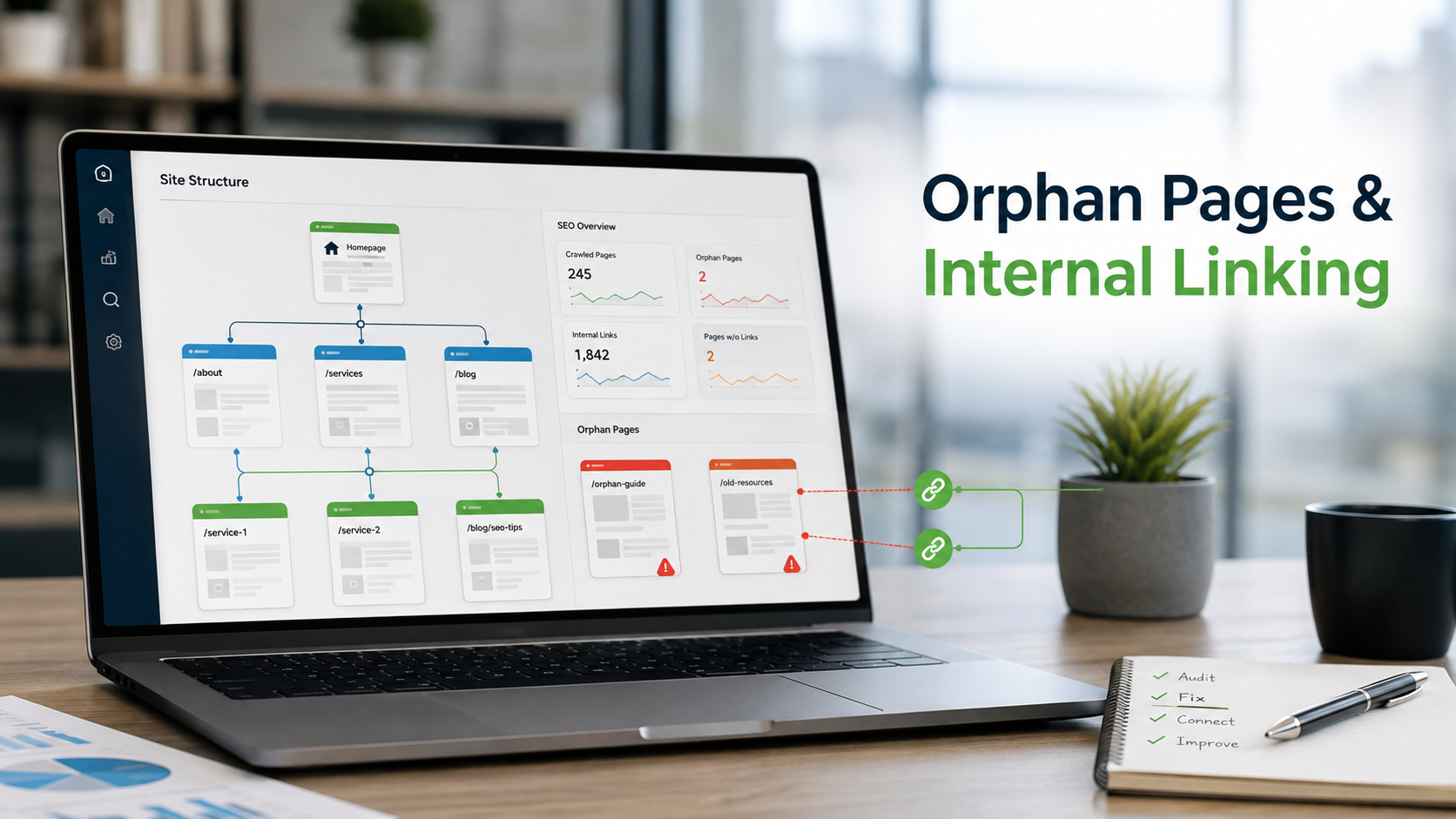
How to Find Orphan Pages and Fix Your Internal Linking
Every page on your site should be reachable through at least one link. When it is not, search engines struggle to find i...

Content Consolidation: When to Merge Competing Articles
When two or three of your own pages chase the same topic, they compete with each other instead of the rest of the web. H...
Please log in or create an account to join the discussion.