Type.ai Alternatives: The Best AI Writing Editors for Long Projects

Type.ai proved that a book-length draft deserves a real editor, not a chat window. Five tools now do the job in their own way. Here is how they differ, what they cost, and which one fits your kind of long project.
THE SHORT VERSION For fiction, Sudowrite has the best prose craft and Novelcrafter the best organization and model control. For nonfiction and essays, Lex is the calmest place to write. Jasper owns marketing content at team scale, and Google Docs with Gemini wins on collaboration. If you want one editor that does most of it in a single clean workspace, Type.ai is still hard to beat. These are the tools worth switching for when your project pulls in a specific direction. |
Short-form AI tools fall apart the moment a project gets long. A chatbot forgets what happened three chapters ago; a template generator has no idea your antagonist changed sides in Act II. Writing that lives in one document for weeks or months needs something else: an editor that keeps the whole draft in view, remembers the details, and stays out of the way while you work.
That is the gap Type.ai carved out, and it set the bar the rest of this list is measured against. So before the alternatives, it is worth being clear about what a strong long-project editor actually does.
The tool everyone is comparing against: Type.ai Type.ai is a clean, keyboard-first document editor with a frontier model built in, tuned for work you stay inside for weeks. It holds up to 150,000 words per document and, the part that matters most for long projects, keeps a huge slice of that draft in context, so you can ask about a detail from 30,000 words back and it finds it. Notes track your characters and world, Type Chat answers questions from a sidebar, inline commands generate at the cursor, and nothing you write trains a model. It runs on models from Anthropic, OpenAI and Google, with AI actions metered by credits, and there is a genuine free plan with paid tiers from roughly $8 per month. |
What actually matters in a long-project editor
Feature lists blur together fast. For a project measured in tens of thousands of words, only a handful of things decide whether a tool helps or gets in your way.
01 Memory that spans the draft Can it hold, or quickly recall, details from far earlier in the document without you re-pasting context? | 02 An organization layer A story bible, codex, or knowledge base that keeps characters, facts and threads straight across chapters. |
03 A calm place to write You will live here for weeks. The editor has to be pleasant for long sessions, not a dashboard of buttons. | 04 Voice, not takeover The AI should extend your style and edit on request, not flatten everything into generic model prose. |
05 Honest, predictable pricing Flat fee, credits, bring-your-own-key or per-seat. Each one bites differently once you are drafting daily. | 06 Your words stay yours Clear data handling: is your manuscript used to train models, and where does the text actually go? |
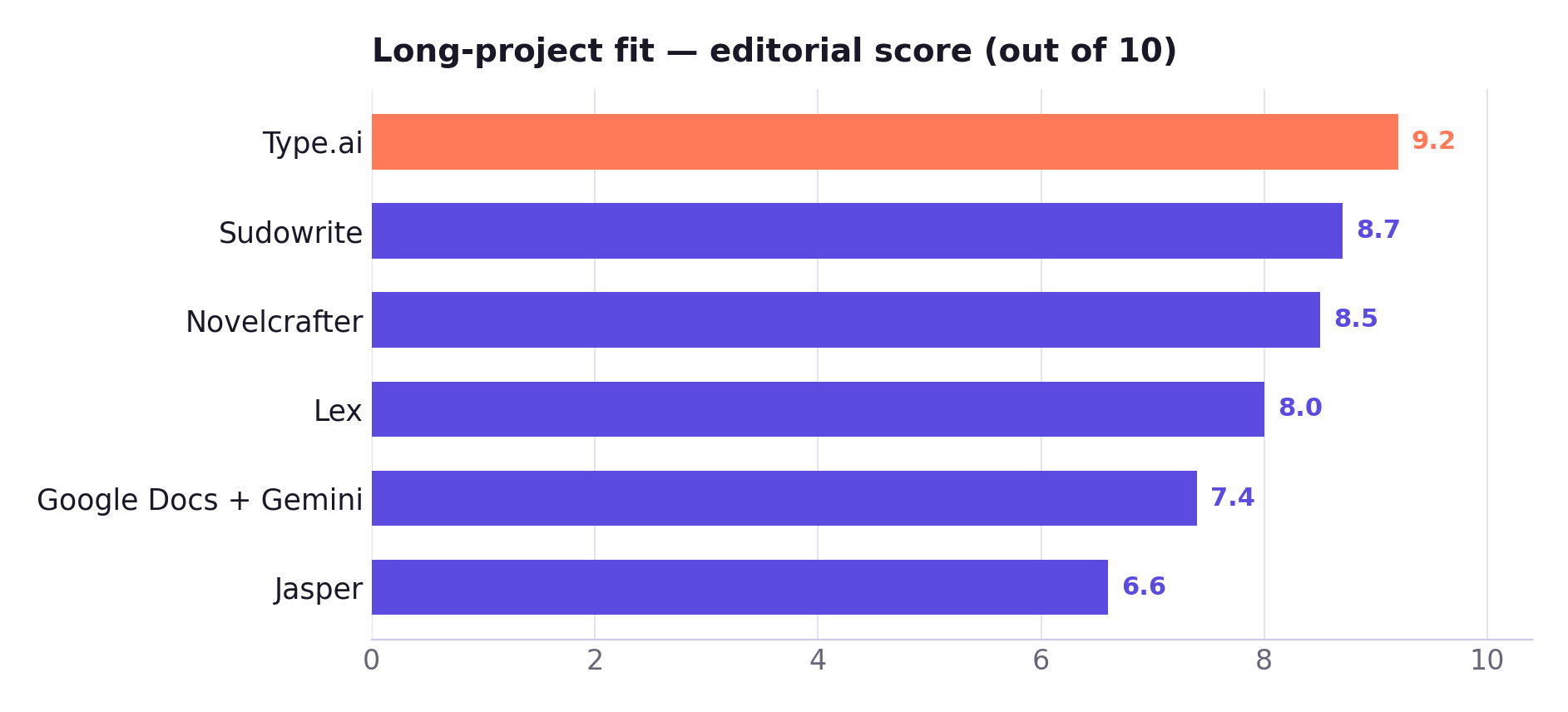
Our editorial read on how well each tool suits sustained, book-length writing.
The five best Type.ai alternatives
Ranked by how well they handle long projects overall, but the right pick depends entirely on what you are writing. Each one wins a different lane.
1. Sudowrite
The fiction specialist
Best for: novelists and screenwriters who care about the prose on the page.
Where Type.ai is a generalist's long-form editor, Sudowrite was built by novelists for novelists. Its Story Bible keeps characters, settings and plot threads consistent across a whole manuscript, while Write, Rewrite, Describe and Expand work at the sentence-to-scene level, generating prose directly in your draft. A plotting Canvas and the house Muse model, alongside Claude and GPT, round it out. The trade-off is the credit meter: heavy drafting burns through credits quickly, there is no permanent free plan, and its instincts are fiction-first, which makes it a poor fit for structured nonfiction.
Strengths Best-in-class fiction prose and consistency Deep, craft-specific tools like Describe and Expand Large, active author community | Watch-outs Credit costs mount on long drafts No permanent free tier, only a short trial Weak for nonfiction and business writing |
Pricing: from $10 per month (Hobby, billed annually; about $19 monthly); Professional about $22; Max about $44. Credit-based AI.
2. Novelcrafter
The organized, model-agnostic studio
Best for: plotters and series writers who want to own their setup and control cost.
Novelcrafter treats a novel as a database, not just a document. Its Codex is a linked wiki of characters, locations and lore that spans multiple books, and the planning and scene tools are built for people who outline. Its signature choice is BYOK, short for bring your own key, so instead of a bundled model you connect GPT-5, Claude, Gemini or a local model through Ollama, and pay that provider directly. That means total control over model and cost and no lock-in; it also means two bills and a little more setup. Workshop Chat and collaboration arrive on higher tiers.
Strengths Deep organization and cross-book series support Any model you like, with no lock-in Generous 21-day full-feature trial | Watch-outs Subscription plus a separate AI API bill More moving parts to configure An environment, not a bundled assistant |
Pricing: Scribe $4 (no AI), Hobbyist $8 (BYOK), Artisan $14, Specialist $20, plus your own API usage on top.
3. Lex
The calm, distraction-free editor
Best for: essayists, bloggers and nonfiction writers who want the AI out of the way until they call it.
Lex feels like Google Docs rebuilt for writers who take craft seriously. The page is quiet; you type a double plus sign to summon the AI for a continuation, a rewrite, or a genuinely honest critique, then accept or ignore it and keep moving. It learns your voice, holds persistent context in Knowledge Bases, and lets you switch between GPT and Claude. What it deliberately is not: a marketing machine. No template library, no SEO workflows, just a beautiful place to write long-form prose, with a feedback tool that flags weak arguments and cliches.
Strengths The cleanest writing experience here Preserves your voice, with useful and honest feedback Usable free tier to start | Watch-outs Writing-only, with no templates, SEO or workspace English-focused No fiction story-bible for heavy world-building |
Pricing: free tier available; Pro from roughly $8 per month (billed annually).
4. Jasper
The business-content platform
Best for: marketing teams producing on-brand content at scale.
Jasper is the outlier here, and on purpose. It has repositioned from an AI writer into a marketing content platform: Brand Voice enforces a consistent style across everything, more than 50 templates cover ad copy to landing pages, Campaigns spin one brief into a blog-plus-email-plus-social set, and team workflows, approvals and a Surfer SEO integration make it a content-operations layer for a whole department. It is less a place to write a novel than a system to keep ten marketers on-message, and it is priced for that, with no free tier.
Strengths Best brand-consistency and team controls Huge marketing template library and campaigns Enterprise security such as SSO and SOC 2 | Watch-outs Expensive for individuals Geared to marketing, not book-length prose Output feels generic without setup |
Pricing: from about $39 per month (Creator, billed annually; about $49 monthly); Pro about $59; Business custom. Trial only, no free plan.
5. Google Docs + Gemini
The mainstream, collaborative default
Best for: teams and professionals who already live in shared documents.
Sometimes the best alternative is the thing you already have open. Gemini is now built into Google Docs, and in 2026 it is bundled into paid Workspace plans rather than sold as a separate add-on. Help me write and Help me create draft and rewrite in place, pulling context from your Drive, Gmail and the web, while match-style and summarize tools smooth out long documents. Where it wins outright is real-time collaboration and sheer ubiquity; where it lags is craft, since there is no story bible, no writer-first ambiance, and the AI is a generalist. For a co-authored report or a long nonfiction manuscript that many hands touch, that is often a trade worth making.
Strengths Best real-time collaboration, by far Already everywhere, with nothing new to learn Context pulled from your own files | Watch-outs No fiction or craft-specific tooling Generalist AI, not writer-tuned Needs a paid Workspace or AI plan |
Pricing: bundled in Workspace Business Standard ($14 per user per month) and up, or Google AI Pro ($19.99 per month).
Difference 1: Fiction or nonfiction? Start there
The fastest way to shortlist is to place each tool on two axes: how creative versus how businesslike the writing is, and how long the typical project runs. Do that and the field sorts itself almost cleanly.
Sudowrite, Novelcrafter and Type.ai cluster in the top-right, built for long, creative work. Lex sits center-left, a long-form editor that leans nonfiction. Google Docs with Gemini anchors the collaborative professional corner, and Jasper lives in short-to-mid business content. Type.ai's position in the middle-top is exactly why it is the reference point: it is the one tool that reaches comfortably into both the creative and professional halves.
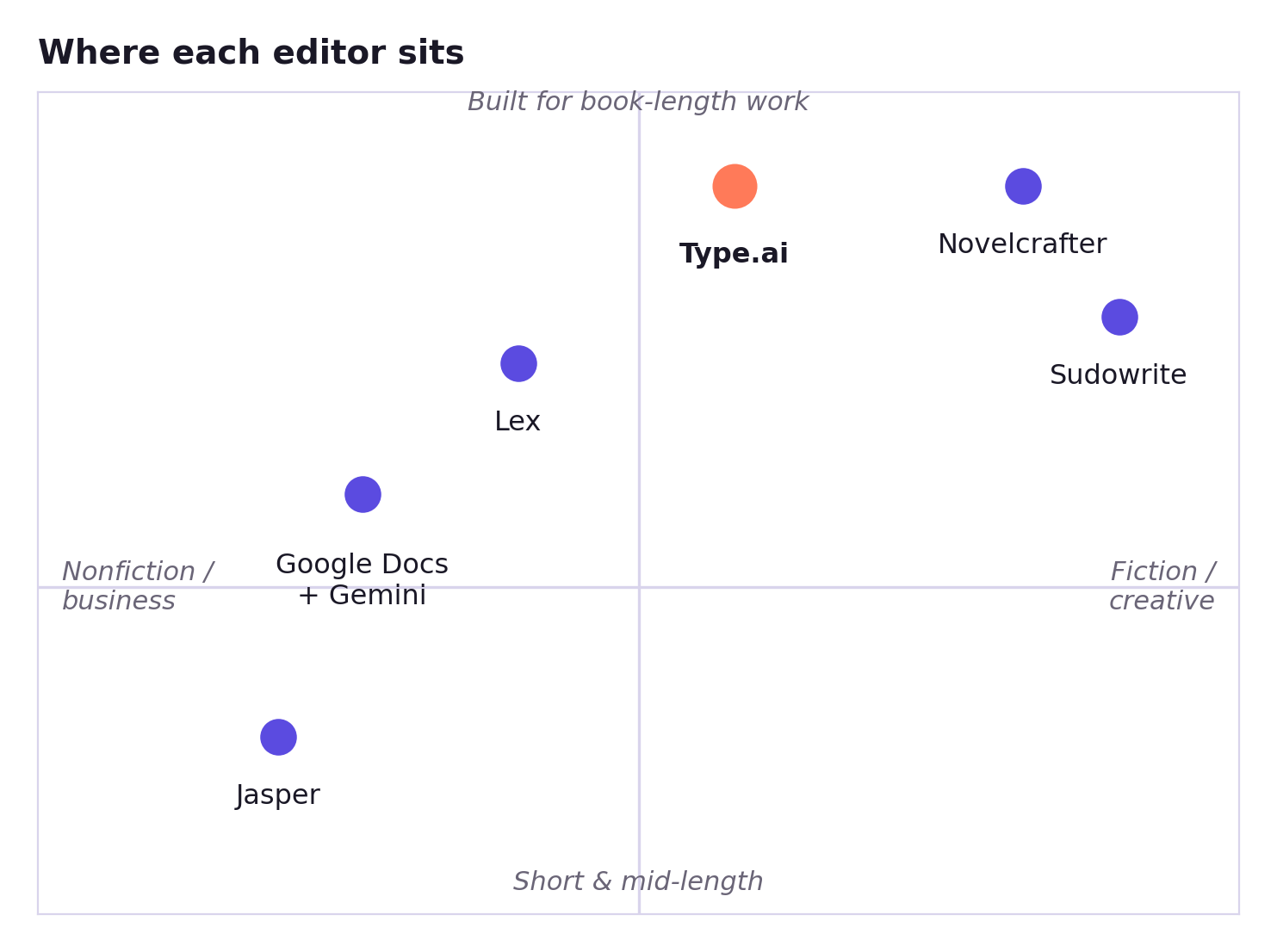
Two questions, what you write and how long it runs, do most of the shortlisting for you.
Difference 2: How they hold a whole book in their head
This is the real test of a long-project tool, and each one solves it differently. Type.ai leans on a very large context window, so it simply reads more of your draft at once. Sudowrite's Story Bible and Novelcrafter's Codex are structured databases you fill in, then feed to the model on demand. Lex keeps lighter persistent context in Knowledge Bases. Google pulls context from your Drive and Gmail rather than the manuscript itself.
Plot those strengths against each other and three archetypes appear: the balanced editor that does a bit of everything well (Type.ai), the craft specialist that trades collaboration for prose depth (Sudowrite), and the collaboration generalist that trades craft for reach (Google Docs with Gemini).
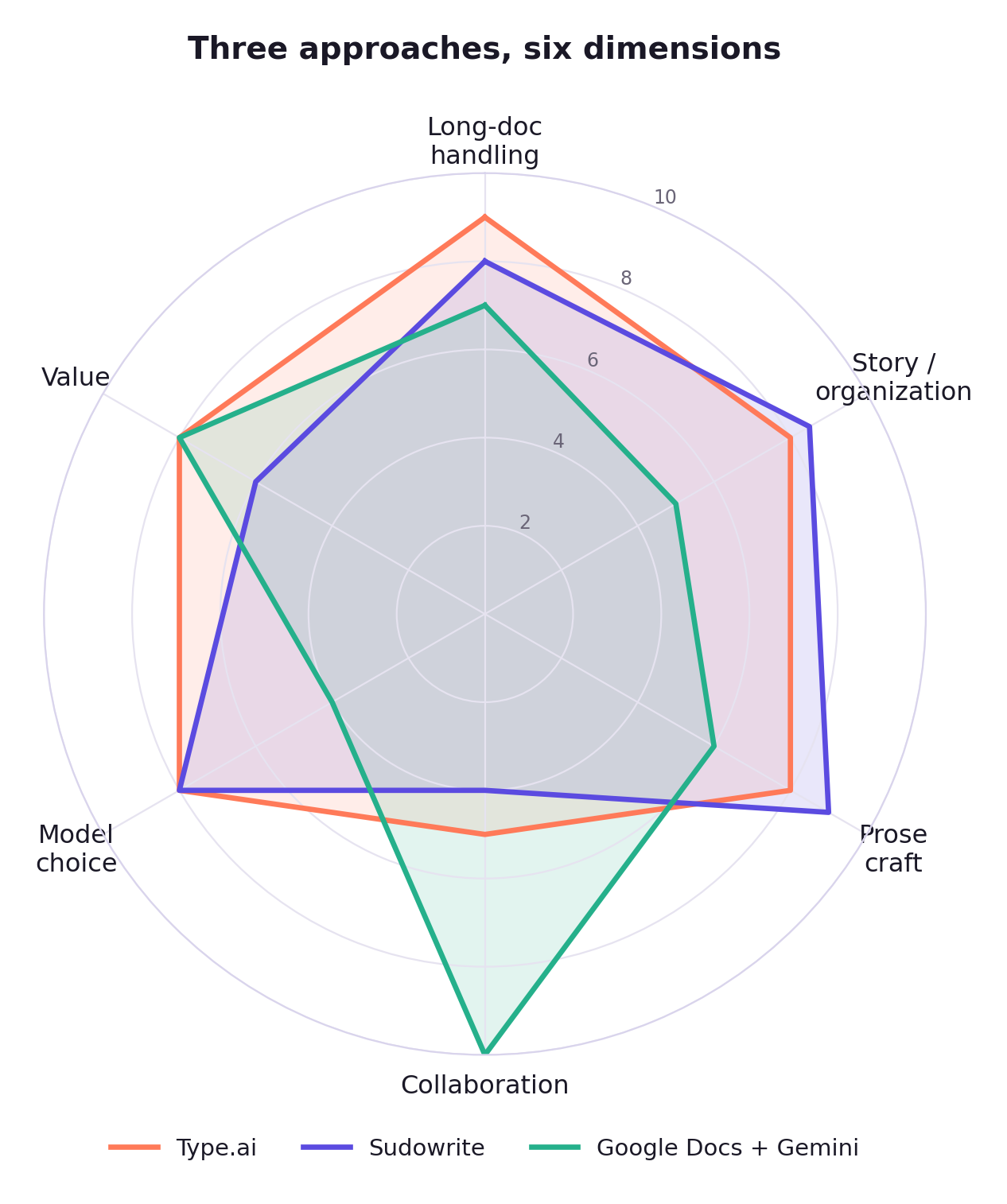
Three approaches to the same problem. No tool wins every axis; the shape is the point.
Widen the lens to all six tools and the pattern holds. No single editor leads on every capability, so the winner is whichever one is strong exactly where your project needs it.
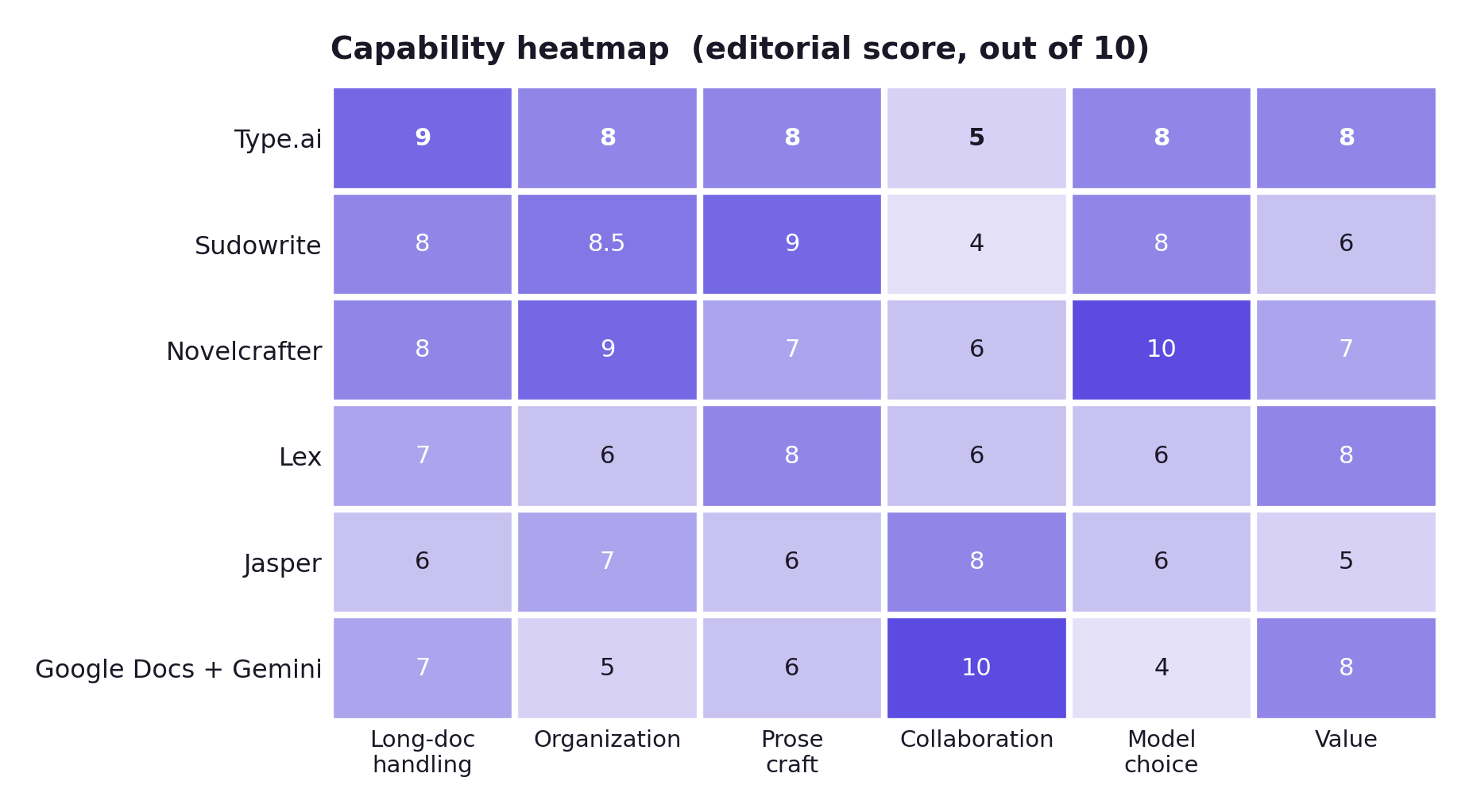
The same six tools across six capabilities. Darker means stronger, in our editorial read.
The full comparison, side by side
Every tool at a glance. Highlighted cells mark where each column genuinely stands out.
| Type.ai | Sudowrite | Novelcrafter | Lex | Jasper | Google Docs + Gemini | |
|---|---|---|---|---|---|---|
| Best for | Long-form, creative and pro | Fiction and novels | Novels and series | Essays and nonfiction | Marketing teams | Collaborative docs |
| Long-doc approach | 150k words, whole-doc context | Story Bible context | Codex and scene org | Knowledge Bases | Canvas, marketing length | Very long, cloud docs |
| Story bible / memory | Notes | Story Bible | Codex (deepest) | Knowledge Bases | Brand Voice / IQ | Drive and Gmail context |
| Model choice | Claude / GPT / Gemini | Muse plus 20+ models | Any (BYOK) | GPT and Claude | OpenAI / Anthropic | Gemini only |
| Collaboration | Sharing | Limited | Teams (top tier) | Comments / share | Team workflows | Best-in-class |
| Free option | Yes | Trial only | 21-day trial | Yes | Trial only | No (paid plan) |
| Entry paid / mo | about $8 | about $10 | $8 plus API | about $8 | about $39 | $14 per seat |
| Trains on your text? | No | No | No (BYOK) | No | No | No |
Table: the six editors compared across the criteria that matter for long projects.
Difference 3: What you will actually pay
Sticker price hides four very different billing models, and the cheapest headline is rarely the cheapest in practice.
Flat subscription (Lex, and Type.ai's plans) is the most predictable: you pay once and write. Credits (Sudowrite, and Type.ai's AI actions) mean a heavy drafting week can drain your allowance early. Bring-your-own-key (Novelcrafter) looks cheap at $8, but you add a separate AI bill that can run $15 to $30 in a busy month. Per-seat pricing (Jasper, Google) is fine for one person and scales up fast for a team. Match the model to how you actually work, not to the number on the pricing page.
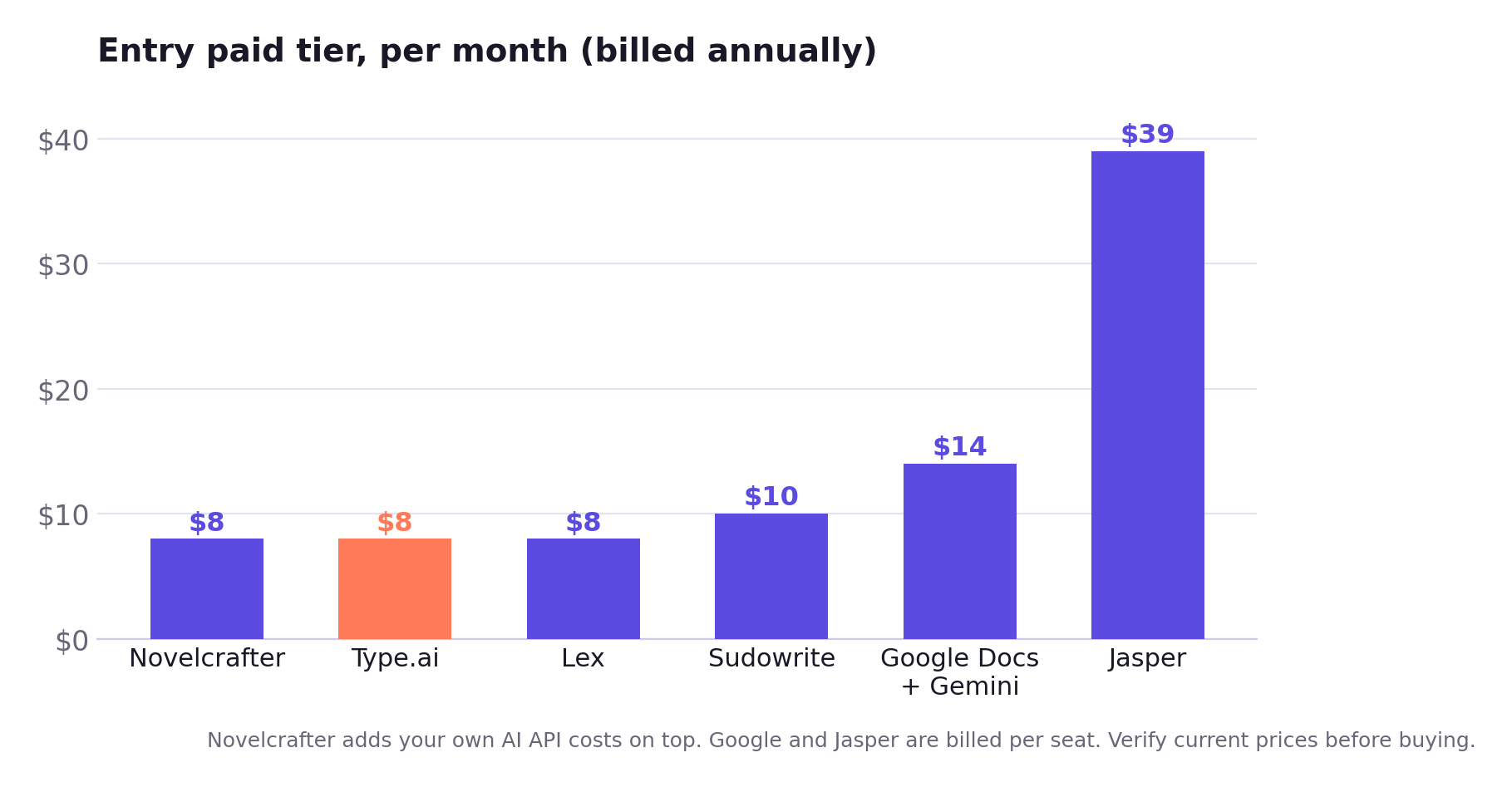
Entry paid tiers, billed annually. Novelcrafter adds a separate API cost, and Jasper and Google scale per seat.
Difference 4: Collaboration, and who owns your words
Two questions come up the moment a project gets serious: can other people work in the document with me, and where does my writing actually go?
On collaboration, Google Docs is in a class of its own for real-time co-editing; Novelcrafter and Jasper add teams and roles on their upper tiers; Lex handles comments and sharing for small groups; Sudowrite and Type.ai are built mainly for a solo writer. On data, none of these train on your manuscript by default. Type.ai and Lex say so plainly, Google keeps Workspace content out of training, and Novelcrafter's BYOK model routes your text to whichever provider you choose under that provider's terms. If privacy is paramount, BYOK with a local model keeps your draft on your own machine entirely.
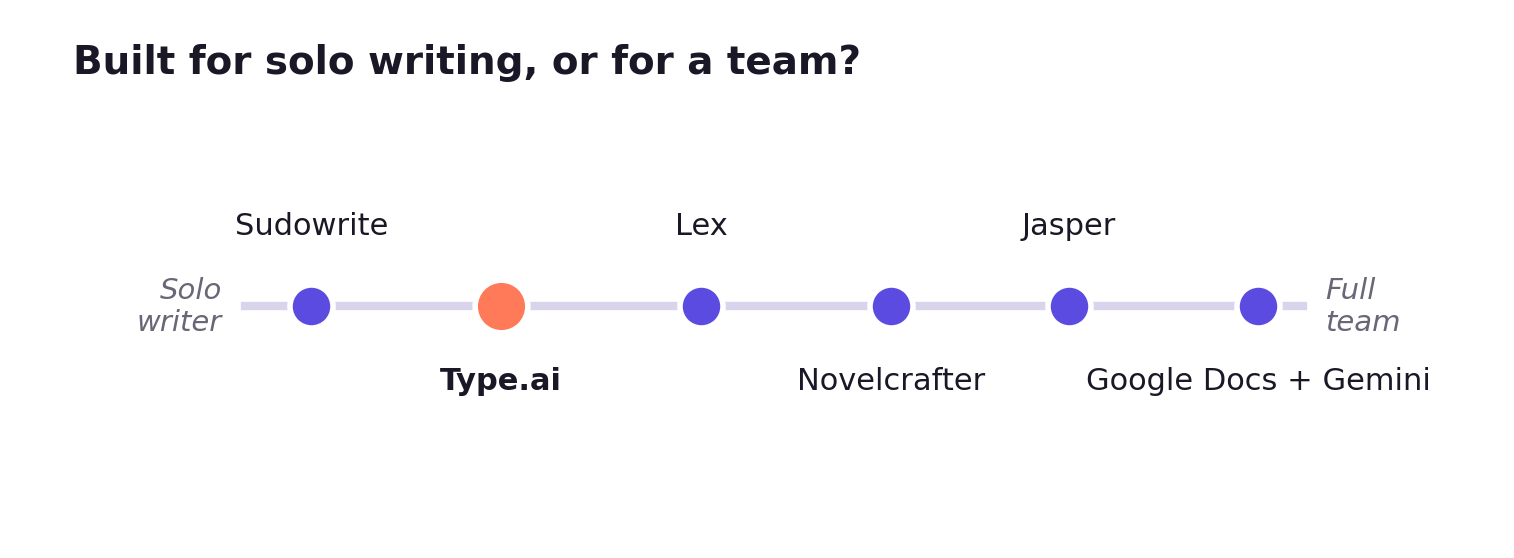
Where each editor sits on the solo-to-team spectrum.
Which one should you actually pick?
Find the line that sounds like you.
You are writing a novel and prose quality is everything. Go with Sudowrite
You plot a series and want to control model and cost. Go with Novelcrafter
You write essays, newsletters or nonfiction. Go with Lex
You want one clean editor for a whole book, creative or pro. Stay on Type.ai
You run a marketing team that needs on-brand output at scale. Go with Jasper
Lots of people co-write the same long document. Go with Google Docs with Gemini
The bottom lineThere is no single best AI writing editor for long projects. There is the best one for your project. Type.ai remains the strongest all-rounder, and it is the safe default if you do not want to think about it. But if you write fiction, Sudowrite and Novelcrafter reward the switch; if you write nonfiction, Lex is a joy; if you run marketing, Jasper is the system; and if collaboration is the whole game, Google Docs with Gemini is already on your screen. Pick the tool that matches the shape of your work, start on a free tier or trial, and give it one real chapter before you commit. |
Discussion 0
More posts

NovelAI: An Hour of Notes Before I Wrote a Single Word
A hands-on NovelAI review: the broken sign-up, the encryption catch, real pricing, the models, real user reviews, and wh...

StealthWriter AI : Hands-On Test of the Humanizer and AI Detector
I put StealthWriter AI through a real test: a Wikipedia paragraph that its detector scored 0% human was rewritten to 100...

Originality.ai: I Tested It and It Flagged Wikipedia as 100% AI
I pasted a plain Wikipedia paragraph into Originality.ai and it came back "Likely AI – 100% Confidence." Two scans later...
Please log in or create an account to join the discussion.